Introduction
Efficient material handling is the foundation of modern warehouse operations. Whether you manage a distribution center, manufacturing facility, retail warehouse, or logistics hub, choosing the right equipment directly impacts productivity, operating costs, and workplace safety.
Among the most commonly used material handling solutions are electric pallet trucks and forklifts. Both are designed to move materials efficiently, but they serve different purposes and perform best in different working environments.
Selecting the wrong equipment can lead to several operational challenges, including:
- Higher equipment and maintenance costs
- Reduced warehouse efficiency
- Slower order fulfillment
- Increased safety risks
- Poor utilization of warehouse space
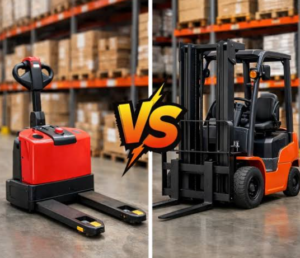
Which one is better for your warehouse operation: an electric pallet truck or a forklift?
The answer depends on factors such as load weight, lifting requirements, warehouse layout, operating environment, and budget. In this guide, we’ll compare electric pallet trucks and forklifts in detail to help you make the right decision.
What Is an Electric Pallet Truck?
An electric pallet truck, also known as an electric pallet jack or powered pallet truck, is a battery-powered material handling vehicle designed primarily for transporting palletized goods over short to medium distances.Unlike manual pallet jacks, electric pallet trucks use an electric drive system to move loads with minimal operator effort.The basic working principle includes:
- A rechargeable battery supplies electrical energy.
- An electric motor provides driving power.
- A hydraulic lifting system raises the forks slightly off the ground.
- The operator controls movement and steering through a multifunction handle.
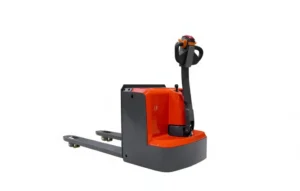
Electric pallet trucks are designed mainly for horizontal transportation rather than high-level lifting.
Main Features of Electric Pallet Trucks
Electric pallet trucks are primarily used for horizontal transportation of palletized goods at ground level, while forklifts can not only transport materials but also lift them to higher elevations for stacking, loading, and unloading. In addition, there are several other key differences between the two types of equipment, as outlined below.
Compact Design
Their small footprint allows them to work efficiently in confined spaces and narrow aisles.
Easy Operation
Most operators can learn basic operation quickly, reducing training time and improving workforce flexibility.
Low Maintenance Requirements
Electric pallet trucks have fewer moving parts and simpler structures than forklifts, resulting in lower maintenance costs.
Efficient Pallet Transportation
They are ideal for repetitive pallet movement tasks such as loading docks, warehouse transfers, and production line replenishment.
Battery-Powered Operation
Modern lithium-ion electric pallet trucks provide long operating hours, fast charging, and zero emissions, making them ideal for indoor environments.
Common Applications of Electric Pallet Trucks
Electric pallet trucks are widely used in:
- Warehouses
- Distribution centers
- Manufacturing facilities
- Retail stores
- Supermarkets
- Cold storage warehouses
- E-commerce fulfillment centers
- Logistics terminals
Their ability to move pallets quickly and efficiently makes them an essential tool in modern material handling operations.
What Is a Forklift?
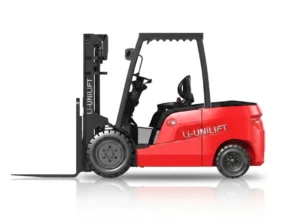
A forklift is a powered industrial vehicle designed to lift, transport, stack, and position heavy loads.Unlike electric pallet trucks, forklifts are capable of lifting goods to significant heights, making them suitable for warehouse storage systems and heavy-duty applications.The main components of a forklift include:
Mast System
The vertical lifting structure that raises and lowers loads.
Forks
Steel arms used to support and transport palletized goods.
Counterweight
Located at the rear of the forklift to maintain stability while lifting loads.
Hydraulic Lifting System
Provides the power required to raise and lower loads safely.
Main Features of Forklifts
Forklifts provide capabilities beyond simple transportation.
Higher Load Capacity
Most forklifts can handle significantly heavier loads than electric pallet trucks.
Vertical Lifting Capability
They can lift materials to storage racks, mezzanines, and warehouse shelving systems.
Heavy-Duty Construction
Designed for demanding industrial environments and continuous operation.
Multiple Equipment Types
Common forklift categories include:
- Counterbalance forklifts
- Reach trucks
- Electric forklifts
- Diesel forklifts
- LPG forklifts
- Rough terrain forklifts
Common Forklift Applications
Forklifts are commonly used in:
- Heavy manufacturing plants
- Large warehouses
- Construction material handling
- Container yards
- Ports and terminals
- Building material suppliers
- Industrial logistics centers
Electric Pallet Truck vs Forklift: Key Differences
Load Capacity Comparison
| Comparison | Electric Pallet Truck | Forklift |
|---|---|---|
| Typical Capacity | 1.5–3 tons | 1.5–10+ tons |
| Best For | Pallet transportation | Heavy lifting and stacking |
| Heavy Load Handling | Limited | Excellent |
Forklifts are engineered for handling heavy loads and demanding industrial applications. Some heavy-duty models can lift more than 10 tons.
Electric pallet trucks, on the other hand, are primarily designed for moving palletized goods efficiently at ground level.
If your operation regularly handles loads exceeding 3 tons, a forklift is generally the better choice.
Lifting Height Comparison
| Function | Electric Pallet Truck | Forklift |
|---|---|---|
| Ground Transportation | Excellent | Good |
| High Rack Storage | Not Suitable | Excellent |
| Stacking Ability | Limited | Strong |
One of the biggest differences between these two machines is lifting capability.
Electric pallet trucks typically raise forks only enough to transport pallets safely.
Forklifts can lift loads several meters high, allowing operators to:
- Stack pallets
- Retrieve inventory from racks
- Utilize vertical warehouse space
- Improve storage density
Operating Environment Comparison
Electric Pallet Truck
Best suited for:
- Narrow aisles
- Small warehouses
- Indoor operations
- Loading docks
- Production lines
- Short-distance transportation
Forklift
Best suited for:
- Large warehouses
- Outdoor operations
- Heavy-duty environments
- High-bay storage facilities
- Construction sites
- Long-distance material movement
Cost Comparison
Purchase Cost
Electric Pallet Truck
- Lower initial investment
- Lower financing costs
- Cost-effective for SMEs
Forklift
- Higher purchase price
- Greater investment requirement
- Additional attachment costs
Maintenance Cost
Electric Pallet Truck
- Simpler design
- Fewer hydraulic components
- Lower maintenance expenses
Forklift
- More complex systems
- Higher maintenance requirements
- Increased repair costs over time
Operation Difficulty Comparison
| Factor | Electric Pallet Truck | Forklift |
|---|---|---|
| Training Requirements | Low | Higher |
| Operator Skill Level | Basic Training | Professional Training |
| Maneuverability | Excellent | Moderate |
Electric pallet trucks are easier for new operators to learn and operate safely.
Forklifts often require formal operator training and certification depending on local regulations due to their lifting capabilities and safety risks.
Electric Pallet Truck vs Forklift: Advantages Comparison
Advantages of Electric Pallet Trucks
1. Compact Design
Their compact size allows them to work effectively in narrow warehouse aisles and congested areas.
2. Lower Operating Costs
Benefits include:
- Lower purchase cost
- Lower energy consumption
- Reduced maintenance expenses
- Lower total cost of ownership
3. Greater Flexibility
Electric pallet trucks excel at:
- Frequent pallet movement
- Dock operations
- Warehouse replenishment
- Order fulfillment activities
Advantages of Forklifts
1. Higher Load Capacity
Forklifts can safely transport and lift significantly heavier materials.
2. Superior Stacking Performance
They maximize warehouse storage capacity by utilizing vertical space efficiently.
3. Wider Application Range
Forklifts can operate:
- Indoors
- Outdoors
- On uneven surfaces
- In industrial environments
When Should You Choose an Electric Pallet Truck?
An electric pallet truck is the ideal choice when:
- Most loads are below 3 tons
- Pallets are transported primarily at ground level
- Warehouse space is limited
- Aisles are narrow
- Transportation distances are relatively short
- Operating costs must be minimized
Typical Applications
- Retail warehouses
- Small distribution centers
- E-commerce fulfillment centers
- Food and beverage facilities
- Production lines
- Cold storage warehouses
When Should You Choose a Forklift?
A forklift is generally the better solution when:
- Heavy loads must be handled regularly
- Goods need to be stacked vertically
- Warehouse racks are high
- Outdoor operations are required
- Materials must be loaded onto trucks or containers
- Long-distance transport is common
Typical Applications
- Manufacturing plants
- Construction sites
- Building material warehouses
- Container terminals
- Large logistics centers
Can Electric Pallet Trucks Replace Forklifts?
This is a common question among warehouse managers looking to reduce costs.
Situations Where Electric Pallet Trucks Can Replace Forklifts
Electric pallet trucks can successfully replace forklifts when:
- Loads are light to medium weight
- No stacking is required
- Transportation is primarily horizontal
- Warehouse space is limited
- Cost reduction is a priority
Situations Where Forklifts Remain Essential
Forklifts are still necessary for:
- Heavy-duty lifting
- High-rack storage
- Container loading
- Outdoor material handling
- Industrial manufacturing operations
Conclusion
Electric pallet trucks are not a complete replacement for forklifts. Instead, they complement forklifts by providing a more efficient and cost-effective solution for specific material handling tasks.
Many warehouses achieve the best results by using both types of equipment together.
How to Choose Between an Electric Pallet Truck and Forklift?
The most important factor when choosing between an electric pallet truck and a forklift is whether your operation requires vertical lifting and stacking. However, there are several other factors that should also be taken into consideration.
1. Load Requirements
Consider:
- Maximum load weight
- Average pallet weight
- Load dimensions
- Daily handling volume
2. Warehouse Layout
Analyze:
- Aisle width
- Rack height
- Floor conditions
- Available operating space
3. Budget Considerations
Calculate:
- Purchase cost
- Maintenance expenses
- Battery replacement costs
- Energy consumption
- Long-term ownership cost
4. Operational Requirements
Review:
- Daily travel distance
- Working hours per shift
- Number of operators
- Required productivity levels
A thorough evaluation helps ensure the selected equipment delivers the highest return on investment.
Conclusion: Selecting the Right Material Handling Solution
Both electric pallet trucks and forklifts play critical roles in modern material handling operations, but they are designed for different purposes.
Electric pallet trucks are ideal for fast and efficient pallet transportation, offering lower operating costs, easy operation, and excellent maneuverability.
Forklifts provide superior lifting capacity, stacking capability, and versatility for demanding industrial applications.
Ultimately, the best choice depends on your warehouse size, storage requirements, load characteristics, and operational goals.
Choosing between an electric pallet truck and a forklift is not about finding the better machine—it is about selecting the equipment that best matches your specific application.
FAQ
Q1: What is the main difference between an electric pallet truck and a forklift?
The primary difference is that electric pallet trucks are mainly designed for horizontal pallet transportation, while forklifts are designed for lifting, stacking, and handling heavier loads at various heights.
Q2: Can an electric pallet truck replace a forklift?
For light and medium-duty pallet transportation, an electric pallet truck can replace certain forklift tasks. However, forklifts remain necessary for heavy lifting and high-level storage operations.
Q3: Which is cheaper, an electric pallet truck or a forklift?
Electric pallet trucks generally have lower purchase costs, lower maintenance expenses, and lower energy consumption compared with forklifts.
Q4: Which equipment is better for a small warehouse?
Electric pallet trucks are usually the better choice for small warehouses because they require less operating space and are easier to maneuver in narrow aisles.
Q5: Which equipment is better for heavy-duty applications?
Forklifts are better suited for heavy-duty applications because they provide higher lifting capacities, greater stacking capabilities, and stronger overall material handling performance.