Moving palletized goods across uneven outdoor surfaces requires equipment designed for more than conventional warehouse floors. A Rough Terrain Pallet Truck combines a lifting mechanism, a suitable wheel configuration, and a load-supporting frame to help operators transport compatible materials across appropriate outdoor working areas. Its performance depends on how these components work together under the specified operating conditions.
For construction suppliers, agricultural businesses, industrial yards, and outdoor storage facilities, understanding how this equipment works helps buyers evaluate its suitability before purchasing. By examining the hydraulic system, wheel design, steering mechanism, and structural components, businesses can identify the features that matter most for safe handling, reliable performance, and long-term value.
1. What Is a Rough Terrain Pallet Truck?
A Rough Terrain Pallet Truck is a specialized material handling device designed to lift and move palletized loads over suitable outdoor surfaces that may be uneven or unfinished. Compared with conventional pallet trucks intended primarily for smooth floors, these models typically use larger wheels, a chassis designed for outdoor work, and ground clearance suited to the intended terrain.
Depending on the model, a Rough Terrain Pallet Truck may feature a manual hydraulic lifting system, pneumatic or solid rubber tires, adjustable forks, and reinforced structural components. These design features help accommodate different load configurations and surface conditions, although actual performance depends on the manufacturer’s specifications.
Most manual models are intended for short-distance pallet transportation rather than high-level storage or long-distance powered movement. Businesses should confirm the rated capacity, fork dimensions, wheel configuration, and permitted operating surfaces before choosing a model.
2. How Does the Hydraulic Lifting Mechanism Work?
The hydraulic system is central to how a Rough Terrain Pallet Truck raises a load, converting manual input into the force needed to lift compatible palletized goods. In a typical manual design, the operator moves the handle up and down to activate an integrated hydraulic pump.
As the pump moves hydraulic fluid into the lifting cylinder, pressure drives the lifting mechanism and raises the forks. The forks lift the pallet just high enough for transportation across a suitable surface, reducing direct contact between the load and the ground.
When the load reaches its destination, the operator uses the designated lowering control to release hydraulic pressure in a controlled manner. The forks descend under the load’s weight, allowing the pallet to rest on the floor before the operator withdraws the forks.
The precise mechanism can vary by model, so operators should follow the manufacturer’s instructions for lifting, lowering, and handling loads. Hydraulic components must also be inspected regularly for leaks, abnormal movement, and signs of wear.
3. How the Wheel System Supports Movement
Wheel design has a significant influence on how a Rough Terrain Pallet Truck travels across outdoor working surfaces. Larger wheels can help the equipment negotiate minor surface irregularities more effectively than the small, hard wheels commonly found on conventional indoor pallet trucks.
Pneumatic tires may provide cushioning by deforming slightly over uneven surfaces, while suitable solid rubber tires may offer advantages where puncture resistance is important. The best configuration depends on the terrain, expected load, tire specifications, and maintenance requirements.
The wheels also influence rolling resistance, steering effort, and load stability. Even a truck designed for outdoor work may struggle on deep mud, loose sand, steep slopes, or severely damaged ground, so operators must assess the travel route before moving materials.
4. Understanding the Steering and Movement Mechanism
The steering mechanism determines how a Rough Terrain Pallet Truck changes direction while carrying a raised load. On a typical manual model, the handle is connected to the steering assembly, allowing the operator to guide the truck along the intended route.
Once the forks have lifted the pallet to the required transport height, the operator pushes or pulls the handle according to the model’s design. The wheel arrangement supports the movement of the loaded truck, while controlled steering helps position the pallet at the destination.
Larger wheels can improve movement over certain surface irregularities, but they do not eliminate the effort required to control a heavy load. Turning space, ground firmness, load dimensions, and operator visibility all affect handling performance.
Some models may use different steering arrangements or powered travel systems. Buyers should therefore distinguish between manual pallet trucks and powered alternatives rather than assuming every rough terrain model operates in the same way.
5. Step-by-Step: How to Operate a Rough Terrain Pallet Truck
Understanding the operating sequence of a Rough Terrain Pallet Truck helps operators use its lifting and movement mechanisms correctly while reducing avoidable handling risks.
Step 1: Inspect the equipment and route. Before use, check the wheels, forks, frame, hydraulic system, and lowering controls. Confirm that the travel surface is suitable for the truck and load.
Step 2: Position the forks. Lower the forks fully and align them with the pallet openings. Insert both forks far enough to support the load correctly, ensuring that the pallet is compatible with the equipment.
Step 3: Raise the load. Operate the hydraulic pump according to the manufacturer’s instructions. Lift only enough to provide suitable ground clearance for transportation, and make sure the load remains stable.
Step 4: Move the load carefully. Guide the truck at a controlled speed along the inspected route. Avoid sudden turns, unstable ground, and obstacles beyond the equipment’s capabilities.
Step 5: Lower the pallet. Stop at a suitable destination and operate the release control to lower the load gradually. Once the pallet is fully supported by the ground, withdraw the forks carefully.
This sequence applies to typical manual hydraulic models, but operating controls and procedures can differ. The manufacturer’s instructions always take precedence over general guidance.

6. Key Components and Their Functions
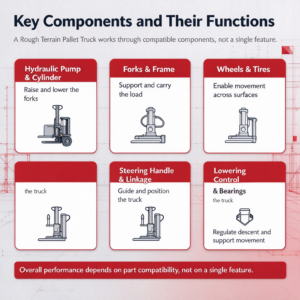
A Rough Terrain Pallet Truck relies on several components working together to provide lifting capability, controlled movement, and appropriate load support. Understanding these components helps buyers compare models and identify the features most relevant to their operations.
| Component | Main function | What buyers should evaluate |
|---|---|---|
| Hydraulic pump and cylinder | Raise and lower the forks | Lifting performance, serviceability, and maintenance requirements |
| Forks and frame | Support the load during handling | Rated capacity, structural design, and pallet compatibility |
| Wheels and tires | Support movement across suitable surfaces | Diameter, construction, durability, and terrain suitability |
| Steering handle and linkage | Guide the truck during transportation | Maneuverability, handling effort, and operating controls |
| Lowering control | Regulate fork descent | Controlled lowering and reliable operation |
| Bearings and moving joints | Support rolling and mechanical movement | Wear resistance, component quality, and inspection access |
The performance of a Rough Terrain Pallet Truck depends on the compatibility of these parts, not on a single feature in isolation. For example, larger tires cannot compensate for unsuitable load capacity, and a robust frame cannot overcome poor pallet compatibility.
7. Main Design Advantages and Product Selling Points
The practical value of a Rough Terrain Pallet Truck comes from its ability to combine lifting functionality with a wheel and chassis configuration suited to specific outdoor handling tasks. These features can help businesses move compatible palletized goods where conventional warehouse equipment may be unsuitable.
Suitable wheel configuration: Larger or specially selected wheels can help the truck travel across designated uneven surfaces, depending on tire construction and ground conditions.
Hydraulic lifting performance: A manual hydraulic mechanism enables the operator to raise and lower the forks without an electric traction motor, which may simplify equipment setup for suitable short-distance applications.
Robust structural design: Appropriately engineered forks and load-bearing components help support the manufacturer’s rated capacity under specified operating conditions.
Adjustable fork options: Where available, adjustable forks can improve compatibility with different pallet widths and load carriers.
Practical servicing: Accessible components, suitable replacement parts, and clear maintenance instructions can simplify routine inspections and long-term equipment management.
When comparing a Rough Terrain Pallet Truck, buyers should confirm which of these features are included in the exact model. Product configurations differ, so features such as adjustable forks, specific tire types, and particular hydraulic arrangements should not be assumed to be standard across every range.
8. Where Is This Equipment Used?
A Rough Terrain Pallet Truck is useful in selected applications where compatible palletized materials must be transported across outdoor surfaces that remain sufficiently firm and stable for the equipment.
Construction sites and building material yards: Suitable models may move packaged building materials and other palletized supplies between delivery areas and nearby storage points.
Agricultural operations: Farms may use this equipment to handle packaged supplies around suitable storage buildings and prepared outdoor work areas.
Industrial yards: Businesses can use the truck for short-distance transfers between loading areas, outdoor storage locations, and nearby workstations.
Nurseries and landscaping facilities: Compatible palletized containers and packaged supplies may be moved around suitable outdoor storage areas when ground conditions permit.
Across all these applications, the selected Rough Terrain Pallet Truck must match the load and operating environment. Deep mud, unstable soil, substantial gradients, and large obstacles may require different equipment.

9. Rough Terrain Pallet Truck vs. Standard Pallet Truck
The main difference between a Rough Terrain Pallet Truck and a standard pallet truck lies in their intended surfaces and wheel configurations. Conventional pallet trucks are generally optimized for smooth warehouse floors, while outdoor models are designed around the challenges of suitable unfinished or uneven surfaces.
Standard models may be more compact and economical for indoor transportation, whereas rough terrain versions typically emphasize larger wheels and ground clearance. However, a rough terrain design does not automatically mean higher load capacity or better performance in every environment.
Buyers should compare rated capacity, fork dimensions, wheel type, ground clearance, steering characteristics, maintenance requirements, and purchase price. The best equipment is the model that fits the real application and provides the required handling capability without unnecessary cost.
10. Maintenance Tips for Reliable Performance
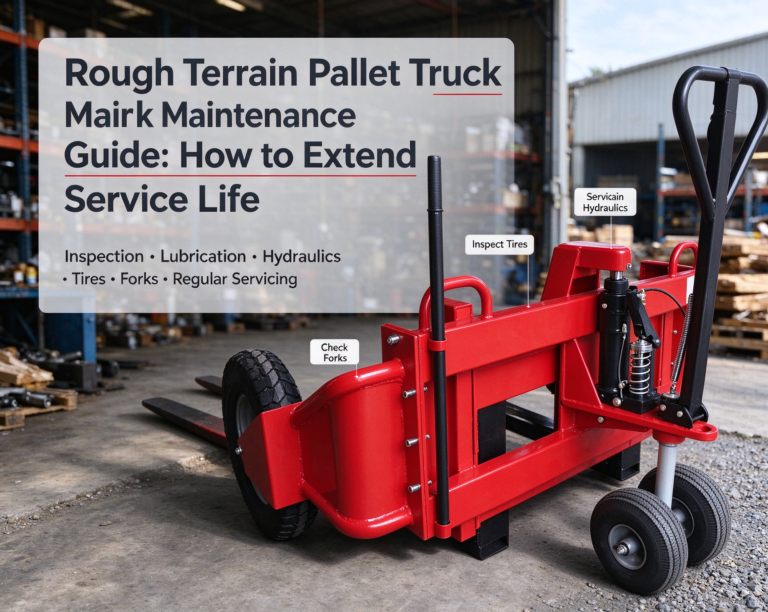
Regular maintenance helps a Rough Terrain Pallet Truck retain reliable lifting and movement performance throughout its working life. Outdoor operation may expose wheels, hydraulic components, joints, and structural parts to dust, grit, moisture, and impact.
Check tire condition, wheel alignment, bearings, forks, welded joints, and the hydraulic system at the intervals recommended by the manufacturer. Abnormal lifting, hydraulic leaks, damaged load-bearing parts, or steering problems should be investigated before the equipment returns to service.
Cleaning the equipment after use can help prevent contaminants from accumulating around moving components. Lubrication should follow the manufacturer’s instructions, and replacement parts must match the specified dimensions and operating requirements.
A Rough Terrain Pallet Truck also benefits from regular inspection records that document wear, repairs, and component replacement. These records help businesses plan servicing and identify recurring issues before they cause extended downtime.
11. How to Choose the Right Model for Your Business
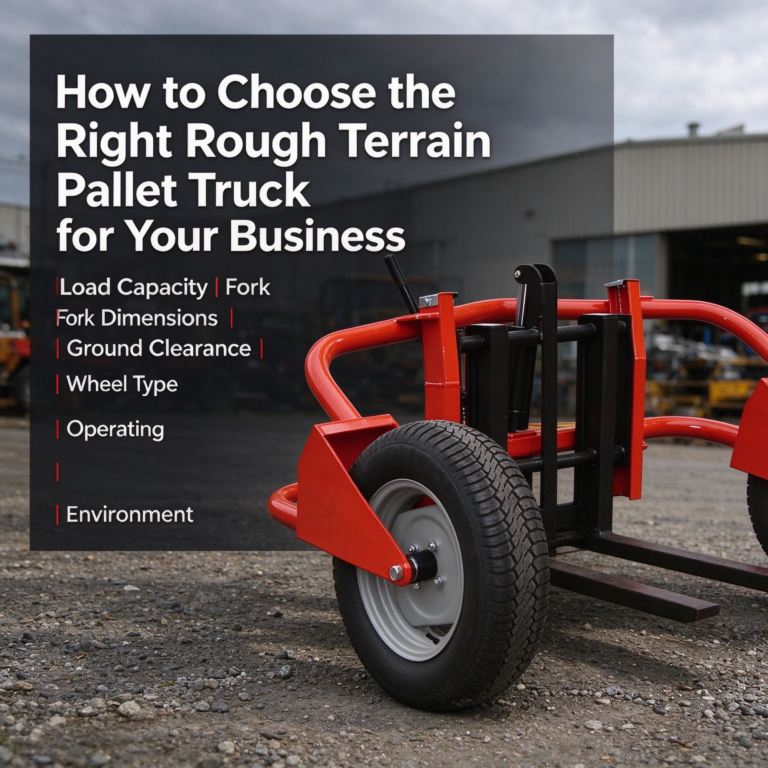
Selecting a Rough Terrain Pallet Truck requires balancing load requirements, surface conditions, operating frequency, and maintenance expectations. Reviewing these factors before purchase helps businesses avoid unsuitable equipment and make better use of their investment.
Start by identifying the maximum intended load and confirming that the rated capacity covers the application. Next, check pallet dimensions, fork compatibility, tire configuration, ground clearance, and the route the equipment will travel.
Businesses should also consider how frequently the truck will be used and whether manual operation is appropriate for the workload. For repeated handling over long distances or particularly demanding routes, a powered alternative may be worth evaluating.
Finally, review technical documentation, replacement-part availability, warranty terms, and supplier support. UNILIFT-mhe buyers should confirm the actual model specifications and operating limitations before selecting equipment for a particular workplace.
Conclusion
A Rough Terrain Pallet Truck works by combining a lifting mechanism, load-supporting forks, a steering system, and wheels designed for suitable outdoor handling conditions. In manual hydraulic models, the operator pumps the handle to raise the load, guides the truck to the destination, and lowers the forks through the designated release control.
Understanding these mechanisms helps businesses evaluate equipment based on more than its appearance or rated capacity. Wheel design, structural quality, pallet compatibility, serviceability, and permitted operating conditions all contribute to practical performance.
For companies moving palletized materials outside conventional warehouse environments, choosing a model that matches the actual load and surface conditions is essential. Careful selection, correct operation, and preventive maintenance can support safer material handling and dependable long-term value.
Follow UNILIFT MHE for More Material Handling Insights
Stay connected with UNILIFT MHE for the latest updates on electric pallet trucks, electric stackers, electric tuggers, warehouse equipment, material handling solutions, and industry insights. Follow our social media channels to discover new products, application scenarios, company updates, and practical information for modern warehouse and logistics operations.
Explore reliable electric pallet trucks, electric stackers, and material handling solutions at Unilift MHE.
If you would like to contact us, please click here.
If you would like to learn more about our news, please click here.
Facebook: Follow UNILIFT MHE on Facebook
TikTok: Follow UNILIFT MHE on TikTok
Instagram: Follow UNILIFT MHE on Instagram
X: Follow UNILIFT MHE on X
Pinterest: Explore UNILIFT MHE on Pinterest
LinkedIn: Connect with UNILIFT MHE on LinkedIn