Choosing the right Rough Terrain Pallet Truck Capacity is essential for businesses that need to move palletized materials across suitable outdoor surfaces. The correct load rating helps ensure that equipment matches daily handling requirements while supporting operational reliability, workplace safety, and long-term value. However, rated capacity is only one part of the selection process; load dimensions, weight distribution, pallet compatibility, wheel configuration, and ground conditions also influence performance.
For construction suppliers, agricultural businesses, industrial facilities, and outdoor storage operations, Rough Terrain Pallet Truck Capacity should be evaluated against actual working conditions rather than selected by maximum lifting weight alone. Understanding these factors helps buyers identify equipment that can handle their intended loads without unnecessary investment or avoidable operating risks.
1. What Does Rough Terrain Pallet Truck Capacity Mean?
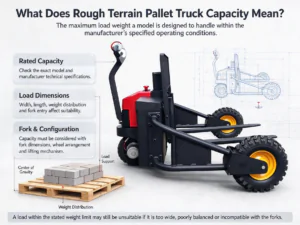
The term Rough Terrain Pallet Truck Capacity refers to the maximum load weight a particular model is designed to handle within the operating conditions specified by its manufacturer. This rating is a fundamental purchasing specification because it defines an important limit for safe lifting and transportation.
Unlike a simple comparison of maximum load weights, Rough Terrain Pallet Truck Capacity must be considered alongside the truck’s fork dimensions, wheel arrangement, lifting mechanism, and approved load configuration. A load may fall within the stated weight limit but still be unsuitable if it is too wide, poorly balanced, or incompatible with the forks.
Buyers should always verify the rated capacity of the exact model under consideration. Product descriptions and general equipment categories cannot replace the manufacturer’s technical specifications, particularly when loads vary considerably in size or distribution.
2. Why Choosing the Correct Load Capacity Matters
Selecting an appropriate Rough Terrain Pallet Truck Capacity helps businesses balance handling performance, operational safety, and purchasing costs. The right specification supports routine transportation while reducing the likelihood of equipment being used beyond its intended limits.
Safe and Stable Load Handling
Safe material movement depends on matching Rough Terrain Pallet Truck Capacity to the load’s actual weight, dimensions, and center of gravity. Exceeding the manufacturer’s rated capacity can damage load-bearing components, compromise stability, and increase the risk of accidents.
Even when the total weight is within the permitted limit, uneven weight distribution can create additional stress on the forks and affect load control. Operators should position loads correctly, check pallet compatibility, and follow the manufacturer’s instructions before lifting or moving materials.
Reliable Daily Performance
A suitable Rough Terrain Pallet Truck Capacity helps ensure that the equipment is appropriate for the loads encountered during normal operations, including reasonably anticipated heavier loads. Selecting a model based only on average load weight may leave insufficient capacity for occasional but important handling tasks.
Long-term reliability also depends on structural design, hydraulic performance, wheel quality, and maintenance practices. The rated capacity establishes an operating limit, while appropriate engineering and routine inspection help support dependable performance within that limit.
Better Control of Purchasing Costs
Choosing the right Rough Terrain Pallet Truck Capacity can help businesses avoid paying for equipment specifications they do not need. A higher-capacity truck may be unnecessary if the intended loads are consistently lighter and the additional capacity does not provide a practical operational benefit.
However, choosing an undersized model can restrict handling operations and introduce unacceptable risks. The best purchasing decision balances the maximum intended load, equipment dimensions, operating environment, expected service life, and total cost of ownership.
3. Key Factors to Consider When Matching Load Requirements
An accurate assessment of Rough Terrain Pallet Truck Capacity starts with more than the weight printed on a package or pallet. Businesses should evaluate the following factors together before choosing a model.
Maximum Load Weight
The first step in evaluating Rough Terrain Pallet Truck Capacity is identifying the heaviest load the equipment is expected to handle. Buyers should use the maximum intended operating load rather than relying exclusively on average weights or typical shipment sizes.
For example, a business may normally move relatively light packages but occasionally transport denser building materials or bulk supplies. The selected model must satisfy the manufacturer’s rated-capacity requirements for those heavier loads, provided that the load configuration is also permitted.
Load Dimensions and Weight Distribution
Load dimensions are important when assessing Rough Terrain Pallet Truck Capacity, because long, wide, or irregularly shaped goods can affect stability and maneuverability. The total weight alone does not establish whether a load can be safely supported by a particular truck.
A load that extends significantly beyond the forks may be difficult to control, particularly when transported across uneven surfaces. Buyers should verify fork support, load balance, center-of-gravity position, and the manufacturer’s restrictions for non-standard loads.
Pallet Design and Fork Compatibility
Pallet compatibility is another essential part of evaluating Rough Terrain Pallet Truck Capacity, since the truck must be able to engage and support the intended load carrier correctly. Fork length, fork width, adjustable spacing, pallet entry points, and ground clearance all influence compatibility.
Some outdoor loads use non-standard pallets or specially configured bases, so buyers should confirm that the truck fits the actual pallet design. A suitable weight rating alone cannot compensate for insufficient fork support or incompatible entry dimensions.
Ground Conditions and Terrain
Working conditions can affect the suitability of Rough Terrain Pallet Truck Capacity because outdoor surfaces influence rolling resistance, movement, and load control. Firm, compacted ground may provide a suitable operating surface for an appropriately configured model, while soft soil, deep mud, loose debris, or steep gradients can create significant limitations.
Wheel diameter, tire construction, chassis clearance, and the condition of the travel route should all be assessed. Buyers should verify the manufacturer’s permitted operating conditions instead of assuming that every truck marketed for rough terrain can operate safely on every outdoor surface.
Handling Frequency and Duty Requirements
Daily workload also matters when selecting Rough Terrain Pallet Truck Capacity, especially in facilities where equipment is used repeatedly throughout a shift. Frequent handling places ongoing demands on structural components, wheels, bearings, and hydraulic systems.
Businesses should consider the number of handling cycles, travel distances, operating conditions, and expected service life. These factors help determine whether a particular model is suitable for the workload or whether a more specialized or powered solution should be evaluated.
4. How to Match Capacity to Your Actual Loads
A structured assessment of Rough Terrain Pallet Truck Capacity makes it easier to compare different models and avoid selecting equipment based on assumptions.
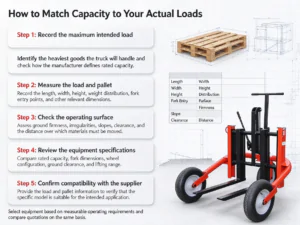
Step 1: Record the maximum intended load. Identify the heaviest goods the truck will handle and check how the manufacturer defines rated capacity.
Step 2: Measure the load and pallet. Record the length, width, height, weight distribution, fork entry points, and other relevant dimensions.
Step 3: Check the operating surface. Assess ground firmness, irregularities, slopes, clearance, and the distance over which materials must be moved.
Step 4: Review the equipment specifications. Compare rated capacity, fork dimensions, wheel configuration, ground clearance, and lifting range.
Step 5: Confirm compatibility with the supplier. Provide the load and pallet information to verify that the specific model is suitable for the intended application.
Following these steps helps businesses select equipment based on measurable operating requirements. It also provides a clearer basis for comparing quotations and discussing product suitability with manufacturers or distributors.
5. Why Wheel Design and Ground Clearance Matter
Wheel design is an important consideration when selecting Rough Terrain Pallet Truck Capacity, because the equipment must be suitable for both the intended load and the surface over which it will travel. Tire diameter, construction, tread characteristics, and ground clearance can influence movement across uneven outdoor areas.
Pneumatic tires may provide cushioning on certain surfaces, while solid tires may offer advantages where puncture resistance and reduced tire maintenance are priorities. Neither design is universally better; performance depends on the tire specifications, floor conditions, load, and approved operating configuration.
Ground clearance also deserves careful attention, particularly where routes include minor surface transitions or irregularities. A model with suitable clearance may help reduce contact between the chassis and the ground, but it should not be used to cross obstacles beyond its designed capabilities.
6. Product Features to Evaluate Beyond Capacity
Although Rough Terrain Pallet Truck Capacity is a primary specification, buyers should also assess the components that support safe handling, durability, and long-term serviceability. A well-matched model combines an appropriate rating with suitable mechanical design and practical maintenance requirements.
Forks and Frame Construction
Structural quality supports the specified Rough Terrain Pallet Truck Capacity by helping the equipment withstand normal lifting and transportation stresses. Fork geometry, chassis design, welded joints, and other load-bearing components should be appropriate for the model’s rated load and intended operating conditions.
Buyers should review technical information about materials, structural design, and quality inspections when comparing products. Material thickness or equipment weight alone does not prove that a truck is suitable; the complete design and rated specifications should be considered together.
Hydraulic Lifting Components
The hydraulic system supports Rough Terrain Pallet Truck Capacity by raising and lowering the load within the equipment’s specified operating range. Pump performance, cylinder condition, seals, and the lowering mechanism all contribute to consistent operation.
Before purchase, confirm the lifting range, rated capacity, maintenance requirements, and availability of replacement components. Routine inspection is also essential because leaks, abnormal movement, or unreliable lowering can affect both performance and safety.
Wheels and Directional Components
Wheel assemblies and steering components must support the specified Rough Terrain Pallet Truck Capacity while remaining suitable for the intended terrain. Wheel material, bearing quality, component alignment, and the design of the steering mechanism can influence rolling resistance and ease of movement.
Buyers should consider how frequently the truck will be used and whether replacement parts are readily available. Components suited to the operating environment can simplify maintenance planning and help maintain dependable performance over time.
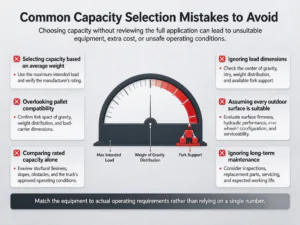
7. Common Capacity Selection Mistakes to Avoid
Choosing Rough Terrain Pallet Truck Capacity without reviewing the full application can lead to unsuitable equipment, avoidable expenditure, or unsafe operating conditions.
- Selecting capacity based on average weight: Use the maximum intended load and verify the manufacturer’s rating.
- Ignoring load dimensions: Check the center of gravity, weight distribution, and available fork support.
- Overlooking pallet compatibility: Confirm fork spacing, entry direction, and load-carrier dimensions.
- Assuming every outdoor surface is suitable: Evaluate surface firmness, slopes, obstacles, and the truck’s approved operating conditions.
- Comparing rated capacity alone: Review structural design, hydraulic performance, wheel configuration, and serviceability.
- Ignoring long-term maintenance: Consider inspections, replacement parts, servicing, and expected working life.
A more complete evaluation helps businesses match the equipment to actual operating requirements rather than relying on a single number in a specification sheet.
8. Matching Capacity to Different Industries
The right Rough Terrain Pallet Truck Capacity varies according to the materials handled, working environment, and frequency of use in each industry. Understanding these differences can help buyers narrow down the most suitable specifications.
Construction and building materials: A suitable model may be used to move compatible palletized supplies across firm, prepared ground. Load weight, pallet stability, and route conditions should be checked carefully before operation.
Agriculture and farm storage: Businesses may transport packaged feed, containers, and other compatible supplies around appropriate storage areas. Ground firmness and moisture conditions are particularly important when selecting equipment.
Industrial yards: Short-distance movement between storage points and workstations may require a combination of suitable load capacity, maneuverability, and durable components.
Outdoor storage and distribution: Buyers should consider shipment weights, pallet dimensions, handling frequency, and the condition of access routes when comparing models for regular material movement.
Regardless of industry, the selected truck must comply with its specified limits. The actual model requirements, rather than assumptions about an industry, should determine the final capacity choice.
9. How to Evaluate Total Cost of Ownership
A practical Rough Terrain Pallet Truck Capacity decision should include the cost of owning and maintaining the equipment, not just the initial purchase price. A model with suitable capacity and durable components may provide better value than a lower-priced alternative that does not match the operating environment.
When comparing quotations, businesses should consider purchase cost, tire replacement, hydraulic maintenance, routine inspection, spare parts, and expected service life. Warranty conditions and technical support can also affect the overall ownership experience.
The most economical choice is the model that meets load and terrain requirements while keeping operating and maintenance costs reasonable. Paying for unnecessary capacity may not create a return, but saving money by selecting an unsuitable truck can result in limitations or additional costs later.
10. UNILIFT-mhe: Practical Solutions for Material Handling
Selecting the appropriate Rough Terrain Pallet Truck Capacity requires accurate product information and a clear understanding of the intended application. UNILIFT-mhe focuses on practical material handling solutions, with attention to structural design, equipment usability, and the demands of industrial customers.
Manufacturing quality plays an important role in the performance of handling equipment. Appropriate materials, well-designed load-bearing components, reliable hydraulic systems, consistent assembly, and suitable functional inspections can all contribute to dependable operation within the specified limits.
For buyers evaluating products, UNILIFT-mhe recommends confirming the exact model’s rated capacity, fork dimensions, wheel configuration, ground clearance, and permitted operating surfaces. Reviewing these specifications alongside maintenance requirements and available technical support helps businesses make a more informed purchasing decision.
Conclusion
Choosing the correct Rough Terrain Pallet Truck Capacity begins with understanding maximum load weight, load dimensions, pallet compatibility, ground conditions, and daily handling requirements. Evaluating these factors together helps businesses select equipment that fits the application rather than relying on rated capacity alone.
A suitable truck should also provide appropriate structural strength, dependable hydraulic performance, compatible wheels, and manageable maintenance requirements. Buyers should verify the manufacturer’s specifications and operating limitations before making a final decision.
By matching load requirements to the correct model and working environment, businesses can improve material handling planning, support safer operations, and make a more considered long-term investment in outdoor handling equipment.
Follow UNILIFT MHE for More Material Handling Insights
Stay connected with UNILIFT MHE for the latest updates on electric pallet trucks, electric stackers, electric tuggers, warehouse equipment, material handling solutions, and industry insights. Follow our social media channels to discover new products, application scenarios, company updates, and practical information for modern warehouse and logistics operations.
Explore reliable electric pallet trucks, electric stackers, and material handling solutions at Unilift MHE.
If you would like to contact us, please click here.
If you would like to learn more about our news, please click here.
Facebook: Follow UNILIFT MHE on Facebook
TikTok: Follow UNILIFT MHE on TikTok
Instagram: Follow UNILIFT MHE on Instagram
X: Follow UNILIFT MHE on X
Pinterest: Explore UNILIFT MHE on Pinterest
LinkedIn: Connect with UNILIFT MHE on LinkedIn