A Rough Terrain Pallet Truck is designed to move palletized loads across suitable outdoor surfaces where conventional warehouse equipment may struggle. With features such as larger wheels, a robust frame, and increased ground clearance on applicable models, this specialized equipment can support material handling in construction areas, agricultural facilities, and industrial yards.
For businesses operating beyond traditional warehouse environments, a Rough Terrain Pallet Truck can provide a practical solution for short-distance transportation of compatible loads. Understanding its features, benefits, limitations, and applications helps buyers select equipment that matches their working conditions and long-term operational requirements.
1. What Is a Rough Terrain Pallet Truck?
A Rough Terrain Pallet Truck is a specialized material handling solution developed for transporting palletized goods over suitable uneven outdoor surfaces. Compared with conventional pallet trucks designed primarily for smooth floors, these models typically emphasize wheel design, ground clearance, and structural strength for outdoor applications.
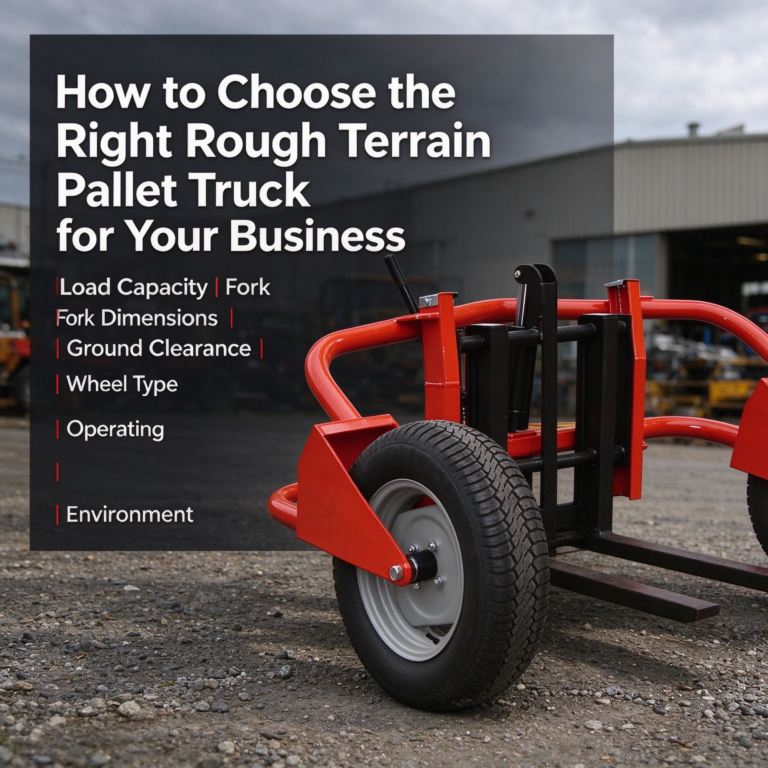
Depending on the model, a Rough Terrain Pallet Truck may feature large pneumatic or solid tires, adjustable forks, a manual hydraulic lifting system, and a reinforced chassis. These specifications influence its suitability for different loads and surfaces, so buyers should always verify the manufacturer’s technical documentation before making a purchase.
2. Key Features and Design Advantages
The design of a Rough Terrain Pallet Truck combines several components that affect maneuverability, durability, and load handling. Understanding these features helps businesses identify the specifications that matter most for their applications.
Large Wheels and Suitable Tires
Large wheels can help a Rough Terrain Pallet Truck travel over certain surface irregularities more effectively than equipment designed exclusively for smooth floors. Tire diameter, tread design, and construction influence rolling resistance, traction, and the ability to negotiate minor obstacles.
Pneumatic tires may provide cushioning over uneven surfaces, while alternative tire configurations may offer different maintenance or durability advantages. The appropriate choice depends on the terrain, load weight, and operating frequency rather than the tire type alone.
Strong Frame and Load-Bearing Structure
A Rough Terrain Pallet Truck requires a suitably engineered frame to withstand repeated lifting and transportation under its specified operating conditions. Fork construction, chassis geometry, weld quality, and load-bearing components all contribute to structural integrity and dependable performance.
Material selection and manufacturing consistency are particularly important for equipment used in demanding industrial environments. Buyers should evaluate rated capacity, structural specifications, and quality inspection procedures instead of judging durability solely by the product’s appearance.
Adjustable Forks and Ground Clearance
Adjustable forks can make a Rough Terrain Pallet Truck more versatile when a business handles compatible pallets in different widths. Ground clearance is equally important because it affects the equipment’s ability to move over minor irregularities without the chassis or forks contacting the ground.
Before selecting a model, check the fork adjustment range, fork length, minimum fork height, and chassis clearance. These dimensions must match the pallet design and actual operating environment to support safe, practical handling.
Hydraulic Lifting System
A Rough Terrain Pallet Truck commonly uses a hydraulic mechanism to raise and lower palletized goods. In manual models, operating the handle activates a pump that directs hydraulic fluid into a cylinder, lifting the forks and supporting the load for transportation.
A reliable lifting system helps operators position loads at the required height and lower them in a controlled manner. Regular inspections of hydraulic components, seals, and release mechanisms are essential for maintaining performance and identifying potential problems early.
3. How Does It Work?
A Rough Terrain Pallet Truck operates through a combination of hydraulic lifting, steering, wheel movement, and load-supporting forks. The operator positions the forks beneath a compatible pallet, raises the load, moves it along a suitable route, and lowers it at the destination.
In a manual model, handle movement generates hydraulic pressure that raises the forks, while the wheel and steering systems support transportation. Larger wheels and suitable ground clearance can improve movement across certain outdoor surfaces, but they do not eliminate limitations caused by soft ground, large obstacles, or steep slopes.
During unloading, the operator uses the designated release control to lower the forks gradually. Loads must remain stable, the destination must be suitable, and all movements should follow the manufacturer’s operating instructions.
4. Main Benefits for Outdoor Material Handling
A Rough Terrain Pallet Truck can help businesses manage palletized goods in locations where standard indoor equipment may not be suitable. Its benefits depend on selecting the right configuration for the intended load, terrain, and handling process.
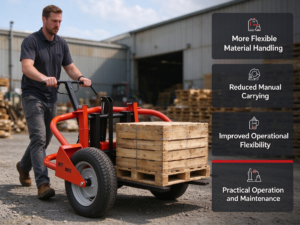
Greater Flexibility Across Suitable Surfaces
Outdoor work areas often include gravel, compacted ground, and unfinished surfaces that differ from conventional warehouse floors. A properly specified truck can help move compatible palletized materials between storage areas, loading points, and workstations where surface conditions permit safe operation.
This flexibility can reduce the need to carry individual items manually over short distances. However, loose debris, deep mud, soft soil, and unstable surfaces may still make pallet transportation unsuitable.
Reduced Manual Carrying
A Rough Terrain Pallet Truck enables operators to lift and transport compatible palletized goods as a single handling unit. This can reduce repetitive carrying and simplify the movement of construction supplies, packaged products, and other materials.
The equipment still requires physical effort, particularly on challenging surfaces or when moving heavy loads. Businesses should consider travel distance, handling frequency, operator workload, and whether powered equipment would be more appropriate for demanding applications.
Practical Operation and Ownership
A Rough Terrain Pallet Truck with a manual hydraulic lifting system can operate without battery charging or an electric traction motor. For suitable short-distance tasks, this design may simplify equipment setup and reduce dependence on powered handling infrastructure.
Long-term value also depends on component durability, maintenance requirements, and the availability of replacement parts. Routine inspection and correct operation remain essential, particularly when equipment is regularly exposed to outdoor contaminants.
5. Common Applications
A Rough Terrain Pallet Truck is suitable for selected outdoor operations where compatible palletized goods must be moved over firm, sufficiently stable surfaces. Businesses should evaluate each application individually because ground conditions and load requirements can vary significantly.
Construction Sites and Building Material Yards
Construction teams may use a Rough Terrain Pallet Truck to move packaged materials between temporary storage areas and designated work zones. Potential applications include transporting palletized bags, boxed components, and construction supplies over prepared ground.
The site must provide a route that can safely support the truck and its load. Steep gradients, unstable surfaces, large obstacles, and loose debris may require a different handling method.
Agriculture and Farm Operations
Agricultural businesses may use a Rough Terrain Pallet Truck to transport compatible palletized supplies around storage buildings and suitable working areas. Packaged feed, containers, and other secured goods may be appropriate when the ground conditions and equipment specifications permit.
Moisture and changing surface conditions can affect maneuverability, so operators should assess the route before moving a load. Soft soil and muddy ground may prevent safe operation even when the equipment is intended for outdoor use.
Nurseries and Landscaping
A Rough Terrain Pallet Truck may help nurseries and landscaping businesses move packaged growing supplies, containers, and other compatible palletized goods around outdoor storage areas. Adjustable forks, where available, can provide additional flexibility when handling different approved pallet sizes.
Wet ground, gravel paths, and transitions between surfaces require careful assessment. The equipment should not be assumed to operate safely on every lawn, garden path, or unprepared surface.
Industrial Yards and Outdoor Storage
Industrial yards can benefit from a Rough Terrain Pallet Truck when palletized materials need to move between storage locations, delivery areas, and workstations. This application is particularly relevant when transportation distances are relatively short and the ground is sufficiently firm.
Before introducing this equipment, businesses should evaluate the yard layout, load dimensions, handling frequency, and surface condition. Longer travel distances or more demanding terrain may justify considering other material handling solutions.
6. Rough Terrain Pallet Truck vs. Standard Pallet Truck
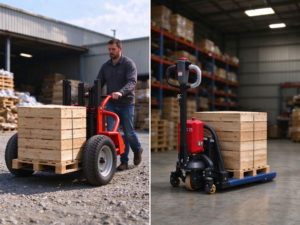
A Rough Terrain Pallet Truck is intended for suitable outdoor environments, whereas a standard pallet truck is generally optimized for smooth warehouse floors and controlled industrial areas. Their differences typically involve wheel configuration, ground clearance, overall dimensions, and intended operating conditions.
A rough terrain model often emphasizes larger wheels and a chassis configuration suited to outdoor handling, while a conventional model commonly prioritizes compact dimensions and efficient movement across smooth surfaces. Neither design is universally superior; the best option depends on the application.
When comparing products, buyers should review rated capacity, fork dimensions, minimum fork height, tire type, maneuverability, and maintenance requirements. A standard pallet truck may offer better value for indoor work, while a suitable outdoor model may be more practical where conventional equipment cannot meet the site’s requirements.
7. How to Choose the Right Model
A Rough Terrain Pallet Truck should be selected according to load specifications, ground conditions, operating frequency, and the features required for daily work. Reviewing these factors before purchase helps businesses avoid unsuitable equipment and unnecessary costs.
Load capacity: Confirm the maximum intended load and verify the manufacturer’s rated capacity. Load dimensions, weight distribution, and center of gravity must also be considered.
Wheel and tire design: Select a configuration suited to the actual surfaces encountered at the worksite. Compare durability, traction, cushioning, maintenance needs, and compatibility with the expected load.
Fork dimensions: Check fork length, width adjustment range, minimum height, and pallet entry requirements. The truck must fit the intended pallet and load carrier.
Ground clearance: Assess the height of surface irregularities and compare these conditions with the manufacturer’s specifications. Do not assume that an outdoor model can travel safely over every obstacle.
Handling frequency: Consider the number of daily handling cycles, travel distances, and expected service life. Intensive operations may require a different design or powered alternative.
Supplier support: Review technical documentation, spare parts availability, warranty conditions, and maintenance guidance. Reliable support can make equipment easier to manage throughout its working life.
8. Maintenance Tips for Reliable Performance
A Rough Terrain Pallet Truck needs regular inspection because outdoor operation can expose wheels, moving components, and hydraulic systems to dust, grit, and moisture. Preventive maintenance helps identify developing problems before they affect daily operations.
Inspect Wheels and Tires
Wheel inspection is essential because tire damage, excessive wear, embedded debris, or loose components can affect movement and control. Pneumatic tires should also be checked according to the manufacturer’s maintenance recommendations, including pressure where applicable.
Damaged wheels and tires should be addressed promptly. Continuing to operate with defective components may increase wear and compromise the equipment’s ability to move safely.
Check the Hydraulic System
A Rough Terrain Pallet Truck should be inspected for fluid leaks, abnormal lifting behavior, and problems with controlled lowering. Hydraulic fluid levels and service requirements must follow the manufacturer’s instructions.
If lifting becomes unreliable or the load lowers unexpectedly, remove the equipment from service until the problem has been assessed. Hydraulic repairs should be carried out by qualified personnel.
Inspect the Frame and Moving Parts
Regular checks should cover forks, the chassis, welded joints, fasteners, steering components, and other load-bearing or moving parts. Cracks, deformation, unusual noise, or visible damage may indicate that maintenance is required.
Cleaning the equipment after use can also make wear and damage easier to identify. Maintenance records help businesses monitor recurring problems and plan servicing more effectively.
9. Safety Considerations for Outdoor Use
A Rough Terrain Pallet Truck must operate within its rated capacity and only on surfaces suitable for the specific model and load. Operators should assess the route, position the load correctly, and follow the manufacturer’s instructions before moving materials.
Particular attention is required around slopes, loose gravel, holes, soft ground, and sudden changes in surface height. An outdoor-rated truck should not automatically be considered suitable for steep gradients, deep mud, or unstable terrain.
Operators should maintain control of the load, keep travel paths clear, and prevent people from entering the handling area. Loads must never exceed the rated capacity, and the equipment must not be used to carry people.
10. Why Product Design and Manufacturing Quality Matter
A Rough Terrain Pallet Truck needs appropriate structural strength, dependable lifting performance, and components suited to its intended operating environment. Product quality therefore affects durability, serviceability, and the consistency of everyday performance.
Buyers should examine material specifications, fork and frame construction, hydraulic components, wheel assemblies, and the manufacturer’s quality inspection procedures. Consistent assembly and functional testing can help identify potential issues before the equipment reaches the customer.
UNILIFT-mhe focuses on practical material handling solutions designed around operational requirements, with attention to structural design, product usability, and manufacturing quality. When evaluating equipment, customers should confirm the actual model specifications, testing information, and available service support rather than relying on general product descriptions.
Choosing a supplier with clear technical documentation and accessible replacement parts can also simplify maintenance planning. Reviewing these factors alongside product performance helps businesses make a more informed long-term investment.
Conclusion
A Rough Terrain Pallet Truck can provide a practical solution for transporting compatible palletized goods across suitable uneven outdoor surfaces. Large wheels, appropriate ground clearance, a robust frame, and hydraulic lifting can help address handling requirements that conventional indoor equipment may not meet.
The right model depends on load weight, pallet design, terrain, handling frequency, and maintenance requirements. Buyers should verify technical specifications and operating limitations before purchasing to ensure the equipment is suitable for the intended application.
For construction sites, agricultural operations, industrial yards, and other outdoor environments, the correct equipment can support more flexible material movement and dependable daily performance. Combining careful product selection with routine maintenance and safe operating practices helps businesses protect their investment over time.
Follow UNILIFT MHE for More Material Handling Insights
Stay connected with UNILIFT MHE for the latest updates on electric pallet trucks, electric stackers, electric tuggers, warehouse equipment, material handling solutions, and industry insights. Follow our social media channels to discover new products, application scenarios, company updates, and practical information for modern warehouse and logistics operations.
Explore reliable electric pallet trucks, electric stackers, and material handling solutions at Unilift MHE.
If you would like to contact us, please click here.
If you would like to learn more about our news, please click here.
Facebook: Follow UNILIFT MHE on Facebook
TikTok: Follow UNILIFT MHE on TikTok
Instagram: Follow UNILIFT MHE on Instagram
X: Follow UNILIFT MHE on X
Pinterest: Explore UNILIFT MHE on Pinterest
LinkedIn: Connect with UNILIFT MHE on LinkedIn