Introduction
By combining forward, backward, and sideways travel, a Four Way Pallet Truck provides a practical solution for moving long, wide, or bulky loads in areas where conventional pallet trucks have limited room to maneuver. Its multi-directional movement allows operators to reposition loads more efficiently without always needing to turn the entire truck and its load.
For warehouses, manufacturing facilities, and material handling operations, a Four Way Pallet Truck can help improve space utilization, simplify internal transportation, and support safer load handling when working with long materials. Understanding how its wheel system and lifting mechanism work is essential when choosing the right equipment for your operation.
What Is a Four Way Pallet Truck?
Unlike a conventional pallet truck designed primarily for forward and backward movement, a Four Way Pallet Truck is engineered to travel in four directions, including sideways. This capability is particularly useful when handling long products or working in narrow aisles where turning a loaded truck may be difficult.
The key difference lies in the wheel arrangement and the mechanism that enables lateral movement, although the precise design varies by model. Some four-way pallet trucks use additional traverse wheels that engage at a specified fork height, while other design details depend on the manufacturer’s configuration. These components allow the truck to move sideways when the appropriate operating conditions are met.

How Does a Four Way Pallet Truck Work?
Understanding the operating principle of a Four Way Pallet Truck starts with three essential systems: the hydraulic lifting mechanism, the main load-bearing wheels, and the additional wheel arrangement that enables sideways travel.
1. The Hydraulic Lifting System Raises the Load
During normal operation, a Four Way Pallet Truck uses a hydraulic pump to raise its forks and lift a pallet or supported load slightly off the floor. On a manual model, the operator typically operates the pump through the handle, allowing the load to be lifted for transportation and lowered when it reaches the destination.
The hydraulic system provides the lifting force, while the frame, forks, and wheels support the load during handling. A well-designed lifting mechanism should deliver controlled operation and reliable performance within the equipment’s rated capacity.
2. The Wheel Arrangement Enables Multi-Directional Movement
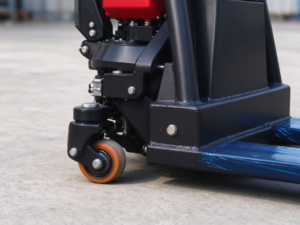
The defining feature of a Four Way Pallet Truck is its specialized wheel configuration, which enables lateral travel in addition to conventional forward and backward movement. Depending on the model, additional traverse wheels or a dedicated roller arrangement allows the truck to move sideways when the mechanism is correctly positioned.
This design reduces the need to rotate the truck through a wide turning arc whenever the load needs to move across an aisle. However, the exact method for switching between travel directions is model-specific, so operators should always follow the manufacturer’s instructions.
3. Sideways Travel Makes Long Loads Easier to Handle
When a Four Way Pallet Truck is configured for traverse movement, operators can move suitable loads sideways through restricted spaces instead of turning them around. This is particularly valuable when handling timber packs, metal profiles, pipes, panels, and other long materials that require additional clearance during conventional transportation.
The ability to move laterally helps operators align long loads with storage locations, workstations, or transport areas more effectively. Before using this mode, it is essential to confirm that the load is stable and that the truck’s rated lateral travel capacity is sufficient for the application.
4. Direction Changes Require Correct Operating Procedures
To change direction safely, a Four Way Pallet Truck must be operated according to its specific wheel configuration, lifting requirements, and steering instructions. Some models require the forks to reach a designated height before the traverse wheels can be used, while the handle or steering assembly may need to be repositioned for lateral travel.
Operators should avoid changing direction with an unstable or improperly supported load. Keeping the load within the rated capacity, checking floor conditions, and maintaining a clear travel path are essential to safe and predictable operation.
Key Benefits of a Four Way Pallet Truck
Better Maneuverability in Narrow Aisles
In space-constrained warehouses, a Four Way Pallet Truck offers greater flexibility by allowing suitable loads to move sideways without requiring the same turning space as a conventional pallet truck. This can be especially helpful when long materials need to pass through narrow aisles, doorways, or restricted work areas.
By reducing unnecessary repositioning, the equipment can make internal transport routes easier to manage. The actual space savings will depend on the load dimensions, aisle layout, floor conditions, and the truck’s operating configuration.
Efficient Handling of Long and Bulky Materials
For businesses handling timber, steel sections, pipes, panels, or similar products, a Four Way Pallet Truck provides a practical alternative to equipment designed mainly for standard pallet movement. Its lateral travel capability helps operators align long loads with storage racks and workstations where conventional turning may be difficult.
This flexibility can simplify material flow in manufacturing facilities, metal processing operations, timber yards, and warehouses handling oversized goods. Choosing a model with suitable fork dimensions, load capacity, and lateral travel performance is important for achieving these benefits.
Improved Workflow and Space Utilization
A Four Way Pallet Truck can help streamline material movement by giving operators more options for navigating restricted layouts. Where the application involves frequent handling of long products, fewer complex turning maneuvers can help make loading, unloading, and repositioning more straightforward.
Better maneuverability can also support more effective use of existing floor space. However, the truck should be selected as part of an overall material handling plan that considers traffic routes, storage design, load characteristics, and operator training.
Durable Construction for Industrial Use
For demanding material handling environments, a Four Way Pallet Truck should feature a robust frame, properly engineered forks, reliable wheel assemblies, and a hydraulic system designed for regular operation. These components work together to support load stability, equipment service life, and dependable day-to-day performance.
Wheel materials, bearing design, surface protection, weld quality, and access to replacement parts are also worth reviewing before purchase. Selecting equipment built for the intended workload can help businesses manage maintenance requirements and avoid unnecessary interruptions.
Where Are Four Way Pallet Trucks Used?
Across different industries, a Four Way Pallet Truck is particularly useful when the dimensions of the load make conventional turning inconvenient or inefficient.
- Warehousing and distribution: Moving suitable long or oversized goods through narrow aisles and restricted storage areas.
- Timber and wood processing: Repositioning timber packs, boards, and other elongated products.
- Metalworking and steel distribution: Handling appropriate metal profiles, bars, and sections within production or storage facilities.
- Manufacturing plants: Transporting materials between workstations where floor space is limited.
- Building materials storage: Moving suitable panels and long products through narrow access points.
The most appropriate application for a Four Way Pallet Truck depends on load dimensions, floor conditions, required travel directions, and the equipment’s rated capacity in each operating mode.
How to Choose the Right Four Way Pallet Truck
When comparing equipment, a Four Way Pallet Truck should be evaluated against the actual loads, aisle dimensions, and transportation tasks encountered in daily operations.
Load Capacity and Lateral Travel Rating
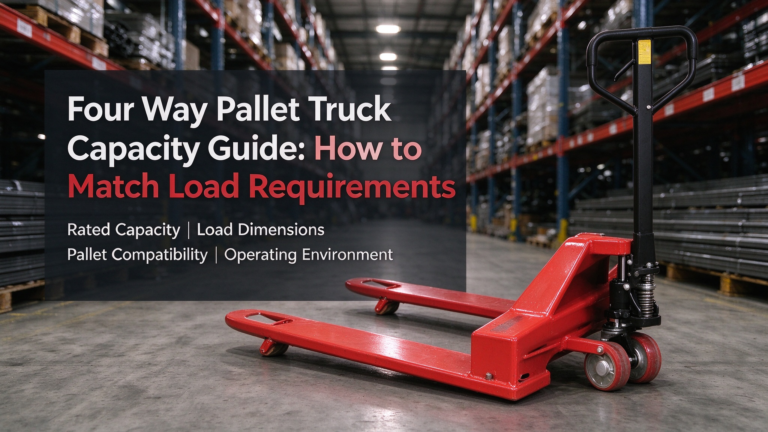
Load capacity is one of the most important specifications for a Four Way Pallet Truck, but buyers should not assume that the rated capacity is identical in every travel direction. Some models have a lower permissible capacity during traverse movement than during conventional forward and backward travel.
Always check the manufacturer’s specifications for both operating modes, including any required fork height or load restrictions. The selected truck must be suitable for the complete load, not simply its nominal weight under standard travel conditions.
Fork Dimensions and Load Compatibility
The fork length, outside fork width, lowered fork height, and available clearance determine whether a Four Way Pallet Truck can safely engage and support the intended load. These dimensions should match the pallets, skids, or materials being handled, with particular attention to long or unusually wide goods.
Buyers should also consider the dimensions of the load relative to the aisle and storage area. Appropriate fork geometry and sufficient clearance are essential for stable handling and smooth movement.
Wheel Design and Operating Environment
A Four Way Pallet Truck should have a wheel configuration suited to the floor surface, load requirements, and frequency of lateral movement. Polyurethane, nylon, and other wheel materials offer different characteristics, so the right choice depends on factors such as floor finish, noise requirements, rolling resistance, and wear expectations.
For regular industrial use, also evaluate the durability of the wheel assemblies, the quality of the hydraulic components, the ease of maintenance, and the availability of technical support.
Maintenance Tips for Reliable Performance
Routine care helps a Four Way Pallet Truck remain dependable and operate as intended throughout its service life. Before use, operators should inspect the forks, frame, wheels, hydraulic system, steering components, and controls for visible damage, abnormal wear, leaks, or other signs of malfunction.
The specialized wheel arrangement deserves particular attention because debris, damaged rollers, or uneven wear can affect lateral movement. Follow the manufacturer’s maintenance schedule, keep moving components clean, use only specified lubricants where required, and remove faulty equipment from service until it has been inspected and repaired.
A Four Way Pallet Truck should also be checked after unusual impacts or operating problems, rather than continuing to work with a suspected fault. Consistent inspection and timely maintenance can help reduce avoidable downtime and support safer material handling.
Why Choose a Well-Engineered Four Way Pallet Truck?
For professional material handling operations, a Four Way Pallet Truck should deliver more than multi-directional movement alone. Its practical value comes from the combined performance of the frame, lifting system, wheel arrangement, steering components, and overall design quality.
When evaluating equipment from UNILIFT-mhe, buyers should consider whether the proposed configuration matches their handling requirements, including load capacity, fork dimensions, sideways travel conditions, and maintenance needs. Careful product selection helps ensure the equipment is suited to the intended application rather than relying on a one-size-fits-all solution.
A dependable material handling solution also requires clear operating guidance, appropriate operator training, and access to maintenance support. By matching equipment design with real working conditions, businesses can make more informed purchasing decisions and build a more efficient internal transport process.
Conclusion
By enabling forward, backward, and sideways movement, a Four Way Pallet Truck offers a useful solution for handling suitable long or bulky loads in restricted spaces. Its specialized wheel arrangement, hydraulic lifting system, and flexible travel options can support improved maneuverability and more efficient material flow.
Before choosing a Four Way Pallet Truck, assess the load dimensions, rated capacity in each travel mode, fork specifications, floor conditions, and maintenance requirements. The right configuration can help your warehouse or manufacturing operation handle challenging loads more efficiently while maintaining a strong focus on safe working practices.
Follow UNILIFT MHE for More Material Handling Insights
Stay connected with UNILIFT MHE for the latest updates on electric pallet trucks, electric stackers, electric tuggers, warehouse equipment, material handling solutions, and industry insights. Follow our social media channels to discover new products, application scenarios, company updates, and practical information for modern warehouse and logistics operations.
Explore reliable electric pallet trucks, electric stackers, and material handling solutions at Unilift MHE.
If you would like to contact us, please click here.
If you would like to learn more about our news, please click here.
Facebook: Follow UNILIFT MHE on Facebook
TikTok: Follow UNILIFT MHE on TikTok
Instagram: Follow UNILIFT MHE on Instagram
X: Follow UNILIFT MHE on X
Pinterest: Explore UNILIFT MHE on Pinterest
LinkedIn: Connect with UNILIFT MHE on LinkedIn