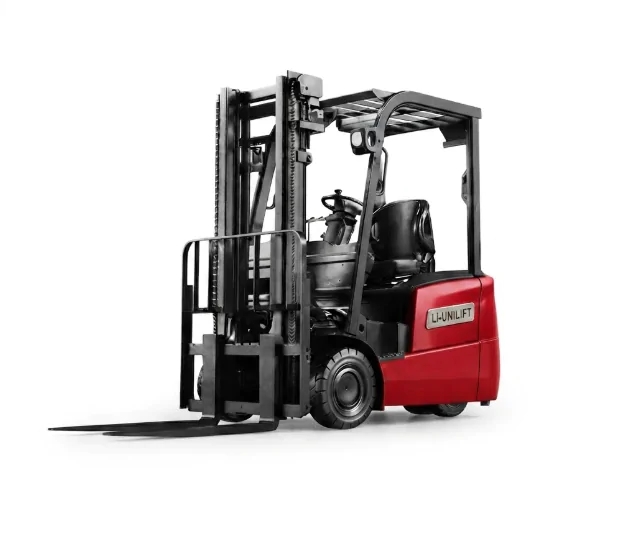
A Four Way Pallet Truck can be a worthwhile investment for businesses that regularly handle long loads, work in restricted spaces, or need greater flexibility when positioning pallets. Unlike a conventional pallet truck designed primarily for forward and backward travel, a four-way model is engineered to support lateral movement in compatible operating conditions. This additional maneuverability can help streamline material handling, reduce unnecessary repositioning, and make better use of available workspace. However, the real value depends on your load requirements, warehouse layout, operating frequency, and total cost of ownership.
1. What Is a Four Way Pallet Truck?
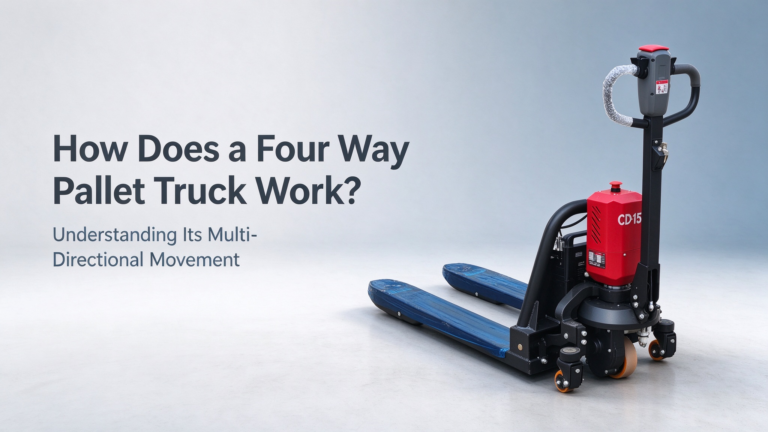
A Four Way Pallet Truck is a specialized material handling solution designed to move compatible pallets in multiple directions, including sideways, as well as forward and backward. Its directional capabilities distinguish it from conventional pallet trucks and make it particularly useful for applications where turning a loaded truck is difficult or space is limited.
Depending on the model, a four-way pallet truck uses a specialized wheel arrangement and directional mechanism to support lateral movement. This design can help operators position suitable loads more precisely without relying on the wider turning movements typically associated with standard pallet trucks.
For warehouses, manufacturing facilities, and logistics operations handling bulky or long materials, a Four Way Pallet Truck offers an alternative to conventional handling equipment when directional flexibility is a priority. Buyers should always verify the specific model’s operating directions, pallet compatibility, and rated capacity before purchase.
2. Key Benefits of Investing in a Four Way Pallet Truck
A Four Way Pallet Truck can deliver practical operational benefits when the handling process requires frequent changes in direction or precise load positioning. Its value comes not simply from additional movement options, but from how those options fit the demands of everyday work.
Improved Maneuverability in Restricted Spaces
A Four Way Pallet Truck can simplify load positioning in compact work areas by allowing compatible loads to move laterally. This capability is particularly valuable when handling long goods, working near storage racks, or positioning pallets where conventional turning movements are difficult.
For facilities with limited clearance, the ability to move a load sideways can reduce the need for repeated adjustments. Actual space savings depend on the load dimensions, equipment configuration, aisle clearance, and workplace layout.
More Efficient Material Handling
A Four Way Pallet Truck can help reduce unnecessary repositioning when operators need to align long or bulky loads with storage locations, production stations, or transport areas. Fewer complex turning maneuvers may simplify certain handling tasks and contribute to a more consistent workflow.
Businesses that frequently move loads sideways may benefit more than operations that primarily transport standard pallets along straight routes. Evaluating actual movement patterns is therefore essential when estimating potential productivity improvements.
Better Use of Available Floor Space
A Four Way Pallet Truck can support more flexible load positioning in work areas where floor space is expensive or difficult to expand. By reducing dependence on wide turning movements in suitable applications, it may help businesses organize material flow more effectively.
This advantage can be especially relevant in compact warehouses, manufacturing cells, and storage areas handling long products. However, multi-directional capability does not eliminate the need for adequate operating clearance, safe pedestrian routes, and properly designed storage layouts.
Manual Operation Without an Electric Drive
A Four Way Pallet Truck may provide specialized positioning capabilities without requiring an electric traction system, depending on the selected model. For operations involving short-distance movement and manageable loads, manual equipment can help avoid the battery charging infrastructure and powered-drive maintenance associated with electric alternatives.
Businesses should still evaluate operator effort, handling frequency, load weight, floor condition, and travel distance. For intensive operations or heavy loads, an electric pallet truck or another powered handling solution may be more appropriate.
Greater Flexibility for Specialized Loads
A Four Way Pallet Truck can be particularly useful for handling compatible long, wide, or specially configured loads that benefit from lateral positioning. Applications may include selected manufacturing materials, long components, and other goods that are difficult to maneuver with conventional pallet handling equipment.
The key consideration is compatibility rather than load size alone. Fork dimensions, pallet entry points, load center of gravity, wheel configuration, and rated capacity must all match the intended application.
3. Limitations You Should Consider Before Buying
A Four Way Pallet Truck is not automatically the best solution for every warehouse, because specialized maneuverability may offer limited value in straightforward transportation environments. Understanding the limitations before purchasing helps businesses avoid unnecessary expenditure and select equipment that fits their actual workflow.
Higher Purchase Cost for Some Models
A Four Way Pallet Truck may cost more than a conventional pallet truck because its specialized directional mechanism can require additional engineering and components. The actual price difference depends on the model, rated capacity, construction, specifications, and supplier.
Buyers should compare quotations based on equivalent technical requirements rather than purchase price alone. If lateral movement is rarely needed, a standard pallet truck may offer better overall value.
A More Specialized Operating Mechanism
A Four Way Pallet Truck may require operators to understand its directional controls and movement limitations before using it effectively. Depending on the design, switching between travel directions may involve a specific operating procedure.
Clear operating instructions, practical training, and routine inspections help support safe and consistent performance. Buyers should review the manufacturer’s documentation to understand the correct operating method for the selected model.
Specific Pallet and Load Requirements
A Four Way Pallet Truck may only work effectively with compatible pallet designs and suitable load dimensions. Some pallets do not provide the necessary clearance or entry points for the intended movement pattern, and irregular loads can affect stability and maneuverability.
Before purchasing, confirm pallet compatibility, fork spacing, load distribution, and the required direction of entry. These checks are particularly important when handling long materials or non-standard pallets.
Maintenance and Service Considerations
A Four Way Pallet Truck requires routine inspection of its wheels, bearings, hydraulic system, directional mechanism, and other model-specific components. Specialized parts may also affect maintenance planning and replacement-part availability.
A well-designed, serviceable truck can help control maintenance costs over its working life. Businesses should assess component accessibility, spare parts support, service documentation, and supplier responsiveness before committing to a particular model.
4. How Much Does a Four Way Pallet Truck Cost?
A Four Way Pallet Truck should be evaluated according to its total cost of ownership rather than its initial purchase price alone. Actual prices vary by manufacturer, load capacity, dimensions, construction materials, wheel configuration, order quantity, and customization requirements, so buyers should obtain a quotation based on their specific application.
The main cost factors typically include:
- Initial purchase price: The cost of the equipment and any specified options.
- Maintenance and replacement parts: Routine servicing, wheel replacement, hydraulic maintenance, and model-specific components.
- Operator training: The time required to familiarize operators with the equipment’s directional mechanism and safe operating procedures.
- Operational efficiency: Potential savings from easier load positioning, reduced repositioning, and improved workflow where multi-directional movement is regularly needed.
- Service life and reliability: The expected durability of structural components, hydraulic parts, and moving mechanisms under actual working conditions.
For a realistic investment assessment, a Four Way Pallet Truck should be compared with a standard pallet truck based on the same workload and operating environment. A model with a higher purchase price may justify the additional investment if it consistently solves a handling problem that would otherwise require extra labor or repeated maneuvering.
5. Four Way Pallet Truck vs. Standard Pallet Truck: Which Offers Better Value?
A Four Way Pallet Truck generally offers greater directional flexibility, while a standard pallet truck is often the more economical choice for conventional pallet transportation. The best option depends on whether multi-directional movement provides a measurable operational benefit.
| Comparison Factor | Four Way Pallet Truck | Standard Pallet Truck |
|---|---|---|
| Directional movement | Supports lateral movement in compatible configurations | Primarily designed for conventional forward-and-backward travel |
| Maneuverability | Useful for specialized positioning in restricted spaces | Effective in open aisles and straightforward routes |
| Typical applications | Selected long loads, bulky goods, and space-constrained handling | General warehouse, retail, and distribution operations |
| Operating complexity | May require familiarity with specialized directional controls | Generally straightforward to operate |
| Purchase cost | May be higher depending on design and specifications | Often a cost-effective choice for routine handling |
| Best investment case | Frequent need for lateral positioning | Regular transport of conventional pallets |
A Four Way Pallet Truck is more likely to justify its cost when lateral positioning is a recurring requirement rather than an occasional convenience. For standard pallet movement over short distances with adequate turning space, a conventional model may deliver comparable practical value with a simpler design.

6. How to Calculate the Return on Investment
A Four Way Pallet Truck can produce a favorable return on investment when the operational benefits it delivers exceed the additional purchase and ownership costs. Rather than relying on general productivity claims, businesses should measure how much time and effort the equipment could realistically save in their own facility.
Start by recording how often operators need to reposition loads, how long these movements take, and whether the current equipment creates delays. Then compare the expected handling time, labor requirements, and maintenance expenses associated with a four-way model against those of a standard pallet truck.
A simple annual benefit estimate can be calculated as follows:
Annual net benefit = Annual measurable operating savings − Additional annual ownership costs
The additional investment can then be assessed against the expected annual net benefit, provided that the estimate includes realistic maintenance, training, and operating assumptions. If the equipment generates a consistent net benefit, the payback period may be estimated by dividing the additional upfront investment by the expected annual net benefit.
A Four Way Pallet Truck should only be considered a financially sound investment when the calculations are supported by actual workflow data and realistic operating assumptions. Businesses should also account for safety, load compatibility, serviceability, and reliability, even when those benefits are difficult to express as immediate financial savings.
7. What to Look for in a High-Quality Four Way Pallet Truck
A Four Way Pallet Truck should combine reliable directional movement with structural strength, suitable load capacity, and straightforward maintenance. Evaluating these features helps buyers identify equipment that is appropriate for repeated industrial use rather than focusing on maneuverability alone.
Strong Steel Construction
A Four Way Pallet Truck must withstand the stresses created by repeated lifting, movement, and load positioning. Buyers should examine the fork structure, chassis design, joints, and other load-bearing components to assess whether the equipment is suitable for the intended workload.
Well-considered structural engineering and appropriate material selection can contribute to durability and dependable performance. Material thickness and rated capacity should be assessed against the manufacturer’s specifications rather than assumed from appearance alone.
Reliable Hydraulic Performance
A Four Way Pallet Truck relies on its hydraulic lifting system to raise and lower compatible loads safely. Consistent lifting performance, sound seals, suitable hydraulic components, and accessible maintenance points all contribute to dependable operation.
Before purchase, confirm the rated capacity, lifting range, lowering behavior, and inspection requirements. The equipment must also be operated within its specified limits and maintained according to the manufacturer’s instructions.
Durable Wheels and Directional Components
A Four Way Pallet Truck depends on its wheels and directional mechanism to provide controlled movement across suitable floor surfaces. Wheel material, bearing quality, component alignment, and the design of the directional system can influence rolling resistance, maneuverability, and maintenance needs.
Buyers should consider floor conditions, expected travel distance, load characteristics, and the availability of replacement components. Matching wheel specifications to the working environment helps support reliable operation over time.
Serviceability and Quality Control
A Four Way Pallet Truck offers better long-term value when its components can be inspected and maintained effectively. Accessible service points, clear technical documentation, consistent assembly standards, and appropriate functional testing all support equipment reliability.
Businesses evaluating suppliers should ask about manufacturing processes, inspection procedures, spare parts availability, warranty terms, and technical support. These factors provide a more complete picture of product quality than appearance or price alone.
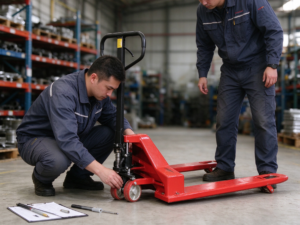
8. Why Choose UNILIFT-mhe for Material Handling Solutions?
A Four Way Pallet Truck should be selected from a supplier that understands the relationship between equipment design, workplace conditions, and long-term operating requirements. UNILIFT-mhe focuses on practical material handling solutions, with attention to structural design, product usability, manufacturing quality, and the demands of daily industrial operations.
Reliable handling equipment starts with appropriate material selection and sound engineering. Strong load-bearing structures, well-designed mechanical components, consistent assembly, and product testing can all contribute to equipment that performs dependably under its intended working conditions.
When comparing pallet truck options, businesses should evaluate the actual product specifications, application suitability, serviceability, and available technical support. UNILIFT-mhe encourages customers to select equipment based on their load requirements, workspace limitations, handling frequency, and long-term operating goals rather than purchase price alone.
Conclusion
A Four Way Pallet Truck can be worth the investment when a business regularly handles compatible loads that require lateral movement, precise positioning, or greater maneuverability in restricted spaces. Its benefits may include simpler load placement, more flexible material handling, and better use of available workspace.
However, a specialized model is not necessarily the most economical choice for every operation. Businesses with straightforward pallet transportation requirements may find that a standard pallet truck offers better value, lower initial costs, and sufficient functionality.
The most effective purchasing decision begins with a clear understanding of load specifications, workplace conditions, maintenance requirements, and measurable operational needs. By comparing these factors carefully and selecting equipment built for its intended application, businesses can make a more informed investment in material handling efficiency and long-term reliability.
Follow UNILIFT MHE for More Material Handling Insights
Stay connected with UNILIFT MHE for the latest updates on electric pallet trucks, electric stackers, electric tuggers, warehouse equipment, material handling solutions, and industry insights. Follow our social media channels to discover new products, application scenarios, company updates, and practical information for modern warehouse and logistics operations.
Explore reliable electric pallet trucks, electric stackers, and material handling solutions at Unilift MHE.
If you would like to contact us, please click here.
If you would like to learn more about our news, please click here.
Facebook: Follow UNILIFT MHE on Facebook
TikTok: Follow UNILIFT MHE on TikTok
Instagram: Follow UNILIFT MHE on Instagram
X: Follow UNILIFT MHE on X
Pinterest: Explore UNILIFT MHE on Pinterest
LinkedIn: Connect with UNILIFT MHE on LinkedIn