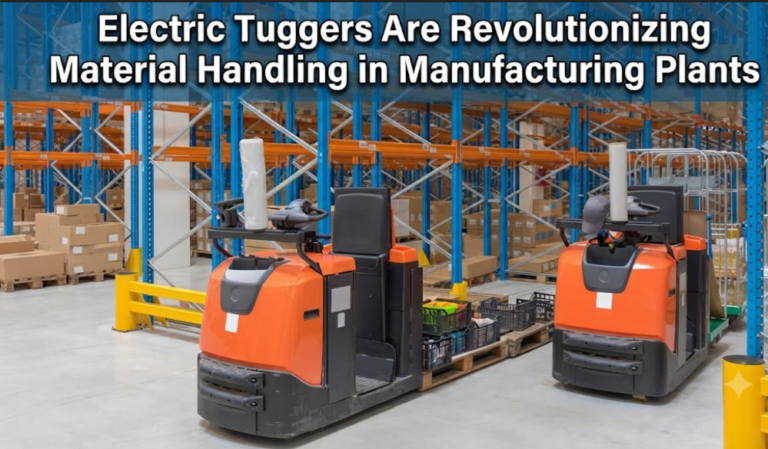
When purchasing an electric pallet truck, you will often encounter technical terms such as rated capacity, fork length, battery capacity, turning radius, and gradeability. This guide provides a comprehensive explanation of the most common electric pallet truck terminology, helping you better understand product specifications and select the right equipment for your application.
What Is an Electric Pallet Truck?
An Electric Pallet Truck, also known as an Electric Pallet Jack or Powered Pallet Truck, is a material handling vehicle powered by electricity and designed for horizontal transportation of palletized goods.
It is widely used in various sectors, including warehousing and logistics centers, manufacturing facilities, retail distribution centers, cold storage warehouses, and e-commerce fulfillment centers.
Compared with manual pallet trucks, electric pallet trucks significantly reduce labor intensity, improve handling efficiency, and enhance workplace safety.
Pallet Truck’s Key Structural Components and Terminology
1. Forks
The parts of electric pallet trolley forks are the load-bearing components that directly support and transport goods.
Key Specifications:
- Fork Length
- Fork Width
- Fork Outside Width
Browse this article to learn more about the Dimensions of the electric pallet truck structure.
Common Fork Lengths:
- 1150 mm
- 1220 mm
- 1500 mm
- 1800 mm
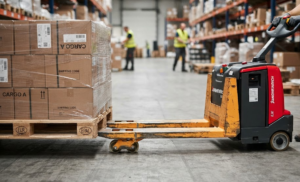
Fork dimensions should match the pallet size used in your operation.
2. Drive Wheel
The drive wheel is responsible for:
- Forward movement
- Reverse movement
- Braking
Common wheel materials include:
- Polyurethane (PU) Wheels
- Rubber Wheels
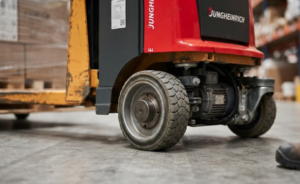
One of the key components of a drive-wheel electric pallet truck that directly affects its performance, traction, handling, and lifespan.
3. Load Wheels
Load wheels are located beneath the forks and support the weight of the load.
Common Configurations:
- Single Load Wheel
- Tandem (Double) Load Wheels
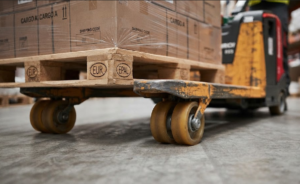
Tandem wheels are a key component that allows electric pallet trucks to perform better on uneven terrain, ensuring smooth movement for this type of carrier.
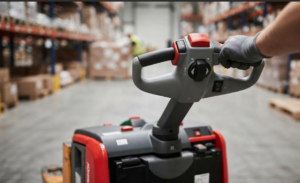
4. Tiller Handle
The tiller handle serves as the primary control interface for the operator.
Functions Include:
- Travel control
- Lift control
- Lowering control
- Horn operation
- Emergency reverse protection
The Tiller Handle is a crucial human-machine interface component, primarily used to control the vehicle’s direction, speed, and some safety functions.
5. Hydraulic System
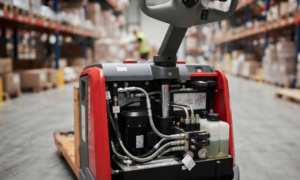
The hydraulic system controls fork lifting and lowering.
Main Components:
- Hydraulic Pump
- Hydraulic Cylinder
- Hydraulic Valve
- Oil Reservoir
The Hydraulic System is a system that uses hydraulic pressure to transmit power inside an electric trailer. It is mainly used to provide auxiliary power functions such as lifting and clamping the forks and controlling towing attachments.
Performance Parameters of Industrial Electric Pallet Truck
1. Rated Capacity
Rated capacity refers to the maximum load weight that the truck can safely handle.
| Model Type | Rated Capacity |
| Light Duty | 1,500 kg |
| Standard Duty | 2,000 kg |
| Heavy Duty | 2,500 kg |
| Industrial Grade | 3,000 kg |
It is recommended to maintain a 10%–20% safety margin when selecting capacity.
2. Load Center Distance
Load center distance is the horizontal distance from the load’s center of gravity to the fork heel.
Industry Standard:
- 600 mm
If the load center exceeds the rated specification, vehicle stability may be compromised.
3. Lift Height
Lift height refers to the vertical distance between the lowest and highest positions of the forks.
Common Lift Heights:
- 115 mm
- 120 mm
- 200 mm
Since electric pallet trucks are primarily designed for horizontal transport, lift heights are generally limited.
4. Lowered Fork Height
The lowered fork height is the height of the forks when fully lowered.
Typical Values:
- 75 mm
- 80 mm
- 85 mm
Different lowered heights accommodate different pallet types.
5. Travel Speed
Travel speed indicates the maximum operating speed of the truck under loaded or unloaded conditions.
Typical Speeds:
- Unloaded: 6–8 km/h
- Loaded: 5–7 km/h
6. Gradeability
Gradeability refers to the maximum incline the truck can climb while carrying a full load.
Measured In:
- Percentage (%)
Typical Values:
- 6%
- 8%
- 10%
Higher gradeability makes the truck better suited for ramps, loading docks, and sloped warehouse environments.
7. Turning Radius
Turning radius is the minimum space required for the truck to complete a turn.
Key Characteristics:
- Smaller turning radius
- Better maneuverability
- More suitable for narrow aisles and confined warehouse spaces
4. Battery System Terminology
1. Lithium Battery
Lithium batteries are currently the most popular power source for electric pallet trucks.
Advantages:
- Fast charging
- Long service life
- Maintenance-free
- Lightweight
2. Lead-Acid Battery
Lead-acid batteries are the traditional power solution.
Characteristics:
- Lower initial investment
- Proven technology
- Requires regular maintenance
3. Battery Capacity
Battery capacity is measured in:
- Ampere-hours (Ah)
Common Specifications:
- 24V / 20Ah
- 24V / 30Ah
- 24V / 60Ah
- 24V / 100Ah
Higher battery capacity generally provides longer operating time.
4. Operating Time
Operating time refers to the continuous working duration after a full charge.
Typical Range:
- 4–8 hours
- 8–12 hours
Actual runtime depends on:
- Load weight
- Operating frequency
- Floor conditions
5. Motor-Related Terminology
1. Drive Motor
The drive motor powers vehicle movement.
It directly affects:
- Acceleration performance
- Gradeability
- Travel speed
2. Lift Motor
The lift motor powers the hydraulic pump to raise and lower the forks.
Higher motor power generally provides:
- Faster lifting speed
- Improved productivity
3. Brushless Motor
Brushless motors are the preferred choice in modern high-end electric pallet trucks.
Advantages:
- Higher efficiency
- Lower noise levels
- Reduced maintenance requirements
- Longer service life
6. Safety System Terminology
1. Electromagnetic Brake
An electromagnetic brake automatically engages when power is disconnected.
Benefits:
- Fast response
- Reliable stopping performance
- Enhanced operational safety
2. Emergency Stop Switch
The emergency stop switch immediately cuts off power during emergencies.
It helps minimize accident risks and equipment damage.
3. Anti-Roll Back System
This system prevents the truck from rolling backward when stopped on an incline.
Particularly useful for:
- Loading dock operations
- Sloped warehouse environments
4. Creep Speed Mode
Creep speed mode allows low-speed operation while the tiller is in the upright position.
Ideal for:
- Narrow aisles
- Container loading and unloading
- Confined working areas
7. Five Key Factors to Consider When Purchasing an Electric Pallet Truck
When selecting an electric pallet truck, pay close attention to the following five criteria:
① Rated Capacity
Ensure the truck can safely handle your maximum load requirements.
② Battery Type
Lithium battery models are generally recommended for better efficiency and lower maintenance costs.
③ Turning Radius
Affects maneuverability and aisle compatibility within your warehouse.
④ Gradeability
Determines performance on ramps, loading docks, and sloped surfaces.
⑤ Motor Configuration
Brushless motors typically offer greater efficiency, lower maintenance requirements, and longer service life.
Conclusion
This article mainly introduces Key Components and Performance Parameters. If you wish to gain a deeper understanding of other aspects of electric pallet trucks, browse this article.
Although electric pallet trucks have a relatively simple structure, they involve numerous technical specifications and industry terms. Understanding key factors such as fork dimensions, rated capacity, load center distance, battery capacity, turning radius, and gradeability can help businesses make informed purchasing decisions.
When selecting an electric pallet truck, it is essential to evaluate actual operating conditions, pallet specifications, load weights, and warehouse layouts. A thorough assessment ensures the selection of the most suitable equipment, leading to improved material handling efficiency, enhanced workplace safety, and reduced operational costs.