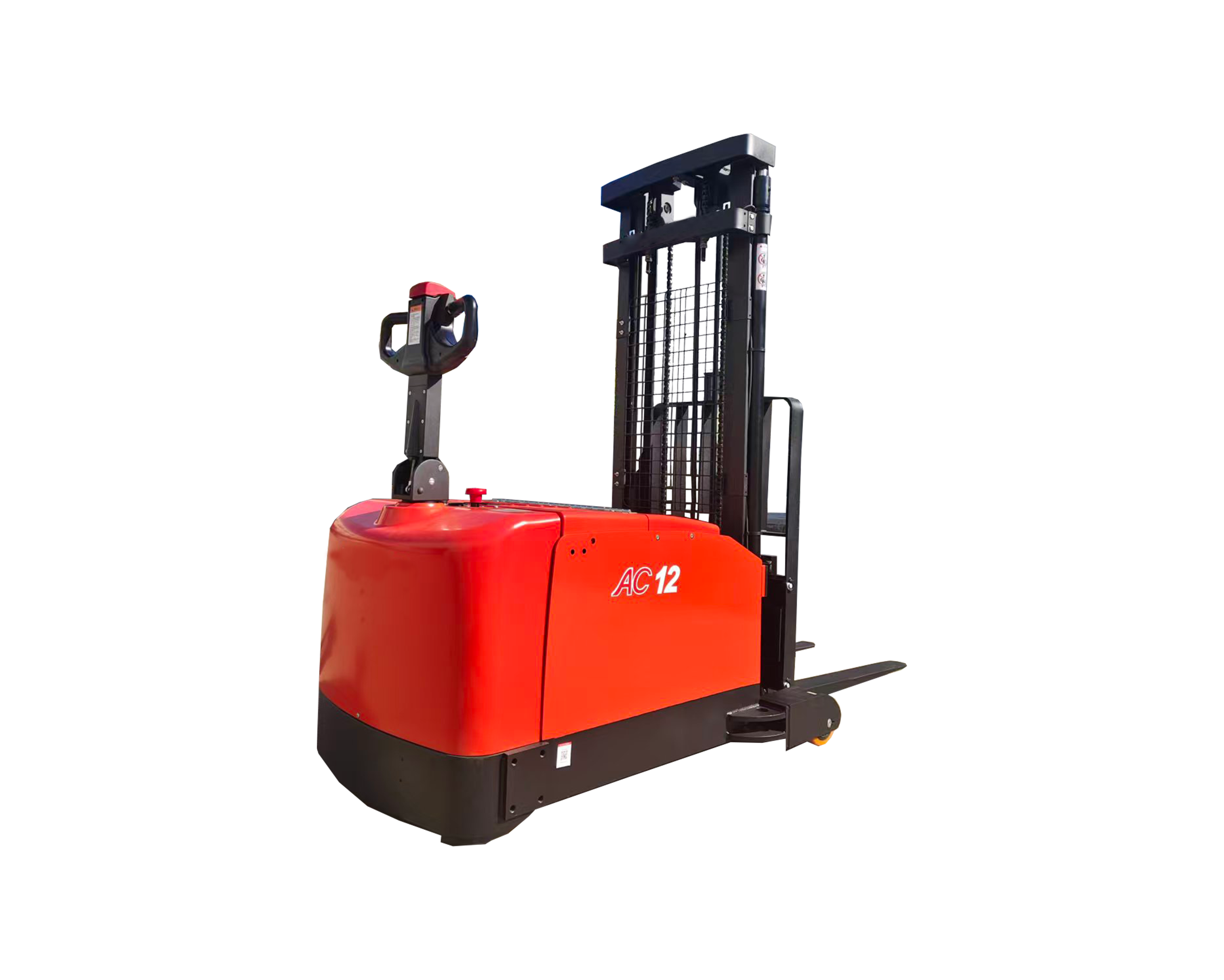
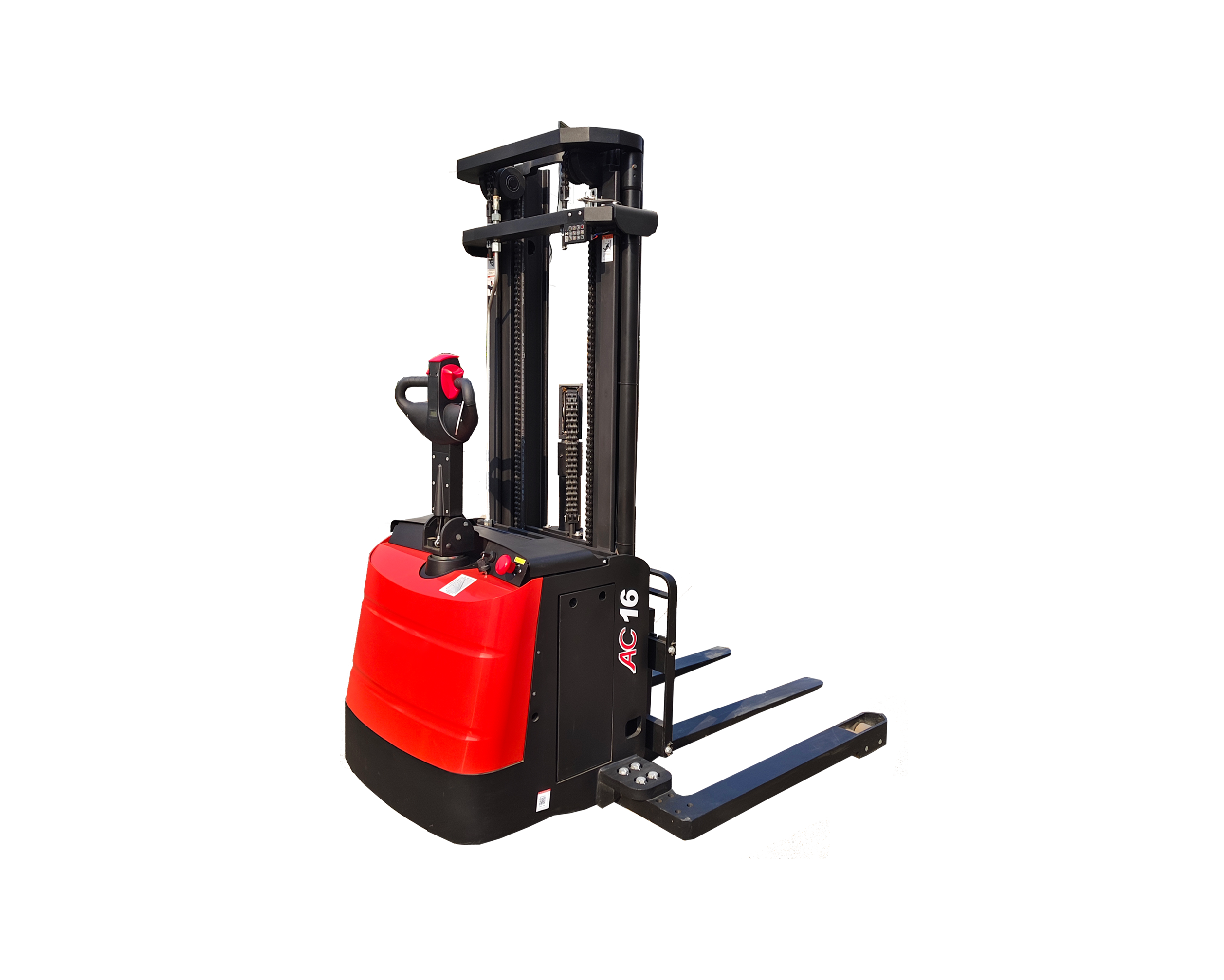
Operating an electric stacker for the first time requires proper training, a pre-operation inspection, and a clear understanding of load-handling procedures. Before moving any pallet, operators should learn the machine’s controls, verify its rated capacity, inspect the working area, and understand the safety instructions for the specific model.
An electric stacker is a powered material-handling truck used to lift and transport palletized loads, particularly in warehouses, manufacturing facilities, and distribution centers. Although it can improve handling efficiency, incorrect operation can cause collisions, falling loads, equipment damage, or serious injuries.
This guide explains how to prepare an electric stacker for first-time use, operate its controls, handle pallets, stack loads, and park the equipment safely.
Important: This article provides general operating guidance, not model-specific operating instructions. Operators must complete the training and authorization required by applicable regulations and workplace procedures. Always follow the manufacturer’s operator manual and the site-specific safety rules for the actual machine.
1. Understand the Main Components of an Electric Stacker
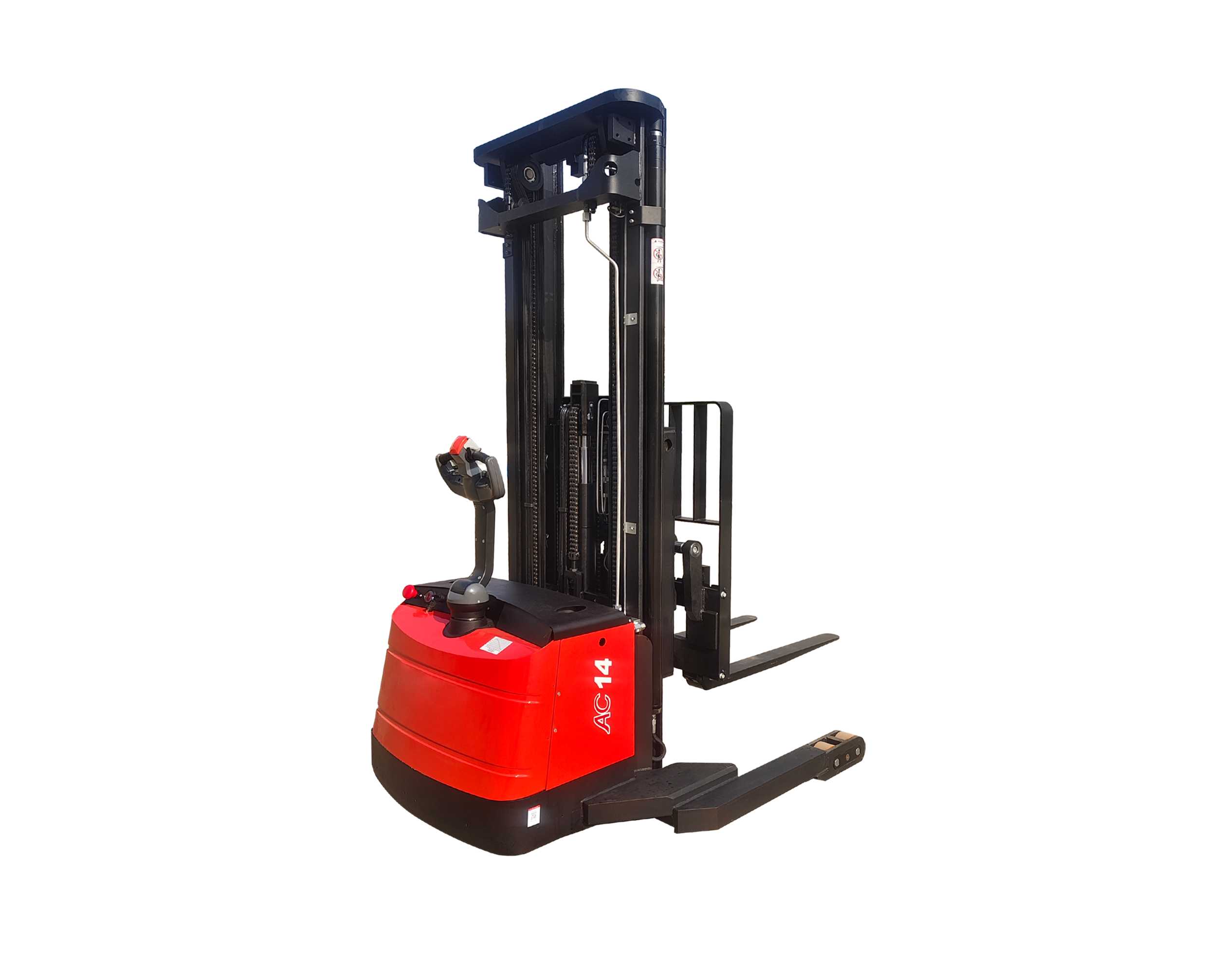
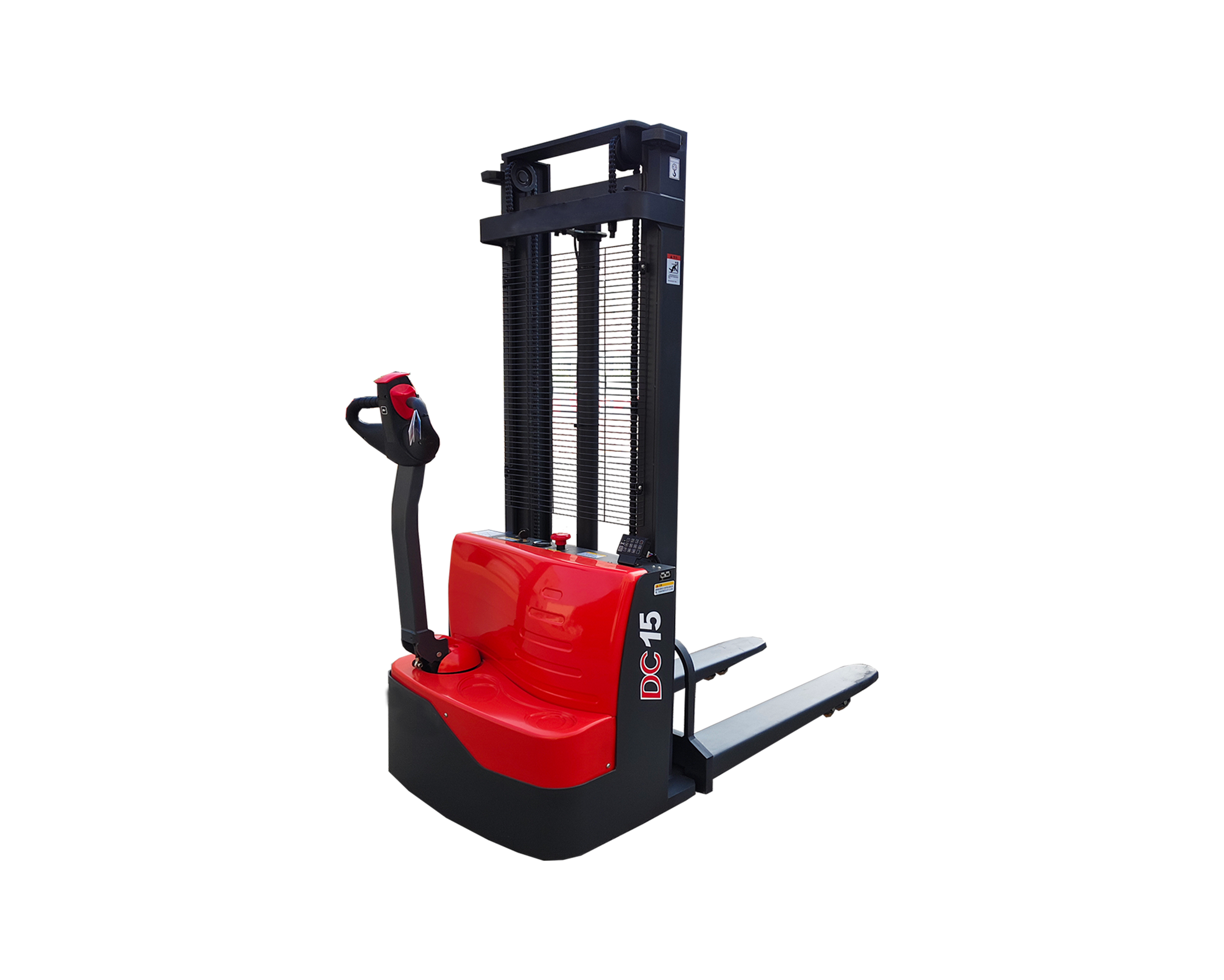
Before operating an electric stacker, become familiar with its main components and their functions. Control layouts and safety features vary by model, so identify the actual controls using the operator manual.
Control Handle and Operating Controls
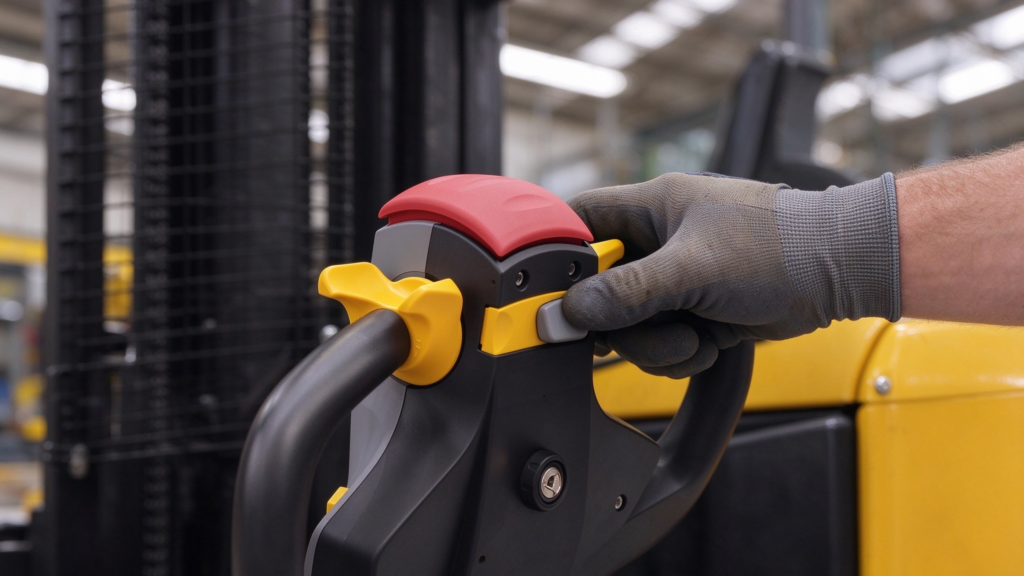
The control handle or control panel allows the operator to steer the machine and operate its travel and lifting functions. Depending on the model, controls may include forward and reverse travel, lifting, lowering, braking, and an emergency stop device.
Before moving the stacker, identify each control and understand its function. Never assume that buttons or switches work the same way across different models.
Forks and Mast
The forks support palletized loads, while the mast guides the forks during lifting and lowering.
Operators should understand the following before use:
- The machine’s rated load capacity and any applicable load-center limits.
- The maximum permitted lifting height.
- The correct fork spacing for the pallet.
- The condition of the forks, mast, chains, rollers, and other lifting components.
Never use visibly damaged or deformed forks, or operate a lifting system that shows signs of malfunction.
Battery and Electrical System
The battery supplies power to the travel motor, lifting system, and other electrical components. Before use, check the battery indicator and confirm that sufficient charge is available for the planned work.
For lithium-ion models, follow the battery manufacturer’s instructions for charging, warning indicators, and fault handling. Do not disconnect, open, or repair battery components unless qualified and authorized to do so.
Safety Devices
Depending on the model, an electric stacker may have a braking system, horn, warning lights, emergency stop device, or other protective features.
Know where these devices are located and how they are intended to work. If a required safety function fails, do not operate the machine until the issue has been assessed and resolved by authorized personnel.
2. Complete a Pre-Operation Electric Stacker Safety Inspection
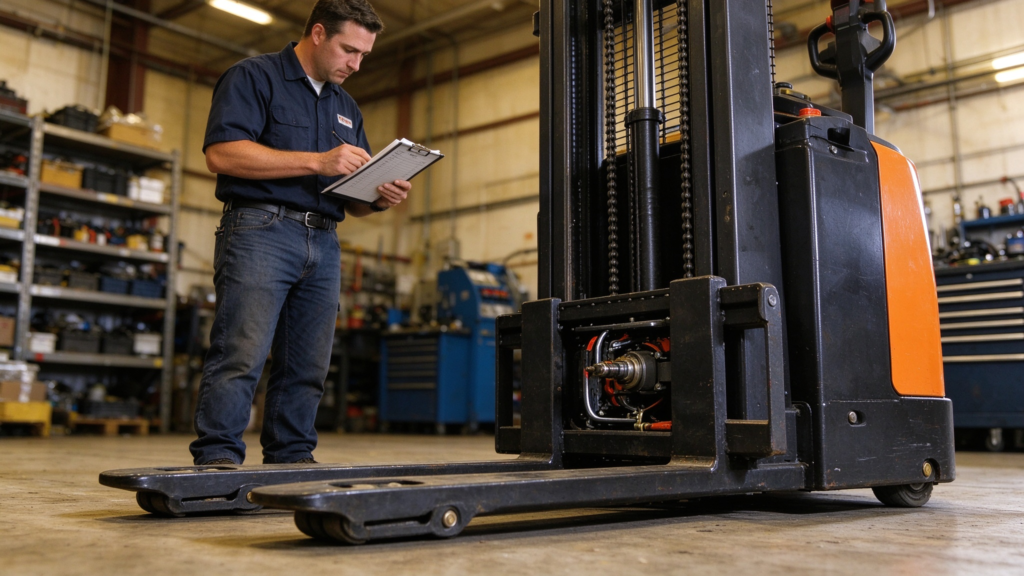
A pre-operation inspection helps identify visible damage and equipment problems before they create a hazard. Follow the manufacturer’s inspection checklist and the workplace’s inspection procedures.
Check the Overall Equipment Condition
Inspect the stacker for:
- Visible cracks, deformation, loose parts, or other damage.
- Hydraulic fluid leakage, where applicable.
- Damaged wheels, worn tires, or unusual wheel movement.
- Loose or damaged cables and connectors.
- Unusual noises, warning messages, or signs of malfunction.
If you find a defect that could affect safe operation, take the equipment out of service according to site procedures and report it to the responsible supervisor or maintenance team.
Inspect the Battery and Electrical System
Check the displayed charge level, visible cables, connectors, and any warning indicators. Confirm that the battery compartment and connections are in the condition specified by the manufacturer.
For lithium-ion batteries, pay attention to abnormal heat, swelling, physical damage, unusual odors, or battery-management-system fault indications. Do not charge or operate a battery that shows signs of damage or a serious fault. Follow the manufacturer’s emergency and reporting procedures.
Inspect the Forks and Lifting System
Check the forks for cracks, deformation, and other visible damage. Inspect accessible mast components, lifting chains, rollers, and hydraulic components according to the approved inspection procedure.
Do not place your hands near moving parts or reach into the mast mechanism. Never attempt to inspect a raised load by placing any part of your body underneath it.
Verify Safety Functions
Where applicable, check the horn, brakes, emergency stop device, travel controls, and lifting and lowering functions using the manufacturer’s prescribed test procedure.
Perform functional tests only in a suitable area, with no people or obstructions in the operating path. If a safety function does not work as intended, do not continue using the equipment.
3. Prepare the Work Area Before Moving the Stacker
A safe machine can still create hazards when the surrounding work area is unsuitable. Before starting, assess the route, floor conditions, nearby workers, and intended stacking location.
Check the Floor and Travel Route
Confirm that the floor is suitable for the stacker’s weight, the load, and the intended lifting height. Look for:
- Uneven surfaces, damaged flooring, and floor openings.
- Slippery areas, loose debris, and obstructions.
- Slopes or transitions that may exceed the manufacturer’s permitted limits.
- Narrow aisles, blind corners, and pedestrian crossing points.
- Low overhead clearances and overhead obstructions.
Do not operate on a surface or slope outside the equipment’s specified limits. Keep the travel route clear and follow the site’s pedestrian and vehicle traffic rules.
Check the Pallet and Load
Before lifting, confirm that the pallet is suitable for the load and compatible with the fork dimensions. Look for broken boards, unstable packaging, uneven weight distribution, and protruding materials.
Determine the load’s weight from reliable information. If its weight is unknown, do not lift it until the weight has been established.
Confirm That the Stacking Location Is Suitable
Before approaching a rack or storage position, check that the floor, rack, and storage area can safely accommodate the intended load.
Verify the permitted rack loading, available clearance, and required lifting height. Never assume that a rack can support a pallet simply because the pallet fits into the opening.
4. Learn the Basic Controls Before Handling Loads
First-time operators should practice in a designated training area with adequate clearance and no unnecessary pedestrian traffic. Initial practice should follow the training program and the manufacturer’s operating instructions.
Step 1: Start the Electric Stacker
Before switching on the machine:
- Confirm that the pre-operation inspection is complete.
- Make sure the travel path is clear.
- Position yourself as specified in the operator manual.
- Activate the machine using the approved starting procedure.
- Check the display for warning messages or fault indications.
If the machine displays an unexplained fault or fails to respond normally, stop and report the problem rather than attempting an improvised reset.
Step 2: Practice Forward and Reverse Travel
Begin with slow, controlled movements in an open area. Learn how the travel control responds and how the stacker stops.
Practice accelerating gradually, releasing the travel control correctly, and stopping without abrupt movements. Reverse only when you have checked the direction of travel and can maintain a safe view of the route.
Never carry out initial driving practice with an unfamiliar load raised.
Step 3: Practice Steering and Braking
Understand the steering response, turning clearance, and braking behavior of the particular machine.
Make gradual turns at a controlled speed. Avoid sudden steering inputs, sharp turns, and abrupt stops, especially when carrying a load.
Keep people outside the operating area during initial practice, and do not assume that every electric stacker has the same turning radius or braking characteristics.
Step 4: Practice Lifting and Lowering
In the designated training area, learn to operate the lifting and lowering controls using the manufacturer’s procedure.
Observe how the forks and mast move, how the controls respond, and how to stop the movement when required. Keep hands, feet, and other body parts away from the forks, wheels, mast, and other moving components.
Do not use a person as a counterweight or allow anyone to stand beneath raised forks or a suspended load.
5. How to Pick Up a Pallet Safely
Correct pallet handling begins before the forks enter the pallet. The operator must confirm that the load, pallet, and equipment are suitable for the task.
Step 1: Approach the Pallet Slowly
Approach on a suitable, level surface whenever possible. Keep the stacker aligned with the pallet and leave enough space to maneuver without striking nearby objects or people.
Check that the pallet is stable and that its openings are compatible with the fork arrangement.
Step 2: Align and Insert the Forks
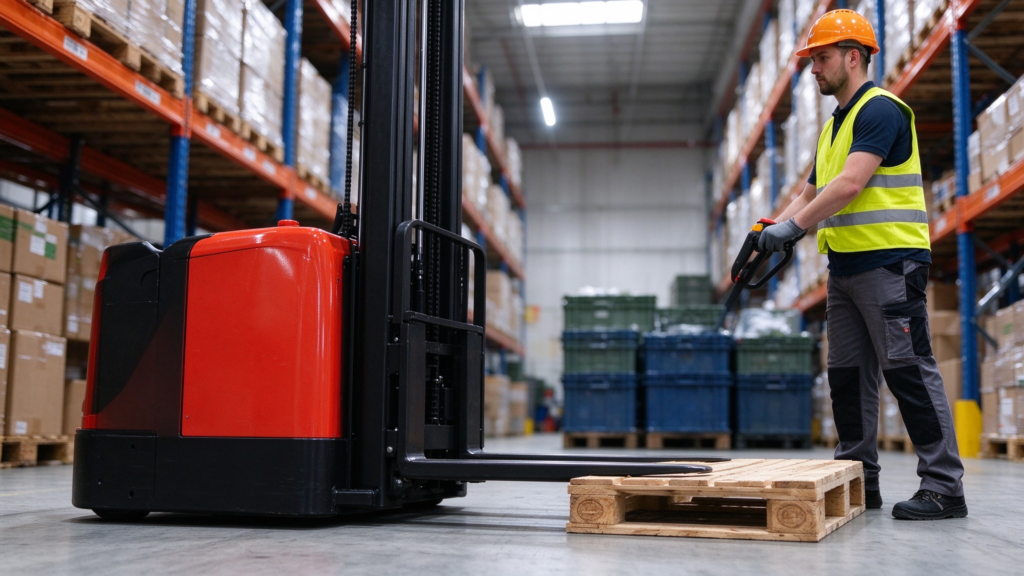
Align both forks with the pallet openings and insert them to the appropriate depth specified by the equipment and pallet-handling requirements.
Keep the forks positioned to support the load properly. Avoid entering at an angle or allowing the forks to contact pallet boards or nearby objects in a way that could damage the load or equipment.
If the forks do not fit correctly, stop and reposition the machine rather than forcing them into place.
Step 3: Verify Load Capacity and Stability
Before lifting, confirm that:
- The load is within the rated capacity for the intended load center and lifting height.
- The load is stable and evenly supported.
- The pallet is not broken or unsuitable for the load.
- The load is secured where necessary to prevent items from shifting or falling.
- No person is standing in the danger area.
The maximum capacity printed on a truck does not necessarily apply to every load configuration or lifting height. Consult the capacity information for the actual model.
Step 4: Lift the Load Under Control
Raise the forks only as much as necessary for the task, following the manufacturer’s procedure. Observe the pallet and load throughout the lift.
Stop if the load tilts, shifts, catches on an obstruction, or causes unusual machine movement. Lower the load to a safe position if possible and reassess the situation before continuing.
Never exceed the rated capacity or use the stacker to lift people.
6. Transport a Load Safely with an Electric Stacker
Once the pallet has been lifted, safe travel depends on load stability, visibility, speed, and the condition of the route.
Keep the Load Low During Travel
When transporting a load, keep it at the low travel height specified by the manufacturer. A raised load increases the risk of instability and can obstruct visibility.
Do not travel with a load elevated to rack height unless the machine’s operating instructions specifically permit the maneuver and the task is performed under the required controls.
Maintain a Controlled Speed
Travel at a speed that allows you to stop safely within the visible, unobstructed distance ahead. Reduce speed around corners, intersections, doorways, pedestrians, and other areas with limited visibility.
Avoid sudden acceleration, abrupt braking, and sharp turns. Maintain enough clearance from people, racks, walls, and other vehicles.
Maintain a Safe View of the Route
Make sure you can see the travel path and potential hazards. If a load blocks your forward view, follow the manufacturer’s specified travel method and the workplace’s traffic rules. This may require traveling in the direction that provides a clear view or using an approved spotter where appropriate.
Do not move blindly into intersections or pedestrian areas. Stop when necessary to restore a safe view before proceeding.
Use Extra Caution on Slopes
Slopes require special attention because they can affect traction, braking, and load stability. Follow the specific model’s instructions for permitted gradients, travel direction, and load orientation.
Never assume that a technique used with one type of powered industrial truck is suitable for another. If the route exceeds the machine’s limits, choose another handling method.
7. How to Stack Pallets Safely with an Electric Stacker
Stacking requires accurate alignment, controlled lifting, and confirmation that the storage position is suitable for the load.
Step 1: Align with the Storage Position
Approach the intended position slowly and align the stacker with the rack or designated storage area.
Confirm that the load is centered, the pallet is in good condition, and there is sufficient clearance for the intended placement. Keep pedestrians outside the stacking area.
Step 2: Raise the Load Carefully
Use the lifting controls to raise the pallet under control. Watch for overhead obstructions, nearby rack components, and changes in load stability.
Do not lift higher than required. If the load shifts or the pallet catches on a rack component, stop the movement and follow the manufacturer’s safe recovery procedure.
Step 3: Place the Pallet Securely
Position the pallet only in a designated storage location that can support the load. Lower it carefully onto the supporting surface and confirm that it is stable before withdrawing the forks.
Do not push a pallet into position with the mast, forks, or another part of the truck unless the manufacturer explicitly permits the action.
Step 4: Withdraw the Forks and Move Away
After confirming that the pallet is safely supported, lower the forks sufficiently to clear the pallet and surrounding structure. Withdraw the forks slowly without striking the rack or disturbing adjacent loads.
Before moving away, check that the forks are clear, the load remains stable, and the travel route is unobstructed.
8. Common Electric Stacker Operating Mistakes to Avoid
Exceeding Rated Capacity
Overloading can compromise stability, damage the equipment, and cause a load to fall. Always verify the applicable capacity limits and load-center requirements before lifting.
Driving Too Fast
Excessive speed reduces the time available to react to pedestrians, obstacles, and changing floor conditions. Travel at a controlled speed appropriate for the visibility, load, and work area.
Turning with a Raised Load
A high load can raise the center of gravity and increase instability during turns. Keep the load at the specified travel height and avoid turning with an elevated load unless explicitly permitted by the manufacturer’s instructions.
Skipping Inspections
Ignoring visible damage, battery warnings, or malfunctioning controls can turn a manageable equipment issue into a serious hazard. Complete the required inspection before each operating period and report defects promptly.
Using the Wrong Charger or Charging Procedure
An incompatible charger or incorrect charging method can damage the battery and create safety risks. Use only the approved charger and follow the battery manufacturer’s charging and fault-handling instructions.
Allowing Unauthorized Operation
An electric stacker should be operated only by people who meet the applicable training, authorization, and workplace requirements. Do not allow untrained coworkers to use the equipment, even for a short task.
9. Essential Safety Rules for First-Time Electric Stacker Operators
Keep the following rules in mind during every shift:
- Follow the rated capacity. Consider the applicable load center, lifting height, and load configuration.
- Keep people clear of moving equipment. Never allow anyone to stand under raised forks or a suspended load.
- Maintain visibility. Stop if you cannot establish a safe view of the route.
- Use suitable surfaces. Stay within the manufacturer’s limits for floor conditions, gradients, and operating environment.
- Keep body parts away from moving components. Never reach into the mast or lifting mechanism.
- Do not carry people. Use only equipment specifically designed and approved for personnel lifting, with the required safeguards and procedures.
- Stop when a fault occurs. Do not bypass safety devices or continue using equipment with a defect that could affect safe operation.
- Follow site traffic rules. Respect pedestrian routes, intersections, speed limits, and designated operating areas.
10. Personal Protective Equipment for Electric Stacker Operators
Personal protective equipment (PPE) should be selected according to the workplace risk assessment, applicable regulations, and site rules.
Depending on the working environment, appropriate PPE may include:
- Safety footwear: Helps protect against impact and crushing hazards.
- High-visibility clothing: Helps other workers identify the operator in shared traffic areas.
- Protective gloves: May be appropriate for handling pallets or conducting certain inspections, where they do not create an entanglement hazard.
Additional protection may be required for specific tasks or environments. PPE does not replace proper training, safe operating procedures, or functioning equipment safeguards.
11. First-Time Electric Stacker Operation Checklist
Use this checklist as a general preparation aid. The manufacturer’s checklist and workplace procedures take priority.
| Stage | Check or action | Acceptance criterion |
|---|---|---|
| Authorization | Confirm training and permission to operate | Requirements are met |
| Equipment | Inspect the truck and report visible defects | No unresolved safety-critical defects |
| Battery | Check charge level and warning indicators | Ready for the planned task |
| Forks and mast | Inspect accessible lifting components | No visible damage affecting safe use |
| Safety functions | Test required controls and protective devices | Functions operate as specified |
| Work area | Check floor, route, overhead clearance, and pedestrians | Route and work area are suitable |
| Load | Verify weight, pallet condition, and load stability | Load is compatible with the equipment |
| Capacity | Check rated capacity and applicable limits | Planned lift is within permitted limits |
| Travel | Practice controls and confirm visibility | Controlled movement is demonstrated |
| Stacking | Confirm storage location and clearance | Load can be placed safely |
| Shutdown | Lower forks and park according to instructions | Truck is left in a safe condition |
If any critical check fails, do not proceed until the problem has been resolved or an approved alternative has been established.
12. How to Park and Shut Down an Electric Stacker
At the end of the task or whenever the equipment must be left unattended, use the manufacturer’s parking and shutdown procedure.
Lower the Forks
Park on an appropriate surface and lower the forks fully to the specified safe position. Never leave a raised load unattended.
Stop and Secure the Equipment
Bring the stacker to a complete stop, apply the specified parking or braking procedure, and switch off the power as instructed. Remove the key or secure access where required by the workplace rules.
Choose a Safe Parking Location
Park in the designated area without blocking aisles, emergency exits, fire equipment, pedestrian routes, or access to other machinery.
If charging is required, use the designated charging area and the approved charging procedure for the specific battery type. Do not leave the equipment in an unsafe or unauthorized charging location.
13. How Proper Operation Helps Extend Electric Stacker Service Life
Correct operating practices help reduce avoidable wear and support reliable equipment performance.
Reduce Unnecessary Component Wear
Controlled acceleration, smooth braking, correct load handling, and avoidance of overloads can reduce unnecessary stress on the drive system, wheels, lifting components, and other parts.
Protect the Battery
Following the correct charging procedure, observing battery warnings, and avoiding unauthorized electrical repairs can help maintain battery condition. Battery life and operating time depend on the battery type, duty cycle, load, temperature, charging practices, and maintenance.
Reduce Unplanned Downtime
Pre-operation inspections and timely reporting of defects can help identify problems before they interrupt work or create safety risks.
Support Consistent Warehouse Productivity
Operators who understand the controls and follow a consistent handling process can reduce avoidable errors, improve load placement, and help maintain an orderly material-handling workflow.
14. Why Electric Stacker Operator Training Matters
Training should combine equipment knowledge, supervised practice, and workplace-specific hazard awareness.
Equipment Knowledge
Operators should learn the truck’s controls, rated capacity, operating limitations, warning indicators, and emergency procedures.
Practical Operating Skills
Training should include controlled travel, steering, braking, pallet pickup, load transport, stacking, and parking, using the actual equipment or an approved equivalent as specified by the training program.
Workplace Hazard Awareness
Operators should understand pedestrian routes, blind corners, floor conditions, overhead hazards, storage-rack limitations, and the procedures for reporting equipment faults.
Authorization and Refresher Training
Training and authorization requirements depend on the applicable jurisdiction and workplace. Operators should receive any required evaluation and refresher instruction, particularly when equipment, tasks, or workplace conditions change.
For specific legal requirements, consult the relevant local occupational safety authority and your organization’s safety procedures.
Frequently Asked Questions
1. What should I check before operating an electric stacker for the first time?
Confirm that you are trained and authorized to operate the equipment. Inspect the truck, battery, forks, mast, required safety functions, and work area. Verify the load weight and applicable capacity limits before lifting.
2. Do I need training before using an electric stacker?
Yes. Operators should receive the training, practical instruction, evaluation, and authorization required by applicable regulations and workplace procedures. Reading a general online guide is not a substitute for formal training.
3. How fast should a beginner operate an electric stacker?
Practice at a low, controlled speed in a designated training area. During normal work, travel at a speed that allows safe stopping and control under the actual conditions. Follow the manufacturer’s limits and workplace speed rules rather than relying on a universal speed recommendation.
4. Can an electric stacker lift any type of pallet?
No. The pallet dimensions, fork arrangement, load weight, load distribution, and pallet condition must be compatible with the equipment. Check the manufacturer’s specifications and inspect the pallet before lifting.
5. What is the biggest safety mistake when using an electric stacker?
There is no single mistake responsible for every incident. Overloading, operating without proper training, ignoring equipment defects, moving with inadequate visibility, and handling unstable loads are all serious hazards.
6. Can I travel with the forks raised?
Travel only at the height and under the conditions permitted by the manufacturer’s instructions. For normal load transport, keep the load at the specified low travel height. Do not travel with a load elevated to stacking height unless the equipment’s operating instructions explicitly permit the maneuver.
7. What should I do if the electric stacker makes an unusual noise or displays a fault?
Stop in a safe location, secure the equipment, and follow the manufacturer’s fault-handling procedure. Report the issue to the responsible supervisor or qualified maintenance personnel. Do not bypass a safety device or attempt an unauthorized repair.
8. How do I choose the right electric stacker for my warehouse?
Consider the maximum load weight, required lifting height, pallet dimensions, aisle width, floor conditions, duty cycle, battery and charging requirements, and operator working method. Verify the capacity at the intended lifting height and load center, then compare suitable models using their technical specifications.
Conclusion
Safe electric stacker operation starts with proper training, a thorough pre-operation inspection, and a clear understanding of the equipment’s operating limits. First-time operators should practice the controls in a suitable area before handling loads, verify pallet and load stability, maintain a clear view of the travel route, and follow the correct stacking and shutdown procedures.
For warehouse managers and equipment buyers, selecting a stacker that matches the required load capacity, lifting height, aisle layout, and operating conditions is equally important.
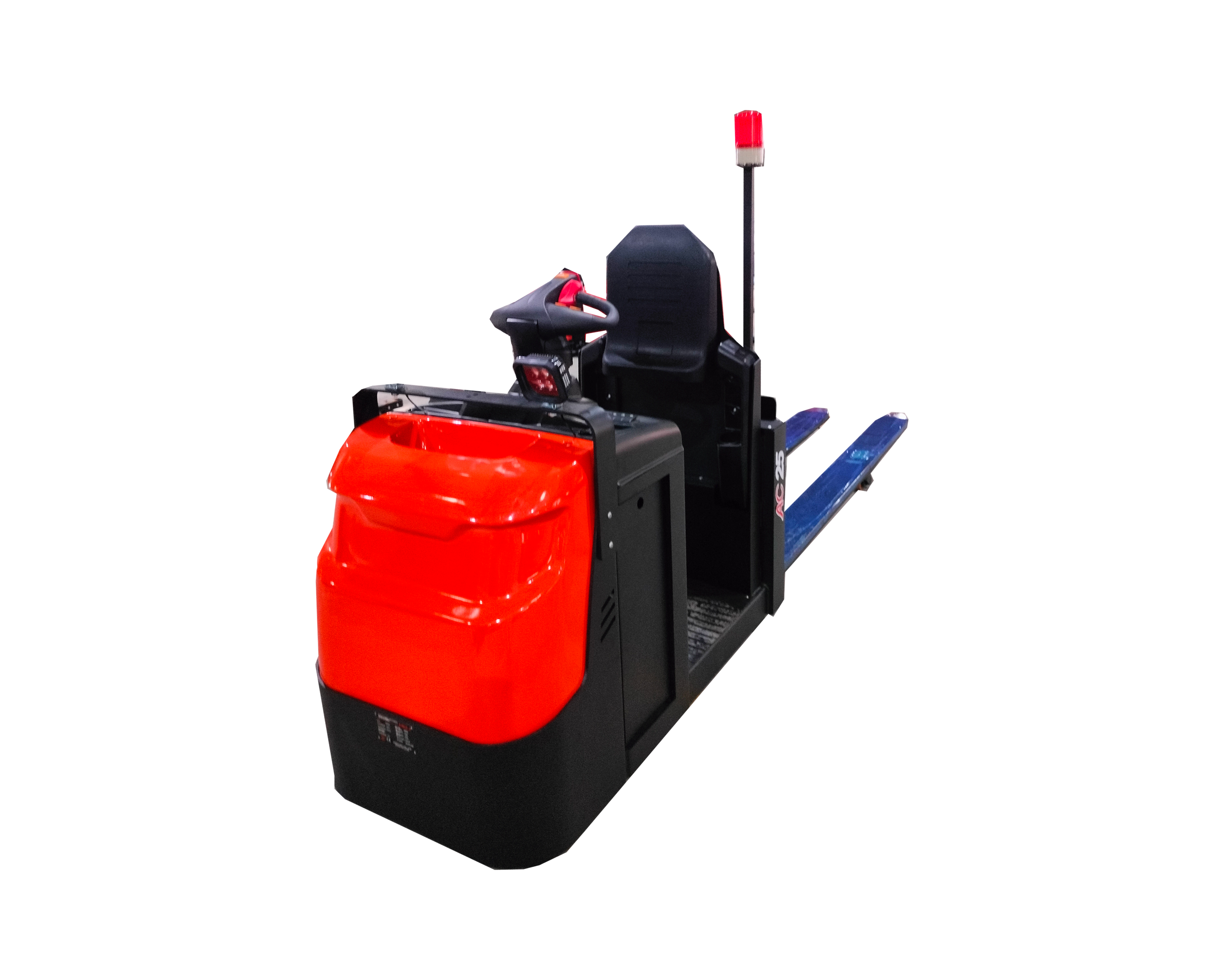
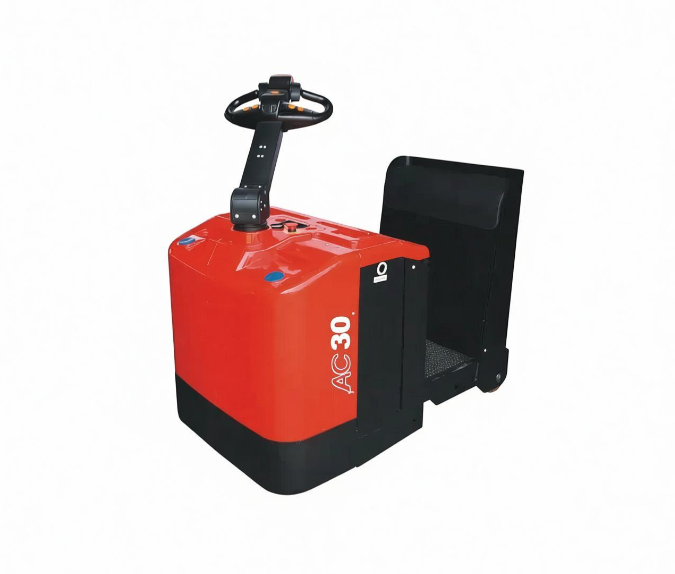
LI-UNILIFT provides electric pallet trucks, electric stackers, and other material-handling equipment for warehouse and industrial applications. If you are comparing equipment for your operation, review the specifications for the intended application and contact LI-UNILIFT to discuss suitable configurations and product information.
Follow UNILIFT MHE for More Material Handling Insights
Stay connected with UNILIFT MHE for the latest updates on electric pallet trucks, electric stackers, electric tuggers, warehouse equipment, material handling solutions, and industry insights. Follow our social media channels to discover new products, application scenarios, company updates, and practical information for modern warehouse and logistics operations.
Explore reliable electric pallet trucks, electric stackers, and material handling solutions at Unilift MHE.
If you would like to contact us, please click here.
If you would like to learn more about our news, please click here.
Facebook: Follow UNILIFT MHE on Facebook
TikTok: Follow UNILIFT MHE on TikTok
Instagram: Follow UNILIFT MHE on Instagram
X: Follow UNILIFT MHE on X
Pinterest: Explore UNILIFT MHE on Pinterest
LinkedIn: Connect with UNILIFT MHE on LinkedIn