Introduction
Modern warehouses require equipment that can handle high-density storage, narrow aisles, and increasing inventory demands. Traditional forklifts may not always provide the flexibility needed for advanced warehouse layouts.
A reach truck forklift is designed specifically to solve these challenges. With its unique reaching mechanism, compact structure, and high lifting capability, it has become an essential piece of equipment for many warehouses.But how does a reach truck forklift work, and what makes it different from other forklifts?This article explains the electric reach truck forklift working principle, key features, and advantages that make it a preferred solution for modern material handling.
The Advantages of Using Electric Reach Truck Forklift
These below advantages make reach trucks ideal for high-density warehouse operations and narrow aisle applications.
Narrow Aisle Capability: Can operate in very tight spaces, maximizing warehouse storage density
High Lift Heights: Can reach elevated storage levels efficiently
Improved Maneuverability: Excellent for navigating congested warehouse environments
Increased Storage Efficiency Capacity: Allows for more efficient use of vertical space
Operator Comfort: Designed for comfortable standing operation during long shifts
Electric Power: Quieter operation and zero emissions compared to internal combustion models
Precise Handling: Excellent for delicate or precise load placement
Cost-Effective: Lower maintenance costs compared to other forklift types
How Does a Reach Truck Forklift Work?Understanding the Reach Mechanism
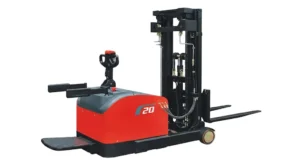
The most important feature of a reach truck is its reach mechanism, which allows the mast and forks to move forward when accessing pallets. This unique system enables operators to store goods deeper inside racks while maintaining forklift stability, forming the core working principle of reach truck forklifts.
The basic operation process involves the operator positioning the forklift in front of the rack, extending the mast forward so the forks can enter the pallet opening, lifting and moving the load backward, and then retracting the mast for transportation. This mechanism is what makes reach trucks particularly effective for narrow aisle operations and high-density storage applications.
How the Mast and Fork System Operates
Here are the specific components.
Mast System
The mast provides vertical lifting capability and allows pallets to be stored at high levels.
Fork Carriage
The fork carriage moves loads accurately into storage positions.
Reach Mechanism
The forward movement allows access to deep rack locations.
Here are the specific working steps.
The mast and fork system is the core mechanism of a reach truck, enabling it to access pallets in deep storage racks. Here’s how it operates:
The system allows the mast and forks to extend forward when accessing pallets. During operation, the operator positions the forklift in front of the rack, then the mast extends forward so the forks can enter the pallet opening. The load is then lifted and moved backward, after which the mast retracts for transportation.
This unique reach mechanism is what makes reach trucks particularly effective for narrow aisle operations and high-density storage applications, as it allows operators to store goods deeper inside racks while maintaining forklift stability throughout the process.
Related reading: Electric Reach Truck Components and Function Overview: A Complete Beginner’s Guide
How Electric Systems Power Modern Reach Trucks
This electric system provides quiet, emission-free operation while offering precise control and lower maintenance requirements compared to internal combustion engine models.Here are the specific working steps.
Battery Power Source: Reach trucks use rechargeable batteries (typically lead-acid or lithium-ion) as their primary power source. These batteries store chemical energy that converts to electrical energy when needed.
Motor Control System: The electrical energy from batteries powers electric motors, which drive the wheels for movement and operate the hydraulic pump for lifting functions. Modern systems use AC motors for efficiency and precise control.
Energy Conversion: The batteries supply direct current (DC) power, which is converted to alternating current (AC) by inverters to drive the traction and hydraulic motors efficiently.
Control Electronics: Sophisticated controllers manage power distribution, speed control, and safety features. They optimize energy usage based on the truck’s load and operational demands.
Regenerative Braking: When decelerating, the motors act as generators, converting kinetic energy back into electrical energy to recharge the batteries, improving overall efficiency.
Hydraulic System Work
Pressurization: The electric motor drives a hydraulic pump, which pressurizes the hydraulic oil.
Control: When the operator moves a control lever, control valves direct the pressurized oil to specific cylinders.
Action: The oil pushes pistons inside the cylinders, converting fluid pressure into mechanical force to lift the mast, tilt the forks, or extend the reach mechanism.
Return: After completing the action, the oil flows back to the reservoir for reuse.
Electric Reach Truck Steering System Operate
Operator Input: The operator turns the steering wheel (or moves the tiller arm), initiating the steering command.
Signal Detection: Sensors detect the steering angle and the speed of the operator’s input, sending this data to the Electronic Control Unit (ECU).
Electronic Processing: The ECU calculates the optimal steering angle and speed required, adjusting the response based on the truck’s driving speed (speed-sensitive steering).
Actuation: The ECU sends a command to an electric steering motor (or electro-hydraulic actuator) located on the rear axle. This motor turns the rear wheels.
Rear-Wheel Steering: Reach trucks almost exclusively use rear-wheel steering. This allows the rear of the truck to pivot sharply, enabling the forklift to turn in very tight circles and maneuver within extremely narrow aisle widths.
Feedback Loop: Position sensors on the axle continuously send real-time feedback to the ECU, ensuring the wheels are precisely aligned with the operator’s input.
Braking System Works
Regenerative Braking (Initial Deceleration): When the operator releases the accelerator pedal or lightly applies the brake, the electric motor switches into a generator. It creates resistance that slows the truck down while converting the kinetic energy back into electrical energy to recharge the battery.
Friction Braking (Full Stop): When the operator presses the brake pedal firmly, the traditional mechanical brakes engage. hydraulic or electromagnetic force pushes brake pads against the brake discs or drums, creating the physical friction needed to bring the truck to a complete stop.
Parking Brake (Stationary Holding): When the operator parks the truck, leaves the seat, or turns off the power, an automatic electromagnetic or spring-applied parking brake engages. This mechanically locks the wheels to prevent the reach truck from rolling, even on inclines.
Additionally, the operation of an electric reach truck also depends on the following systems:
Battery management system
Monitors and optimizes battery performance
It is the “heart” and lifeline of the electric reach truck, playing the most critical role in its operation; therefore, the battery and its management system require the most continuous and frequent maintenance.
Control system
Manages operator inputs and machine functions
Safety system
Includes sensors, alarms, and protective features
Transmission system
Transfers power to wheels for movement
Suspension system
Maintains stability during operation
After understanding the working principles of the electric reach truck, safety becomes the most crucial aspect. I think you need to read this article: Electric Reach Truck Safety Guide for New Operators.
Applications of Electric Reach Truck Forklifts
Reach truck forklifts are widely used in below applications:
Distribution Centers
Used for storing and retrieving large quantities of palletized goods.
E-Commerce Warehouses
Support fast inventory movement and order fulfillment.
Manufacturing Facilities
Handle raw materials and finished products.
Cold Storage Facilities
Provide efficient indoor pallet handling.
Conclusion
Counterbalance forklifts rely on a “heavy counterweight at the rear” to balance the overhanging load at the front, whereas reach forklift maintain stability by “retracting the load back over the chassis” and using base outriggers, making them more compact and suitable for narrow aisle operations.As for which type of forklift is more suitable for your warehouse, you need to read this article.
Understanding how does a reach truck forklift work helps businesses recognize why this equipment is different from traditional forklifts.With its unique reach mechanism, compact design, high lifting capability, and efficient electric systems, a reach truck forklift provides an ideal solution for high-density warehouse operations.
For companies looking to improve storage capacity, optimize warehouse layouts, and increase productivity, investing in the right warehouse reach truck forklift can create significant long-term operational benefits.
UniF Logistics Equipment Manufacturer has decades of experience in overseas trade in the production and sales of logistics equipment, with a large number of customers, especially in industrial vehicles, electric pallet trucks, electric stackers, electric order pickers, electric towing vehicles, reach trucks, heavy-duty and light-duty forklifts.