What is a Forklift?
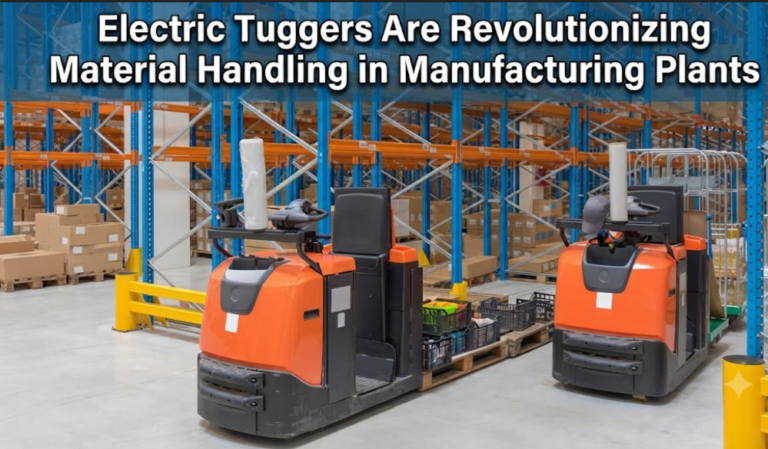
Forklifts are ubiquitous in our daily lives and have become indispensable key equipment in modern logistics and industrial production. They not only possess excellent mobility to efficiently handle heavy loads but also significantly reduce the physical burden of manual handling while greatly improving cargo turnover efficiency.
Definition
A forklift is a wheeled handling vehicle designed for factories, warehouses, and similar facilities, used for loading, unloading, stacking, and short-distance transportation of palletized goods. It uses a pair of adjustable forks at the front to move cargo, effectively reducing the physical labor of搬运 workers, improving handling efficiency, and lowering operational costs.
Read this article to know more information about electric reach truck.
Main Functions
Loading and Unloading: Handling goods from trucks, train carriages, and other transport vehicles
Stacking: Placing goods vertically on shelves to maximize warehouse space utilization
Transportation: Performing short-distance horizontal cargo movement within warehouses or factories
Type Classification
Internal Combustion Forklifts: Powered by fuel engines, with large load capacity, suitable for outdoor environments or places with low emission and noise requirements
Electric reach truck Forklifts: Powered by batteries, running smoothly and environmentally friendly, commonly used for indoor operations
Warehouse-Specific Forklifts: Including various forklifts designed for warehouse operations, such as stackers and pallet trucks (manual or electric)
Electric Reach Truck Structure Overview
A forklift consists of many moving parts and components. The efficient operation of a forklift depends on the coordinated work of each component. Each component performs a specific function and works closely together, and their performance and condition directly affect the operational safety and efficiency of the forklift. The following will provide a detailed introduction to the various main components of the forklift to serve as a reference for practical operation.
- Chassis
- Mast assembly
- Fork system
- Hydraulic system
- Drive unit
- Battery system
- Steering system
- Operator controls
- Safety devices
Chassis and Frame
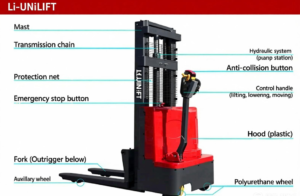
The chassis and frame form the foundation of the reach truck, supporting the mast assembly, battery pack, drive motor, hydraulic system, and operator compartment. Built with a durable load-bearing structure and optimized weight distribution, the chassis provides stability during lifting and enables compact, efficient operation in narrow warehouse aisles.
Reach Truck Mast and Fork System
The Reach Truck Mast and Fork System is responsible for lifting and positioning loads.
Mast Assembly
The mast assembly is responsible for lifting and lowering loads to the required storage height. It consists of inner and outer mast rails, lift chains, rollers, and hydraulic lift cylinders, working together to provide smooth and stable vertical movement. Depending on the model, the mast can support lifting heights from approximately 3 meters to over 12 meters for high-rack warehouse applications.
Forks
The forks are the primary load-handling components of a reach truck, designed to support and lift pallets while enabling operators to accurately place and retrieve loads from storage racks. As essential Reach Truck Parts and Functions, the forks directly affect load stability, handling efficiency, and safe warehouse operations.
Reach Mechanism
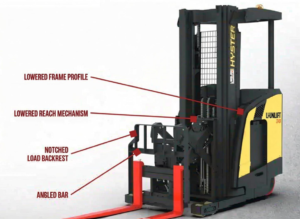
The reach mechanism is a key feature that distinguishes a reach truck from a conventional forklift, allowing the mast or forks to extend forward for precise pallet placement and retract after loading. This system improves load stability, supports efficient narrow-aisle operation, increases storage density, and enables more accurate positioning of goods in high-rack warehouses.
Reach Truck Hydraulic System
The reach truck hydraulic system converts hydraulic pressure into the lifting, tilting, and reaching movements required for efficient load handling. It typically consists of a hydraulic pump, cylinders, hoses, oil reservoir, and control valves, working together to provide smooth fork lifting, mast tilting, reach extension, and side shifting when equipped.
Reach Truck Battery and Motor System
The Reach Truck Battery and Motor System supplies power for all vehicle functions.
Battery
Modern reach trucks typically use:
Lead-Acid Batteries
Advantages:
- Lower initial cost
- Established technology
Lithium-Ion Batteries
Advantages:
- Fast charging
- Opportunity charging
- Maintenance-free operation
- Longer service life
Electric Motors
Most modern trucks utilize AC motors for:
- Drive functions
- Hydraulic functions
- Steering assistance
The battery and motor assembly is one of the most important Reach Truck Electrical Components.
Electric Reach Truck Control System
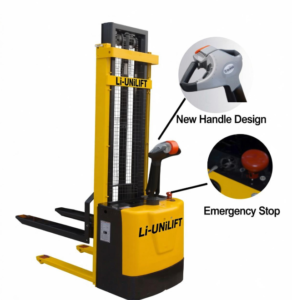
The Electric Reach Truck Control System allows operators to control vehicle functions precisely.Components Include:
- Travel direction selector
- Lift controls
- Reach controls
- Steering wheel
- Emergency stop button
- Display screen
Reach Truck Drive Unit Components
Steering System Components System
The steering system enables precise and responsive control for efficient reach truck operation in narrow aisles. It typically consists of a steering wheel, steering motor, sensors, and electronic controllers, which work together to provide smooth maneuvering, accurate pallet positioning, and reduced operator fatigue.
Reach Truck Safety Components System
The reach truck safety system includes essential features such as overload protection, emergency stop buttons, operator presence sensors, and speed control systems. These components help prevent accidents, ensure stable load handling, and protect both operators and equipment during warehouse operations.
Forklift Power Transmission System
The forklift power system is the core component ensuring the equipment’s driving, lifting, and braking functions, mainly consisting of two types of power components: internal combustion engines and electric motors.
Internal Combustion Forklifts: Use propane, gasoline, or diesel as fuel, generating power through the engine, with the transmission regulating power transmission to support the forklift’s driving and lifting operations.
Electric Forklifts: Work synergistically with motors and batteries, where batteries provide electrical energy converted by motors into mechanical energy to drive the system, operating quietly and environmentally friendly, suitable for indoor operations.
Hydraulic Drive and Braking System
The hydraulic drive system provides power for forklift lifting and tilting actions through components like hydraulic pumps and cylinders for smooth fork operation. The braking system, consisting of brake pedals and discs, controls deceleration and stopping, serving as a key safety element that works in synergy with the power system.
What Precautions Should Be Taken During Daily Forklift Operations?
Safety is paramount in daily forklift operations. Strict adherence to operating procedures must be maintained, and a vehicle inspection must be conducted before driving. While driving, maintain stable vehicle movement, strictly follow speed limits, reduce speed when turning, and pay attention to pedestrians and other obstacles. During loading and unloading, ensure balanced loads, do not exceed weight limits, and keep the cargo stable and secure. After parking, lower the forks to ground level and firmly engage the parking brake.
Pre-Operation Inspection
Check vehicle performance: Before starting, inspect brakes, lights, horns, and other components to ensure they are in good condition. If brake malfunctions are found, report for repair immediately; unauthorized disassembly and repair are strictly prohibited.
Inspect tires and forks: Ensure proper tire pressure and clear any debris. Check that the forks, fork carriage, and chains are securely fastened.
Maintain good condition: Refuel, add lubricants and coolant, and check all pipelines for leaks.
Precautions While Driving
Drive smoothly: Start, steer, and brake gently; avoid sudden acceleration or deceleration.
Follow speed limits: Strictly adhere to speed regulations within factory areas and reduce speed on slippery surfaces.
Pay attention to turns: Significantly reduce speed when turning, turn slowly, and be aware of the forklift’s turning characteristics.
Maintain fork height: Keep forks 300-400 mm above ground level while driving.
Observe surroundings: Constantly watch for pedestrians and obstacles, maintaining a safe distance.
Reverse when necessary: When carrying heavy loads that obstruct forward visibility, drive in reverse.
Operations on slopes: Drive forward when ascending, drive backward when descending; place cargo facing uphill.
Precautions During Loading and Unloading
Balance loads: Ensure balanced loads; never overload or have unevenly distributed loads.
Ensure cargo safety: Do not handle unpackaged or loosely stacked cargo; ensure cargo stability and reliability.
Watch nearby personnel: No one should stand or remain within a 1-meter radius of the forklift when forks are being raised or lowered.
Avoid single-fork use: Never use a single fork or use momentum to load/unload cargo.
Proper forklift use: Do not slide cargo using brake momentum.
Post-Operation Precautions
Lower forks: After the forklift is securely parked, lower forks to ground level.
Engage parking brake: Firmly engage the parking brake.
Turn off engine and remove key: Turn off the engine and remove the key to prevent unauthorized operation.
Park in designated areas: Do not park near emergency exits, entrances, fire equipment, or in areas that obstruct traffic.
Other Safety Regulations
No unauthorized passengers: Prohibit carrying unauthorized personnel, including allowing people to stand on the forklift or pallets.
No alcohol while operating: Strictly prohibit operating the forklift under the influence of alcohol.
Stay focused: Do not be distracted, play around, or eat/drink while working.
No unauthorized repairs: If mechanical faults are discovered, immediately shut down the forklift and notify maintenance personnel. Unauthorized repairs by unqualified personnel are strictly prohibited.
Related Read:What Is a Reach Truck Forklift and Why Is It Essential for Modern Warehouses?
Conclusion
Understanding the Electric Reach Truck Components and Function Overview is essential for anyone involved in warehouse operations. From the Reach Truck Mast and Fork System and Reach Truck Hydraulic System to the Electric Reach Truck Control System and Reach Truck Safety Components, every component plays a critical role in productivity and safety.
Whether you are a first-time buyer, warehouse manager, or forklift operator, learning the fundamentals of Electric Reach Truck Components will help you operate equipment more efficiently, reduce maintenance costs, and maximize warehouse performance.
FAQ
Q1.What are the main components of an electric reach truck?
The primary components include the chassis, mast, forks, hydraulic system, battery, drive unit, steering system, control system, and safety devices.
Q2.What makes a reach truck different from a forklift?
A reach truck uses a reach mechanism that allows the mast or forks to extend forward into storage racks and retract the load for improved stability.
Q3.How does the hydraulic system work in a reach truck?
The hydraulic system uses pressurized hydraulic fluid to power lifting, lowering, and reaching functions.
Q4.What battery types are used in electric reach trucks?
Most electric reach trucks use either lead-acid batteries or lithium-ion batteries.
Q5.Which component requires the most frequent inspection?
Forks, hydraulic hoses, batteries, wheels, brakes, and safety systems should be inspected daily to ensure safe operation.
Q6.What six components must be inspected on a forklift?
The six key components that must be inspected on a forklift include: the braking system, steering system, forks and lifting chains, tires, hydraulic system, and safety devices (such as lights, horns, and seat belts). These six main components form the foundation for ensuring the safe and efficient operation of the forklift.