Electric Counterbalance Forklift Definition
Electric counterbalance forklift trucks are widely used in warehouses, manufacturing plants, distribution centers, and logistics facilities because of their high efficiency, low noise, and environmentally friendly operation.However, improper operation may lead to workplace accidents, equipment damage, and unnecessary downtime.
Following a professional Electric Counterbalance Forklift Safety Guide helps operators understand correct operating procedures, improve workplace safety, and maximize forklift performance.
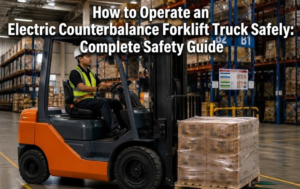
This complete guide explains how to operate an Electric Counterbalance Forklift Truck safely, from pre-operation inspections to daily driving practices.
7 Steps of Operating an Electric Counterbalance Forklift Truck
1.Certifications and legal requirements
Operator Requirements
Valid Certificate: Operators must hold a valid forklift operator certificate or license. Driving without a certificate is illegal, and violators may be fined up to $15,000 or more.
Must not operate forklifts under the influence of alcohol, drugs, or fatigue: It is strictly prohibited to operate forklifts while under the influence of alcohol, drugs, or in a fatigued state.
Age Requirement: Most jurisdictions require operators to be at least 18 years old.
Regular Recertification: Certifications typically need to be renewed every three years, and additional training is required when new equipment is introduced.
Training Programs
Modern training combines classroom teaching with practical operation. Effective training programs include:
Classroom theory covers safety principles, load dynamics, and relevant regulations.
Simulator – based training allows practice in handling various challenging scenarios in a risk – free environment.
On – site operations under the supervision of experienced trainers.
A written test and practical assessment are required before certification.
2.Pre-Operation Inspection Before Using an Electric Counterbalance Forklift
Before starting work, operators should follow standard Electric Counterbalance Forklift Operating Procedures.
Check Battery Condition
To ensure optimal performance of an electric forklift, regularly checking the battery condition is essential. This involves inspecting the battery charging level, battery connections, charging system, and warning indicators. A properly maintained battery guarantees stable power output and extends the operating time of the forklift.
Inspect Forks and Mast System
Regular inspection of the forks and mast system is crucial for safe forklift operation. During inspection, check for fork cracks or deformation, hydraulic leaks, mast lifting performance, and chain condition. It is essential to never operate a forklift with damaged lifting components, as this ensures operational safety and prevents potential hazards.
Check Safety Components
Checking the safety components is a crucial step to ensure the safe operation of an electric forklift. It is necessary to confirm that the emergency stop button works properly, the horn functions correctly, the warning lights operate as intended, and the braking system responds appropriately.
Inspect Tires and Wheels
Regular inspection of tires and wheels is essential for maintaining the safety and performance of a forklift. During the inspection, check for tire wear, tire damage, and the condition of the wheels.
Hydraulic
Check for hydraulic oil leaks around the cylinders and hoses.
Test the lifting, lowering, and tilting functions to ensure smooth operation throughout the entire range.
Work Area
Ensure the work area is free of obstacles, debris, and standing water.
Confirm that the aisle width is sufficient for safe passage.
Check the lighting conditions—extra caution is needed in dimly lit areas.
UNILIFT – mhe Professional Tip: If any damage or malfunction is found during the inspection, immediately mark the forklift as “Out of Service” and report to your supervisor. Do not attempt to operate unsafe equipment.
3.Understanding the control system of a counterbalance forklift
Ignition Key/Start Switch.
The main power switch. Insert the key and turn it clockwise to activate the electrical system and control devices. Turn it back to the “OFF” position to turn off the power.
Pedals.
This is the direct control element for accelerating the forklift, operated by the right foot. Gently press to accelerate—always maintain a smooth and gradual force. Release to decelerate. “Light press and slow release” is the golden rule.
Brake Pedal.
This is the main control element for decelerating the forklift, operated by the right foot. When parking normally, apply pressure gradually. For emergency stops, press the pedal fully, but be aware that sudden braking may cause the load to become unstable.
Steering Wheel.
When making sharp turns, hold the steering wheel knob with the left hand. When driving normally, hold the steering wheel with both hands. Do not turn the steering wheel when the vehicle is stationary to avoid damaging internal components.
Direction Control.
Three – way switch: Forward (F), Neutral (N), and Reverse ®. To protect the drive system, be sure to come to a complete stop before changing direction.
Hydraulic Levers.
Control lifting (main lever) and mast tilting (auxiliary lever). Operate smoothly—sudden movements can cause the load to become unstable.
Parking Brake.
This function should be activated when the forklift is parked or unattended. It is usually achieved through a manual lever or pedal.
Emergency Stop.
A prominent red button that can immediately cut off all power. Be sure to know its location before starting.
4.Please follow the steps in the table below
| Step | Action | Key Details |
|---|---|---|
| 1 | Properly Mount the Forklift | Use the three-point contact method (two hands and one foot or two feet and one hand). Avoid jumping onto the forklift. |
| 2 | Adjust the Seat and Safety Belt | Adjust the seat position to ensure the operator can comfortably reach all controls. Fasten the seat belt securely. |
| 3 | Insert and Turn the Key Switch | Turn the key switch to the “ON” position. Check the instrument panel for warning lights or alarms. |
| 4 | Check the System | Inspect for fault codes and test the horn and other control functions. |
| 5 | Select the Driving Direction | Before starting, make sure the selected driving direction is clear and the path is free of obstacles. |
| 6 | Start Moving | Release the parking brake, select the travel direction, and slowly press the accelerator pedal to move forward. |
5.Basic stance techniques
Load Travel (Driving with Load)
Maintain a safe fork height: During travel, keep the forks 15–20 cm (6–8 inches) above the ground.
Tilt the mast backward: Tilt the mast backward to keep the load stable and prevent it from falling.
Control the travel speed: The recommended driving speed is 10–15 km/h. Reduce the speed to below 5 km/h when turning or driving on uneven surfaces.
Avoid sudden movements: Do not make sudden acceleration, braking, or sharp turns.
Maintain load stability: Before moving, ensure that the load is evenly distributed and securely positioned on the forks.
No-Load Travel (Driving Without Load)
Lower the forks: To improve visibility and safety, keep the forks lowered to approximately 15–20 cm above the ground.
Keep the mast tilted backward: When driving without a load, slightly tilt the mast backward to maintain better vehicle balance.
Pay attention to the environment: Even when the forklift is unloaded, improper operation or poor visibility may still cause serious accidents.
Visibility and Driving Rules
Always drive in the travel direction with the best visibility.
If the load blocks the front view, drive in reverse and keep the travel path clear.
Use the horn at intersections, blind spots, or areas with limited visibility.
Maintain a safe distance from pedestrians and other vehicles (at least 3 meters).
6.Slope and Ramp Operations
| Situation | Driving Direction Rules |
|---|---|
| Driving uphill with load | Drive forward (load facing uphill direction). |
| Driving downhill with load | Drive in reverse (load facing uphill direction). |
| Driving uphill without load | Drive in reverse. |
| Driving downhill without load | Drive forward. |
7.Stop and shut down
Always park the forklift in a safe area, lower the forks completely, keep the mast vertical, engage the parking brake, place the direction control in neutral, and turn off the power. For electric forklifts, connect the charger when required and ensure the vehicle is safely parked before leaving.
Common Electric Counterbalance Forklift Safety Mistakes or Emergency
The following are common situations encountered when operating an electric counterbalance forklift that you must be aware of.
Forklift tip-over
You need to stay calm, stay in your seat and fasten your seatbelt, hold the steering wheel, lean your body away from the point of impact, and brake hard until the vehicle stops.
Lithium-ion battery fire
In this situation, immediately evacuate the danger area, use a Class D fire extinguisher to put out the fire, never use water, and call emergency services.
Lead-acid battery acid leak
In this case, the driver should evacuate the area, use neutralizers or absorbent materials to handle it, ensure ventilation, and immediately report to the supervisor.
Overloading the Forklift
Overloading is one of the most dangerous operating mistakes.
Driving Too Fast
Excessive speed increases accident risks, especially in warehouses with narrow aisles.
Ignoring Daily Inspections
Skipping inspections may allow small problems to become major failures.
Carrying Passengers
Electric forklifts are designed for one operator only.
Electric Counterbalance Forklift Manufacturer
UNILIFT-MHE Logistics Equipment Company is a Chinese manufacturer committed to the intelligent and convenient development of logistics equipment. Our company has launched the Li-UNiLIFT industrial vehicle brand, which boasts environmental advantages while also considering charging efficiency, economy, and ease of maintenance. This brand mainly includes the following forklift types: electric pallet trucks, electric stackers, reach trucks, electric order pickers, electric towing vehicles, and other warehouse material handling equipment for global logistics and industrial applications.
If you need industrial vehicles such as forklifts for logistics equipment, please visit our website: www.unilift-mhe.com. Alternatively, if you have any questions about using industrial vehicles, you can contact us directly. This is our news page, where you can get some initial information.
FAQ
Q1.How to Drive a Counterbalance Forklift?
To drive a counterbalance forklift, a certified operator conducts a pre-use inspection and then uses the steering wheel and hydraulic controls to maneuver and lift loads while strictly observing stability and safety protocols.
Q2.Do I need a driver’s license to operate an electric forklift?
Yes. Electric forklifts are powered industrial vehicles, and operators must complete training and obtain a license to drive. Driving without a license is illegal and may result in severe penalties.
Q3.What are the differences between driving an electric forklift and a diesel forklift?
Electric forklifts accelerate more smoothly, run quieter, and have zero emissions. They require special considerations for battery charging and thermal management. However, both types of forklifts are similar in operational control and safety perception.
Q4.How fast can an electric forklift go?
Most electric forklifts have a speed limit of 10–15 km/h in open areas, and lower speeds (5 km/h or less) in pedestrian zones.
Q5.When traveling, how high should I carry the load?
When carrying loads, keep them as low as possible—usually 15–20 cm off the ground—to ensure stability and ensure the load does not obstruct visibility.
Q6.Can I drive an electric forklift outdoors?
Yes, most electric forklifts with suitable tires can be driven on paved surfaces. They are not designed for rough terrain, muddy roads, or steep slopes. Ensure the battery has sufficient power for outdoor use.
Q7.What should I do if the forklift starts to tip over?
If the forklift starts to tip, immediately lower the load, apply the brakes, and seek help.