Choosing the right material handling equipment is one of the most important decisions for improving warehouse efficiency. As businesses handle increasing inventory volumes and faster delivery requirements, selecting equipment that matches operational needs has become essential.
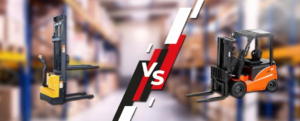
Many companies face the same question: Should you choose an Electric Stacker or a Forklift for your warehouse operations?Both machines are designed to move and lift materials, but they serve different purposes. Understanding the differences between an Electric Stacker vs Forklift can help businesses choose the best solution based on warehouse size, storage requirements, workload, and budget.
This guide compares electric stackers and forklifts to help you determine which option is the right fit for your warehouse.
Why Choosing the Right Warehouse Handling Equipment Matters
Modern warehouses require efficient, safe, and cost-effective solutions for moving goods.
Selecting the wrong equipment may result in:
Higher operating costs
Reduced productivity
Limited warehouse flexibility
Increased maintenance expenses
A proper Warehouse Equipment Selection Guide helps businesses identify the Best Material Handling Equipment for Warehouse operations.Factors such as warehouse layout, load requirements, working environment, and operating frequency should all be considered before investing in lifting equipment.
What Is an Electric Stacker?
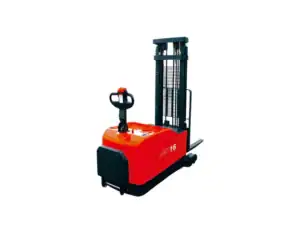
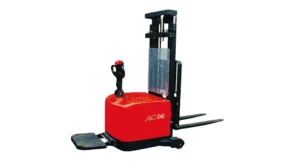
An Electric Stacker is a battery-powered material handling machine designed to lift, transport, and stack palletized goods.Unlike manual equipment, an electric stacker uses an electric motor and hydraulic lifting system to reduce operator effort and improve efficiency.
Common types include:
Fully Electric Stacker
Semi Electric Stacker
Walk Behind Electric Stacker
Electric Pallet Stacker
An Electric Stacker for Warehouse Operations is especially suitable for indoor environments where space efficiency and maneuverability are important.
What Is a Forklift?
A Warehouse Forklift is a heavy-duty lifting machine designed for transporting and stacking large loads.
Forklifts are widely used in:
Large warehouses
Manufacturing plants
Distribution centers
Outdoor industrial environments
Different types include:
Electric Forklift
Counterbalance Forklift
Industrial Forklift
Heavy Duty Forklift
Forklifts are known for their high load capacity and ability to handle demanding material handling tasks.
Electric Stacker vs Forklift: Key Differences
Load Capacity Comparison
One of the key differences between an Electric Stacker and a Forklift is load capacity. While forklifts are designed for heavier loads and demanding industrial applications, an Electric Stacker offers sufficient lifting capacity for most warehouse pallet handling tasks. For businesses dealing with moderate loads, electric stackers provide a cost-effective solution that balances performance, efficiency, and operating costs.
Warehouse Space and Maneuverability
When it comes to warehouse space utilization, an Electric Stacker for Narrow Aisles offers significant advantages due to its compact design and excellent maneuverability. It can operate efficiently in tight spaces, making it ideal for warehouses with limited aisle width, while forklifts generally require more room to move and turn. For businesses focused on warehouse space optimization, electric stackers provide a flexible and efficient material handling solution.
Operating Cost Comparison
When comparing Forklift vs Electric Stacker Cost, electric stackers generally offer a more economical solution thanks to their lower purchase price, reduced energy consumption, and simpler maintenance requirements. While forklifts are better suited for heavy-duty operations, electric stackers can meet the needs of most small and medium-sized warehouses while helping businesses reduce overall ownership and operating costs.
Maintenance and Energy Efficiency
As energy efficiency becomes a greater priority in modern warehouses, a Battery Powered Stacker offers a practical and environmentally friendly solution. With zero direct emissions, it is well suited for indoor operations, while its electric drive system typically requires less maintenance than traditional warehouse lifting equipment, helping businesses improve efficiency and reduce downtime.
Advantages of Choosing an Electric Stacker
Lower Investment Cost
One of the biggest Electric Stacker Benefits is affordability.
Electric stackers generally cost less than forklifts, making them suitable for businesses that need efficient material handling without a large equipment investment.
Better Maneuverability
A Warehouse Electric Stacker is designed for flexibility and can efficiently operate in small warehouses, narrow aisles, storage rooms, and retail backrooms where space is limited.
Improved Operator Safety
Electric stackers reduce physical workload and help minimize workplace injuries caused by manual lifting.Their simple controls also make them easier to operate compared with larger forklift equipment.
Ideal Forklift Alternative for Warehouse Operations
For businesses that do not require heavy lifting capacity, an Electric Stacker as a Forklift Alternative for Warehouse Operations can deliver excellent performance at a lower cost.
Advantages of Choosing a Forklift
Higher Load Capacity
Forklifts are designed for heavy-duty material handling and are ideal for transporting large pallets, heavy machinery components, and other industrial materials in demanding work environments.
Outdoor Capability
Many forklifts are designed for outdoor environments, uneven surfaces, and demanding industrial applications.
Large Warehouse Applications
Large distribution centers with high-volume operations may require the power and capacity of a forklift.However, businesses should consider whether they truly need this level of capability before investing.
Which Equipment Is Better for Different Warehouse Applications?
Small Warehouses
For Electric Stacker for Small Warehouse applications, electric stackers are often the preferred choice due to their lower cost, compact design, easy operation, and efficient use of limited warehouse space.
Large Distribution Centers
Large warehouses handling thousands of pallets daily may benefit from forklifts or a combination of forklifts and electric stackers.
Manufacturing Facilities
In manufacturing facilities, forklifts are commonly used for handling heavy materials, while electric stackers provide an efficient solution for internal warehouse transportation and pallet stacking.
Retail Storage Areas
Retail storage locations usually benefit from compact Electric Pallet Stackers because they operate efficiently in limited spaces.
UNILIFT Logistics Equipments Manufacturer
UNILIFT-mhe Logistics Equipment Company is a Chinese manufacturer committed to the intelligent and convenient development of logistics equipment. Our company has launched the Li-UNiLIFT industrial vehicle brand, which boasts environmental advantages while also considering charging efficiency, economy, and ease of maintenance. This brand mainly includes the following forklift types: electric pallet trucks, electric stackers, reach trucks, electric order pickers, electric towing vehicles, and other warehouse material handling equipment for global logistics and industrial applications.