Introduction
Faced with a vast array of material handling equipment, warehouse managers often find it overwhelming to make a choice. Selecting between a reach truck and a counterbalance forklift is not simply a matter of which machine is bigger; more importantly, it requires precisely matching the right equipment to the warehouse’s aisle layout, storage height, cargo types, and operational workflows. This guide will provide an in-depth comparison of these two primary forklifts, detailing their differences and respective ideal applications.
Different warehouse environments require different material handling solutions. While a reach truck forklift is designed for high-density storage and narrow aisles, a counterbalance forklift is widely used for general lifting, transportation, and loading tasks.
Understanding the differences between these two forklift types helps businesses select the most suitable equipment for their warehouse operations.This article provides a complete warehouse forklift comparison to explain the differences between a reach truck forklift vs counterbalance forklift.
What Is a Electric Reach Truck Forklift?
A reach truck forklift is a specialized warehouse forklift designed for storing and retrieving pallets in narrow aisles and high-level racks.
The electric reach truck is an eco-friendly, high-level material handling device specifically designed for modern, high-standard warehousing environments. It discards the traditional counterweight design, relying instead on robust forward-extended outrigger legs and an electric mast mechanism to stabilize loads, allowing the forks to smoothly extend into the racking. This counterbalance-free structure significantly reduces the overall vehicle length, enabling it to maneuver flexibly in narrow aisles measuring just 2.2 to 3 meters (approximately 7-10 feet) wide—far narrower than conventional counterbalance forklifts. As a purely battery-powered device, it is equipped with a high-performance industrial battery pack, achieving true zero emissions and extremely low noise operation, making it ideal for flat indoor warehouses with strict environmental requirements.
Powered by its robust electric telescopic mast system, the electric reach truck can effortlessly handle high-level lifting tasks ranging from 8 to 12 meters or even higher, with some high-performance models exceeding lift heights of 40 feet. Through precise electronic control, it trades off load capacity for exceptional lifting height; most models have a rated load capacity between 1 and 2.5 tons, while heavy-duty models have a maximum lifting capacity of approximately 4,500 pounds. Operators typically stand or sit sideways, using an electronically controlled steering wheel and precise hydraulic joysticks for fine maneuvering, with safety pedals equipped to ensure operational safety. Although the drive components and mast are positioned directly in front of the operator, which may obstruct the forward view of the cargo to some extent, the sideways driving posture effectively compensates for this drawback and improves overall visibility.
Related Reading: What Is a Reach Truck Forklift and Why Is It Essential for Modern Warehouses?
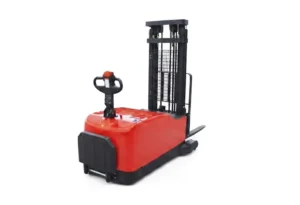
In pallet racking systems where space utilization and vertical storage density are paramount, the electric reach truck demonstrates unparalleled advantages. By significantly reducing the required aisle width, it can increase pallet storage capacity by 20% to 30% for the warehouse. Its unique electric telescopic arm mechanism supports efficient double-deep storage, allowing operators to effortlessly store or retrieve pallets two positions deep through precise electronic control without needing to constantly reposition the truck, thereby greatly enhancing the overall efficiency of warehouse logistics.
What Is a Electric Counterbalance Forklift?
A counterbalance forklift is a traditional forklift design that uses a counterweight at the rear of the machine to balance the load being lifted.
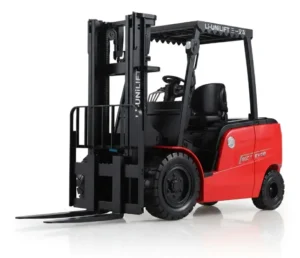
The electric counterbalance forklift is the primary workhorse for indoor material handling. As the name implies, it relies on a heavy counterweight at the rear of the vehicle to offset the weight of the load at the front. The forks are mounted on the front of the mast, and the forklift drives straight up to the pallet to lift and transport it. The typical load capacity ranges from 1.5 to over 5 tons, with a standard lifting height of 4 to 7 meters. As a purely electric-powered device, it boasts the significant advantages of zero emissions and low noise, making it particularly suitable for indoor warehousing or industries with strict environmental requirements, such as food and pharmaceuticals. Since the operator drives facing forward, they have excellent visibility of the forks and the load. Furthermore, it is typically equipped with electronic power steering and fingertip control systems, making operation effortless and highly precise.
The electric counterbalance forklift excels in general indoor warehousing and at loading docks. The rear counterweight enables it to stably handle heavy loads, and it can achieve versatile operations by attaching accessories like clamps and rotators. However, constrained by its counterweight structure, the vehicle body remains relatively long, requiring an aisle width of approximately 3.5 to 4.5 meters (about 10 to 12 feet) to turn safely. If your warehouse has narrow aisles, maneuvering can still be quite challenging.
Reach Truck Forklift vs Counterbalance Forklift: Key Differences
Aisle Width and Maneuverability
Aisle width is the deciding factor between reach trucks and counterbalance forklifts. Counterbalance trucks require 3.5-4.5 meters for safe turning, making them ideal for spacious, mixed indoor/outdoor environments. Reach trucks, featuring extending forks and no counterweight, operate in narrow 2.5-3 meter aisles to maximize storage space, making them better suited for facilities with tight layouts and narrow doorways.
Design and Operating Principle
The electric counterbalance forklift relies on a heavy rear counterweight to offset the load, featuring fixed forks on the mast that require the entire vehicle to drive up to the pallet for lifting. In contrast, the electric reach truck utilizes outrigger legs and a telescopic mast, allowing the forks to extend into the racking while the body remains stationary, eliminating the need for a counterweight. This difference in principles makes the reach truck ideal for precise, high-level storage in narrow aisles, while the counterbalance truck focuses on direct, heavy-load handling.
Lifting Height
Lifting height is a key differentiator between the two. Counterbalance forklifts typically offer a lifting height of 4 to 7 meters (about 13 to 23 feet), though some high-mast models can reach approximately 6 meters (20 feet). In contrast, reach trucks are specifically designed for high-level operations: most standard models can lift loads from 8 to 12 meters, with some models even exceeding 12 meters (about 40 feet) or higher. This exceptional high-lift capacity makes the reach truck the ideal choice for warehouses equipped with multi-tier racking or mezzanines. If your warehouse planning involves vertical expansion, a reach truck provides ample room for growth; conversely, if your racking heights are relatively low, a counterbalance forklift will likely suffice.
Warehouse Space Requirements
Warehouse space is a key differentiator. Counterbalance forklifts need 3.5-4.5m aisles due to their long body and counterweight, lowering storage density. Reach trucks, lacking a counterweight, operate in 2.5-3m aisles to maximize storage. Choose reach trucks for space-constrained, high-density storage, and counterbalance forklifts for spacious areas prioritizing transport.
Related Reading:How Can a Reach Truck Forklift Improve Warehouse Storage Efficiency?
Lifting Height and Storage Capacity
Lifting performance is another key difference between Reach Truck Forklift and Counterbalance Forklift. Reach trucks are designed for high-level storage, helping warehouses improve storage density and space utilization, while counterbalance forklifts are better suited for standard lifting and material transportation tasks.
Maneuverability and Productivity
Reach Truck Forklifts are ideal for confined warehouse spaces due to their compact design and excellent maneuverability, helping operators navigate narrow aisles, reduce movement, and improve pallet handling efficiency. Counterbalance Forklifts offer greater flexibility in open areas but require more operating space, so choosing the right forklift type is important for improving warehouse productivity.
Load Capacity and Stability
Counterbalance forklifts are robust, with typical capacities of 1.5-5 tons and heavy-duty models reaching tens of thousands of pounds. Their rear counterweight stabilizes wide or irregular loads, and they support various attachments for high versatility. Reach trucks trade some load capacity for height, typically handling 1-2.5 tons. Loads are supported by outrigger legs, ensuring stability but limiting load size and restricting large attachments. For exceptionally heavy, off-center, or oversized loads, a counterbalance forklift is the optimal choice.
Power Source and Environment
Counterbalance forklifts offer diverse power options (electric, LPG, diesel, hydrogen, etc.). Pneumatic tires handle rough outdoor terrain, while solid tires suit indoors, making them ideal for mixed environments like yards and docks, though ICE models produce emissions and noise. Reach trucks are purely electric, offering zero emissions, low noise, and minimal vibration; they require flat surfaces and are ideal for indoor environments prioritizing air quality.
Operator Comfort and Controls
Counterbalance forklifts feature car-like seated cabins with steering wheels and pedals, providing excellent forward visibility for long shifts. Reach trucks typically feature stand-up, side-facing operation with steering wheels, joysticks, and a safety pedal. Forward visibility is limited by the front mast, but modern electronic control systems enable precise fingertip operation.
Advantages of Reach Truck Forklift
Reach trucks maximize warehouse storage capacity by enabling taller racks, narrower aisles, and higher-density product storage.
Ideal for Narrow Aisle Warehouses
A reach truck can operate efficiently in areas where traditional forklifts cannot.For warehouses with limited floor space, it provides excellent storage flexibility.
Efficient Indoor Operations
Modern electric reach truck forklifts provide low-noise operation, zero indoor emissions, and lower maintenance costs, making them ideal for efficient and environmentally friendly indoor warehouse operations.
Advantages of Counterbalance Forklift
Counterbalance forklifts are highly versatile and can operate in various environments.
They are commonly used for:
- Outdoor yards
- Loading areas
- Transportation tasks
Suitable for Loading and Transport
Because of their strong stability and simple design, counterbalance forklifts are excellent material handling equipment for general warehouse operations.They are often the preferred choice when flexibility is more important than storage density.
Reach Truck or Counterbalance Forklift: Which One Should You Choose?
Warehouse Scale and Layout
Counterbalance forklifts offer maximum flexibility for warehouses with standard aisles and diverse goods. For narrow aisles and high-density storage, reach trucks excel; narrowing aisles can increase pallet positions by 20%-30%, yielding a fast ROI.
Load Type and Weight
Heavy, oversized, or non-standard loads require the counterweight stability of counterbalance forklifts. Standard 1-2.5 ton pallets suit reach trucks, whose telescopic arms also support double-deep racking.
Height Requirements
Counterbalance forklifts suit racking heights of 4-7 meters. For high-bay and multi-tier storage of 8-12 meters or more, reach trucks are ideal. High-level stacking requires strict safety training.
Indoor/Outdoor Mixed Operations
Counterbalance forklifts with pneumatic tires can cross thresholds and handle uneven outdoor ground. Reach trucks are strictly for flat indoor surfaces only.
Training and Certification
Per HSE classifications, operators must undergo specific training for their truck type and load capacity (usually 3-5 days for novices); skills do not transfer across categories.
Investment Cost and Return
Electric forklifts have higher upfront costs, but zero emissions and low-maintenance lithium-ion batteries significantly reduce long-term operating costs.
Reach Truck vs Counterbalance Forklift Comparison Table
| Feature | Reach Truck Forklift | Counterbalance Forklift |
| Main Purpose | High-density storage | General material handling |
| Working Environment | Indoor warehouse | Indoor and outdoor |
| Aisle Requirement | Narrow aisles | Wider aisles |
| Lifting Height | Higher | Medium |
| Storage Efficiency | Excellent | Moderate |
| Maneuverability | Excellent in tight spaces | Better in open areas |
| Best Application | Rack storage | Loading and transportation |
Explore the UNILIFT-mhe Pallet Truck Series
We specialize in lithium-ion powered equipment, and our electric pallet trucks are the ideal complement to reach trucks and counterbalance forklifts. The following two outstanding models demonstrate how modern pallet trucks can streamline warehouse operations:
Whether you are optimizing a new warehouse or retrofitting an existing facility, UNILIFT-mhe’s lithium-ion pallet trucks integrate seamlessly with reach trucks or counterbalance forklifts. They efficiently transport pallets to staging areas, loading docks, or picking zones. For pricing, demonstrations, or expert advice, please contact us directly.
FAQ
Q1. What is the difference between reach and counterbalance forklifts?
Answer: A reach truck is designed for narrow aisles and high-rack storage, while a counterbalance forklift is more versatile and can operate both indoors and outdoors without needing outriggers.
Q2. What are the disadvantages of a counterbalance forklift?
Answer: Counterbalance forklifts generally require wider aisles, have a larger turning radius, and may be less efficient in high-density warehouse storage.
Q3. What are the advantages of using a reach forklift?
Answer: Reach forklifts offer higher lift heights, better maneuverability in narrow aisles, and improved warehouse space utilization.
Q4. Is a reach truck the same as a forklift?
Answer: A reach truck is a type of forklift specifically designed for warehouse racking applications and narrow aisles.
Q5. What is another name for a counterbalance forklift?
Answer: It is often called a counterbalanced forklift or simply a forklift truck.
Q6. What is the Rule 3 for forklifts?
Answer: The “Rule of 3” commonly refers to maintaining three points of contact when entering or exiting a forklift for safety.
Q7. Should You Choose an Order Picker or a Reach Truck for Your Warehouse?
You should choose an order picker for piece-by-piece picking and handling individual items, while opting for a reach truck for moving pallets in narrow aisles and high-density storage.You can find a more detailed introduction and comparison of the differences between the two types of industrial forklifts in this article.
Q8.Which Type Forklift Is Best for Small Warehouses,Reach truck or counterbalance forklift?
For small warehouses, a reach truck is generally the better choice because its compact design allows for operation in narrow aisles and high vertical stacking, maximizing limited floor space.
Electric Truck Forklift Manufacturer
UNILIFT-MHE Logistics Equipment Company is a Chinese manufacturer committed to the intelligent and convenient development of logistics equipment. Our company has launched the Li-UNiLIFT industrial vehicle brand, which boasts environmental advantages while also considering charging efficiency, economy, and ease of maintenance. This brand mainly includes the following forklift types: electric pallet trucks, electric stackers, reach trucks, electric order pickers, electric towing vehicles, and other warehouse material handling equipment for global logistics and industrial applications.
If you want to know more about electric forklift brand,you can visit our news center,or contact with us directly!