Introduction
Modern warehouses and manufacturing facilities require efficient, reliable, and environmentally friendly material handling equipment. Among various industrial vehicles, Electric Counterbalance Forklifts for Indoor Material Handling have become one of the most popular solutions for improving warehouse productivity.
Unlike traditional diesel forklifts, electric counterbalance forklifts provide cleaner operation, lower noise levels, reduced maintenance requirements, and excellent maneuverability.
For companies looking to optimize indoor logistics operations, choosing the right electric forklift can significantly improve efficiency and reduce long-term operating costs.
1. Zero Emissions Create a Cleaner Indoor Working Environment
One of the biggest advantages of electric forklifts is their zero-emission operation.
As Zero Emission Material Handling Equipment, electric counterbalance forklifts do not produce exhaust gases during operation.
This makes them ideal for:
- Indoor warehouses
- Food processing facilities
- Pharmaceutical plants
- Electronics manufacturing
Cleaner air quality helps create a safer and healthier workplace for operators.
Compared with diesel forklifts, electric models are especially suitable for enclosed spaces where ventilation is limited.
2. Low Noise Operation Improves Workplace Comfort
Noise control is an important factor in indoor working environments.
An Indoor Electric Forklift Solution provides quieter operation because electric motors generate significantly less noise compared with combustion engines.
Benefits include:
- Improved operator comfort
- Better communication between workers
- Reduced workplace noise pollution
This makes electric forklifts suitable for industries where a quiet environment is important.
3. Compact Design Provides Better Indoor Maneuverability
Indoor warehouses often have limited operating space, narrow aisles, and high-density storage areas.
The Best Electric Forklift for Indoor Warehouses should provide:
- Compact dimensions
- Small turning radius
- Precise control
Electric counterbalance forklifts allow operators to move materials efficiently in tight spaces while maintaining excellent lifting performance.
They are widely used for:
- Pallet transportation
- Rack storage operations
- Production line supply
4. Lower Operating Costs and Maintenance Requirements
Cost efficiency is another major reason companies choose electric forklifts.A Low Maintenance Electric Forklift reduces expenses through:
Lower Energy Costs
Electricity is generally more economical than fuel.
Reduced Maintenance
Electric forklifts have fewer mechanical components compared with diesel models.They eliminate many maintenance requirements, including:
- Engine oil replacement
- Fuel system maintenance
- Exhaust system repairs
Over the equipment lifecycle, electric forklifts can provide significant cost savings.
5. Advanced Battery Technology Supports Long-Term Operation
Modern electric forklifts are equipped with advanced battery technologies.
A Lithium Battery Forklift for Warehouse Operations provides several advantages:
- Faster charging
- Longer service life
- Higher energy efficiency
- Reduced maintenance
Lithium batteries also support opportunity charging, allowing operators to recharge during breaks without affecting battery performance.
This makes electric forklifts suitable for multi-shift warehouse operations.
6. Wide Applications in Indoor Material Handling
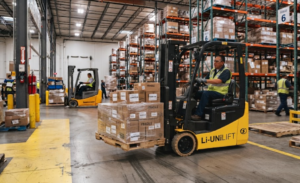
The demand for Electric Forklift Applications in Manufacturing and warehouses continues to grow.Common applications include:
Warehouses
Used for:
- Pallet handling
- Storage operations
- Loading and unloading
Manufacturing Plants
Used for:
- Raw material transportation
- Production line supply
- Finished product movement
Distribution Centers
Used for:
- Logistics handling
- Inventory management
Electric forklifts provide reliable solutions for different indoor material handling requirements.
Conclusion
Electric counterbalance forklifts are becoming a preferred solution for modern indoor material handling operations due to their zero emissions, low-noise performance, excellent maneuverability, lower operating costs, and advanced battery technology. Designed for warehouses, factories, and logistics facilities, these forklifts provide an efficient, reliable, and sustainable alternative to traditional fuel-powered equipment while supporting the development of cleaner and smarter material handling systems.