Introduction
Electric counterbalance forklifts have become essential material handling equipment in modern warehouses, manufacturing facilities, and logistics centers. Compared with traditional internal combustion forklifts, electric forklifts provide cleaner operation, lower noise levels, and improved energy efficiency.
Despite their widespread application, counterbalance forklifts are often subject to misconceptions. Issues such as improper selection, overloading, operation in environments for which they were not designed, or inadequate maintenance leading to system failures often result in unplanned repairs. This mismatch between the machine and its application scenario is a primary cause of lost productivity, safety incidents, and premature equipment damage, which can be difficult to avoid even in well-run operating environments.
A deep understanding of counterbalance forklifts—including their core mechanical principles, the functions of different configurations, the impact of various fuel types on operational suitability, and the key factors in selecting the right model—is the foundation for maximizing the effectiveness of this critical equipment. This guide covers the structural composition, working principles, maintenance, and selection of the appropriate type and supplier for a counterbalance forklift in a practical and accessible manner.
What Is an Electric Counterbalance Forklift?
An electric counterbalance forklift truck is a battery-powered material handling forklift designed to lift, transport, and stack palletized goods.The term “counterbalance” refers to the counterweight installed at the rear of the forklift. Since the load is carried at the front forks, the rear counterweight provides balance and prevents the forklift from tipping forward.
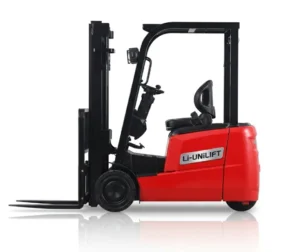
Electric counterbalance forklifts are widely used in:
- Warehouses
- Manufacturing plants
- Distribution centers
- Logistics facilities
- Retail storage areas
Advantages of Electric Counterbalance Forklift Technology
Modern electric material handling forklifts provide several benefits:
High Energy Efficiency
Electric motors convert energy efficiently and reduce operating costs.
Low Noise Operation
Suitable for indoor warehouses and production areas.
Environmentally Friendly
Zero exhaust emissions make them ideal for clean environments.
Lower Maintenance Costs
Electric systems require fewer mechanical components compared with combustion engines.
Working Principle of Electeic Counterbalance Forklifts
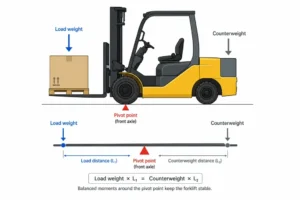
How to operate a counterbalance forklift truck?The operating principle is simple: the rear counterweight offsets the load’s weight to prevent tipping, using the front axle as a fulcrum. Unlike reach or side loaders, it carries loads directly at the front, relying entirely on this rear weight for stability.
Main Structure of an Electric Counterbalance Forklift
The performance of an electric forklift depends on the cooperation of multiple components.Understanding the electric counterbalance forklift structure helps users better maintain and operate the equipment.
Mast System
The mast system is the vertical lifting structure situated at the front of the forklift, designed to perform functions such as raising and lowering loads, tilting the forks, and supporting lifting operations, typically comprising components like mast rails, hydraulic cylinders, and lift chains.
Fork and Carriage Assembly
The forks and carriage directly support the load, serving to pick up pallets, carry materials, and maintain load stability, making proper fork positioning essential for safe operation.
Counterweight System
The counterweight is one of the most critical design features of a counterbalance forklift, functioning to balance the weight of the load carried on the front forks, whereby a properly designed system enhances stability, safety, and load capacity.
Battery System
The battery system provides the essential energy for forklift operation, powering key components such as the drive motor, hydraulic pump, and control system, with modern electric forklifts typically utilizing either lead-acid or lithium-ion batteries, the latter offering distinct advantages like faster charging, longer service life, and reduced maintenance needs.
Electric Drive System
The electric drive system is responsible for moving the forklift, comprising key components such as the drive motor, controller, and gear transmission, with the controller regulating speed, acceleration, and torque output.
Hydraulic System
The hydraulic system provides lifting power to control fork lifting, lowering, and mast tilting, utilizing a pump to convert electrical energy into hydraulic power.
Control System
The control system allows operators to manage forklift functions through components including the accelerator, steering system, display panel, and safety switches.
How Does an Electric Counterbalance Forklift Work?
The stability of a counterbalance forklift relies on the “stability triangle” formed by the front wheels and rear pivot point. The forklift remains stable only when its center of gravity stays within this triangle; if it shifts outside due to overloading or improper maneuvering, tipping occurs. This concept serves as the fundamental basis for all load capacity limits and safety operating procedures.
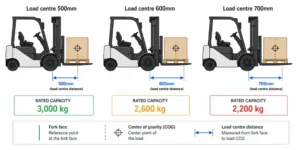
The rated load capacity indicated on the nameplate of a counterbalance forklift refers to the maximum load the machine can safely lift at a standard load center distance (500mm). The load center refers to the horizontal distance from the front of the forks to the center of gravity of the load.
The working principle of an electric counterbalance forklift involves the conversion of electrical energy into mechanical energy and the utilization of physical balance principles to achieve material handling. The workflow can be summarized in the following core steps:
1. Power Source: Battery Supply
Everything starts with the battery, which acts as the power source. The battery supplies power to the forklift’s two main systems:
- Drive Motor: Used for vehicle travel.
- Hydraulic Pump Motor: Used for load lifting and mast tilting.
2. Drive System: Electrically Controlled Movement
When the operator presses the accelerator pedal, the control system (controller) regulates the current delivered to the drive motor. The drive motor rotates the wheels through transmission gears, moving the forklift forward or backward. The controller precisely regulates the motor’s speed and torque to achieve smooth acceleration and braking.
3. Material Handling: Hydraulic Lifting
When the operator moves the lift control lever, electrical current powers the hydraulic pump motor. The hydraulic pump pressurizes hydraulic oil from the reservoir and delivers it to the lift cylinders. High-pressure oil pushes the piston rod inside the cylinders upward, raising the mast and forks via a chain pulley system to lift the load. The tilt cylinders control the forward and backward tilt angle of the mast.
4. Core Mechanism: The Counterbalance Principle
This is how this type of forklift gets its name and is the key to its safe operation. When the forks carry a load at the front, it generates a forward tipping moment. To prevent tipping over, the counterweight (cast iron block) at the rear of the forklift generates a counter-moment, using the front wheels as the fulcrum to offset the load’s gravity. As long as the center of gravity remains within the “Stability Triangle,” the forklift remains balanced.
See also: How to Operate an Electric Counterbalance Forklift Truck Safely?
Electric Counterbalance Forklift Maintenance
Counterbalance Forklifts must be maintained to ensure safety, uptime, cost control, compliance, and longevity, thereby extending the equipment’s operational life cycle.
Battery Care: Check electrolyte levels and terminal connections regularly to ensure consistent power and battery longevity.
Hydraulic System: Inspect fluid levels and examine hoses for leaks to maintain optimal lifting performance.
Tire Condition: Check tires for wear, cracks, or debris to guarantee stability and safe operation.
Brake System: Monitor brake fluid and brake pad wear to ensure reliable stopping power and safety.
Mast and Chains: Lubricate the mast assembly and chains regularly to prevent friction and ensure smooth lifting.
Electrical System: Inspect wiring and connections for wear or corrosion to prevent short circuits and operational failures.
Choose the Right Counterbalance Forklift with Confidence
The dominance of the counterbalance forklift in the material handling industry is no accident; it stems from a design that balances simplicity, versatility, and operational efficiency—a combination unmatched by any other forklift type across various general applications. However, this versatility is not without its limits. Limiting factors include the stability triangle, rated capacity, load center, operating environment, and facility constraints specific to the application.
Correctly selecting a counterbalance forklift—matching its capacity, mast, fuel type, tires, and attachments to actual operational needs—is the decision that determines whether the machine becomes a reliable, efficient asset or the source of persistent operational problems.
Electric Counterbalance Forklift
Electric counterbalance forklifts are powered by a large battery pack, typically lead-acid or lithium-ion batteries, which drives both the traction motor (for traveling) and the hydraulic pump motor (for lifting and tilting).
Diesel Counterbalance Forklift
Diesel counterbalance forklifts are the standard choice for heavy-duty outdoor operations, construction sites, loading yards, lumber yards, steel service centers, ports, and any operation requiring the transport of heavy loads on rough or unpaved surfaces. Diesel engines deliver high torque at low RPMs, providing superior performance for lifting heavy loads and climbing ramps.
LPG Counterbalance Forklift
LPG forklifts use propane cylinders, and their emissions are significantly lower than those of diesel forklifts. The combustion of LPG produces carbon dioxide and water vapor, with extremely low particulate matter emissions.
Gasoline Counterbalance Forklift
Due to higher fuel costs and CO2 emissions compared to LPG forklifts, and lower torque compared to diesel forklifts, gasoline counterbalance forklifts are relatively rare in industrial applications.
See also: Choosing the Right Electric Counterbalance Forklift Truck
UNILIFT-MHE Logistics Equipment Company is a Chinese manufacturer committed to the intelligent and convenient development of logistics equipment. Our company has launched the Li-UNiLIFT industrial vehicle brand, which boasts environmental advantages while also considering charging efficiency, economy, and ease of maintenance. This brand mainly includes the following forklift types: electric counterbalance trucks,electric pallet trucks, electric stackers, reach trucks, electric order pickers, electric towing vehicles, and other warehouse material handling equipment for global logistics and industrial applications.If you want know more about logistics equipment,contact with us directly!