An Electric Counterbalance Forklift is one of the most widely used material handling vehicles in modern warehouses, factories, logistics centers, and manufacturing facilities. Unlike reach trucks or pallet trucks, a counterbalance forklift uses a rear counterweight or battery weight to balance the load carried by the front forks.
Understanding the structure of an electric counterbalance forklift helps buyers select the right equipment, evaluate performance, and understand maintenance requirements.The main structure of an electric counterbalance forklift consists of:
- Frame and counterweight system
- Mast and lifting system
- Battery and power system
- Hydraulic system
- Electrical control system
- Driving and steering system
- Operator safety components
Together, these systems provide stable lifting performance, efficient operation, and safe material handling.
The Structure of Electric Counterbalance Forklift Truck
Understanding the structure of an Electric Counterbalance Forklift helps operators gain a comprehensive understanding of how different forklift systems work together and how they affect overall performance. This knowledge enables companies to select the right equipment based on load capacity, lifting height, working environment, and operating frequency. In addition, understanding key components such as the frame, power system, hydraulic system, and electrical control system can improve operational efficiency, reduce maintenance costs, identify potential failures quickly, and enhance safety and reliability during factory operations. For businesses, having a clear understanding of forklift structure is also essential for evaluating equipment quality, optimizing material handling solutions, and reducing long-term operating costs.
1. Frame and Counterweight System
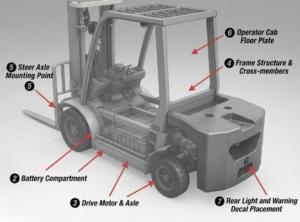
Frame and counterweight system is the Foundation of Electric Counterbalance Forklift Structure.The frame is the main supporting structure of the forklift. It connects and supports all major components, including the mast, battery, wheels, hydraulic system, and electrical components.
Chassis / Frame
The forklift chassis is usually manufactured from high-strength steel plates through welding processes.It has main functions include:
Supporting the total weight of the forklift
Withstanding impact during daily operations
Providing a stable installation platform for key components
Improving durability under heavy-duty working conditions
A reinforced steel frame allows electric forklifts to maintain reliable performance even during continuous warehouse operations.
Counterweight
The counterweight is installed at the rear of the forklift.
Its purpose is to:
- Balance the front load carried by the forks
- Improve vehicle stability
- Reduce the risk of tipping during lifting operations
In electric counterbalance forklifts, the battery pack itself also acts as part of the counterweight because of its heavy weight.
2. Mast and Lifting System
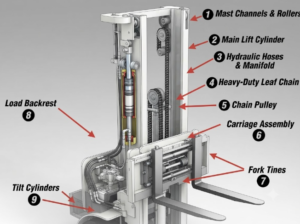
Mast and lifting system is the core structure of counterbalance electric forklift for Material Handling Operations,The mast system is responsible for lifting and lowering loads. It determines the forklift’s maximum lifting height and operational flexibility.The main components include mast,fork,fork carriage and lift cylinder.
Mast
The mast provides the vertical lifting structure for the forks.It consists of:outer mast,Inner mast and guide rollers.
Main functions:
- Supporting vertical fork movement
- Maintaining stable lifting operations
- Providing accurate load positioning
Common mast types include:
Duplex Mast (Two-stage Mast)
Suitable for:
- Standard warehouses
- Medium lifting height applications
Triplex Mast (Three-stage Mast)
Suitable for:
- High rack warehouses
- Applications requiring higher lifting height
Fork Carriage and Forks
The forks are the direct load-bearing components of the forklift.It has functions include:
- Supporting pallets and goods
- Carrying rated loads
- Adjusting fork spacing according to pallet dimensions
Fork design directly affects load stability and operation safety of operation of electric counterbalance forklift.
Lift Cylinder
The hydraulic lift cylinder controls the upward and downward movement of the mast.Its main functions are as follows:
- Receiving hydraulic pressure
- Pushing the mast upward
- Controlling smooth lifting and lowering
3. Battery and Power System
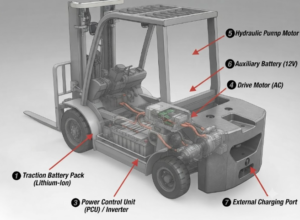
Battery is the Main Power Source of Electric Counterbalance Forklifts,and the battery system is the key difference between electric forklifts and fuel-powered forklifts.Modern electric counterbalance forklifts mainly use:Lead-acid batteries and Lithium-ion batteries.
Battery Pack
The battery provides energy,its main functions are as follows:
- Drive motor operation
- Hydraulic system operation
- Electrical control system
- Safety monitoring components
Compared with traditional lead-acid batteries, lithium batteries provide:
- Faster charging
- Longer service life
- Higher energy efficiency
- Lower maintenance requirements
Traction Motor
The traction motor provides driving power for forklift movement.It controls:
- Forward movement
- Reverse movement
- Acceleration
- Braking performance
Modern electric counterbalance forklifts commonly use:
- AC induction motors
- AC brushless motors
Advantages:
- Higher efficiency
- Lower noise
- Less maintenance
- Better energy utilization
4. Hydraulic System
Hydraulic system is the Power System Behind Forklift Lifting Operations,which controls all lifting-related movements,ensures smooth and precise handling performance.The system include main components include:
The hydraulic system provides:
- Load lifting
- Load lowering
- Mast tilting adjustment
- Attachment control
| Component | Function |
|---|---|
| Hydraulic Pump | Generates hydraulic pressure |
| Hydraulic Tank | Stores hydraulic oil |
| Control Valve | Controls oil flow direction |
| Lift Cylinder | Raises and lowers forks |
| Tilt Cylinder | Controls mast tilting |
5. Electrical Control System
This system is the Intelligent Control Center of Electric Forklifts,The electrical control system works as the “brain” of an electric counterbalance forklift.It manages:
- Motor operation
- Battery energy distribution
- Vehicle safety functions
- Operating parameters
Controller:The controller regulates:Motor output,Driving speed,Energy consumption and Operating modes.
Display System:The display provides important information such as:Battery level,Operating hours,Fault codes and System status.
Sensor System:Common sensors include:Speed sensors,Seat safety switch,Tilt sensors and Load detection sensors.
6. Driving and Steering System
The drive and steer system ensures flexible and stable movement,which allows the forklift to move efficiently in different working environments.
Drive Wheels:Drive wheels provide the traction power needed for forklift movement, support vehicle weight, and ensure stable operation during heavy-duty material handling tasks.
Steering Axle:The steering axle controls the forklift’s direction and provides a small turning radius, better maneuverability, and flexible operation in warehouse environments.
Brake System:Electric forklifts usually use electromagnetic braking, hydraulic braking, and regenerative braking systems to provide reliable stopping performance, improve safety, and enhance energy efficiency during operation.
7. Operator and Safety Components
These components protect operators during daily operations,Safety structures are essential parts of electric counterbalance forklift design.Main components include:
- Operator seat
- Steering wheel
- Control lever
- Overhead guard
- Seat belt
- Emergency stop button
These components help:
- Protect operators
- Reduce operation risks
- Improve driving comfort
How Does an Electric Counterbalance Forklift Truck Work?
The working principle of an electric counterbalance forklift is based on the cooperation between multiple systems.The operation process is:
1. Battery Provides Electrical Energy
The battery supplies power to the traction motor, hydraulic motor, and control system.
2. Motor Drives the Forklift
The traction motor converts electrical energy into mechanical power to move the forklift.
3. Hydraulic System Lifts the Load
The hydraulic pump generates pressure, allowing the lift cylinder to raise the mast and forks.
4. Counterweight Maintains Balance
The rear counterweight or battery weight offsets the front load to maintain vehicle stability.
5. Controller Manages Vehicle Operation
The controller coordinates speed, power output, safety systems, and operating parameters.
Counterbalance Electric Forklift Structure Summary
| System | Main Components | Function |
|---|---|---|
| Frame System | Chassis, Counterweight, Battery Compartment | Provides structural stability |
| Lifting System | Mast, Forks, Cylinders | Handles lifting operations |
| Power System | Battery, Motor | Provides driving energy |
| Hydraulic System | Pump, Valve, Cylinder | Controls lifting movement |
| Electrical System | Controller, Sensors | Intelligent vehicle management |
| Steering & Brake System | Steering Axle, Brake | Ensures safe operation |
| Safety System | Seat Belt, Guard, Emergency Stop | Protects operators |
Conclusion
An Electric Counterbalance Forklift is a combination of mechanical structure, electric power technology, hydraulic control, and intelligent management systems.
Its main structure includes:High-strength steel frame + Battery power system + Electric drive motor + Hydraulic lifting system + Intelligent control system + Counterbalance design
By understanding these components, buyers can better evaluate forklift performance, maintenance requirements, and suitability for different warehouse and industrial applications.
For companies looking for efficient, environmentally friendly, and low-maintenance material handling solutions, electric counterbalance forklifts provide a reliable alternative to traditional fuel-powered equipment.
FAQ
1. What are the main components of an electric counterbalance forklift?
The main components include the frame, counterweight, mast, forks, battery, motor, hydraulic system, controller, steering system, and safety devices.
2. How does an electric counterbalance forklift maintain balance?
It uses a rear counterweight and heavy battery pack to offset the weight of the front load.
3. What type of battery is used in electric counterbalance forklifts?
Electric forklifts commonly use lead-acid batteries or lithium-ion batteries. Lithium batteries provide faster charging and longer service life.
4. What is the function of the hydraulic system in an electric forklift?
The hydraulic system controls lifting, lowering, mast tilting, and attachment operations.
5. Why are AC motors used in modern electric forklifts?
AC motors provide higher efficiency, lower maintenance requirements, and smoother operation compared with traditional DC motors.