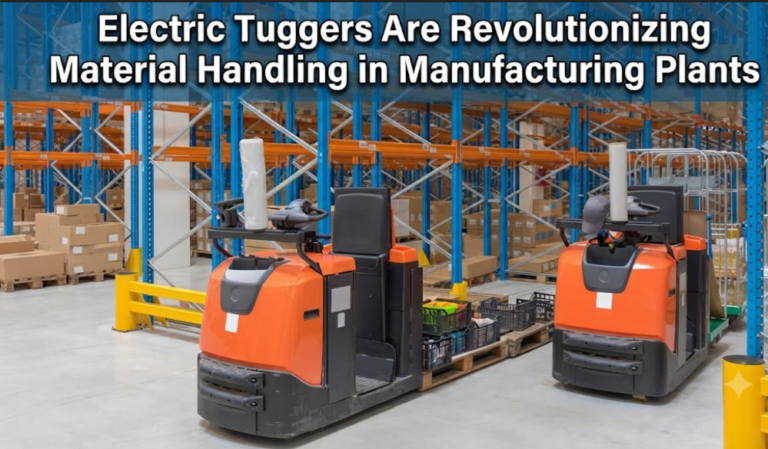
Electric Tugger and AGV systems are both increasingly used to improve material flow in modern warehouses, but they are designed for different operating requirements. While AGVs focus on automated, predefined transportation routes, an electric tugger provides a flexible solution for towing multiple carts or trailers with operator control. Understanding the differences can help warehouse managers choose the right equipment for productivity, flexibility, and operating cost.
What Is an Electric Tugger?
Electric Tugger is a battery-powered material handling vehicle designed to tow one or more carts, trailers, or material handling units across warehouses, factories, and distribution centers. Unlike a conventional forklift, it does not primarily lift pallets; instead, its main function is efficient horizontal transportation over short and medium distances.
Modern electric tuggers typically combine an electric drive motor, rechargeable battery system, ergonomic controls, and a robust towing mechanism. Depending on the application, they can be used for production-line feeding, warehouse replenishment, order picking support, and internal logistics.
What Is an AGV?
Electric Tugger technology differs from an AGV because an AGV is designed around automated transportation rather than direct operator control. Automated Guided Vehicles use technologies such as magnetic guidance, QR codes, laser navigation, cameras, or other navigation systems to follow predefined or dynamically managed routes.
AGVs can operate with limited human intervention, making them attractive for highly automated warehouses with stable workflows and predictable transportation requirements. However, their automation infrastructure can require greater planning, integration, and investment than conventional electric material handling equipment.
Electric Tugger vs. AGV: A Quick Comparison
Electric Tugger solutions generally provide greater operational flexibility, while AGVs offer a higher level of transportation automation.
| Feature | Electric Tugger | AGV |
|---|---|---|
| Operator | Human-operated | Automated |
| Main function | Towing carts and trailers | Automated material transport |
| Route flexibility | High | Depends on navigation system |
| Automation level | Manual/semi-automated | High |
| Initial investment | Generally lower | Generally higher |
| Deployment | Relatively simple | Requires planning and integration |
| Multiple carts | Excellent | Depends on AGV configuration |
| Workflow changes | Easy to adapt | May require system adjustment |
| Best suited for | Flexible internal logistics | Repetitive automated transport |
Flexibility in Warehouse Operations
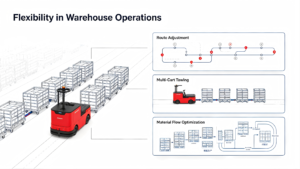
Electric Tugger equipment is particularly valuable when warehouse routes, production requirements, or material flow change frequently. Operators can select different routes according to current production needs without requiring changes to navigation infrastructure or software.
This flexibility is useful in factories where components need to move between storage areas, assembly stations, production lines, and finished-goods areas. A single tugger can also tow multiple carts, allowing operators to transport several loads in one trip and reduce unnecessary vehicle movements.
Automation and Labor Requirements
Electric Tugger systems require an operator, which can be an advantage when transportation tasks involve changing priorities or unpredictable conditions. The operator can react immediately to obstacles, modify routes, and adjust the transportation sequence according to real-time warehouse requirements.
AGVs, on the other hand, can reduce the need for direct transportation labor by performing repetitive movements automatically. For large-scale facilities with stable processes and high transportation volumes, this can provide significant efficiency benefits.
Operating Efficiency and Load Movement
Electric Tugger vehicles can improve warehouse efficiency by moving multiple carts in a single towing cycle instead of transporting individual loads separately. This approach is particularly effective for milk-run logistics, where materials are delivered repeatedly between predefined warehouse and production locations.
A properly configured towing train can reduce empty travel, improve delivery frequency, and support just-in-time material supply. For manufacturers, this makes electric tuggers especially useful for feeding production lines without relying on forklifts for every transportation task.
Electric Tugger Battery and Power Advantages
Electric Tugger models powered by modern battery technology can provide clean and efficient operation for indoor logistics. Lithium-ion battery systems are particularly attractive because they can support opportunity charging, reduce maintenance requirements, and eliminate the need for conventional fuel handling.
Electric drive systems also produce no direct exhaust emissions during operation, making them well suited to enclosed warehouses and production environments. Lower noise levels compared with combustion-powered equipment can further improve the working environment.
Maneuverability and Operator Control
Electric Tugger equipment offers direct operator control, allowing the vehicle to respond quickly to changing warehouse conditions. Compact dimensions and responsive steering can make electric tuggers suitable for facilities where transportation routes pass through aisles, workstations, or production areas.
Ergonomic control handles, intuitive operating controls, smooth acceleration, and reliable braking can also reduce operator fatigue during repeated transportation cycles. These details are important when the vehicle is used throughout a full working shift.
Towing Capacity and Multi-Cart Transportation
Electric Tugger performance should be evaluated according to towing capacity rather than simply comparing rated lifting capacity with a forklift or AGV. The correct model depends on the combined weight of the carts and materials, floor conditions, gradients, travel distance, and required operating speed.
For high-volume internal logistics, the ability to tow multiple carts can be one of the biggest advantages. Instead of moving individual pallets or containers separately, operators can create a transportation train that consolidates several loads into one trip.
When Should You Choose an Electric Tugger?
Electric Tugger equipment is often the better choice when a warehouse needs flexible and cost-effective horizontal transportation without fully automating the entire logistics process. It is especially suitable for manufacturing plants, distribution centers, warehouses, and facilities where routes or material requirements change regularly.
An electric tugger can also be a practical starting point for companies moving toward automation. Businesses can first optimize transportation routes and material flow with operator-controlled equipment before introducing more advanced automated systems where they provide a clear return on investment.
When Is an AGV the Better Choice?
Electric Tugger solutions are not always a replacement for AGVs, particularly when a facility requires continuous automated transportation with minimal human intervention. AGVs can be advantageous for repetitive, high-volume workflows where transportation routes and processes are highly standardized.
For example, a large automated warehouse may use AGVs to continuously transport materials between fixed storage, staging, and production areas. In such an environment, automation can reduce manual handling and provide consistent transportation cycles.
Electric Tugger as a Practical Material Handling Solution
Electric Tugger technology provides a strong balance between productivity, flexibility, and investment for many warehouse applications. Its ability to tow multiple carts, operate efficiently indoors, and adapt to changing transportation requirements makes it an important option for modern material handling.
For businesses that do not yet require full automation, an electric tugger can deliver many of the efficiency benefits associated with optimized material flow without the complexity of a complete AGV infrastructure. The result is a practical solution that can scale with changing warehouse and manufacturing requirements.
How to Select the Right Electric Tugger
Electric Tugger selection should begin with the actual transportation task rather than simply choosing the vehicle with the highest towing capacity. Consider the total trailer load, number of carts, travel distance, floor conditions, operating frequency, turning space, battery requirements, and workplace environment.
It is also important to evaluate safety features, braking performance, steering response, operator ergonomics, battery charging options, and after-sales support. A professional material handling manufacturer can help match the equipment configuration to the specific workflow and operating environment.
Conclusion
Electric Tugger and AGV systems each have an important role in modern warehouse operations, but the right choice depends on the required level of automation, flexibility, and investment. Electric tuggers excel at flexible operator-controlled transportation and multi-cart towing, while AGVs are better suited to highly repetitive processes that benefit from automated material flow.
For warehouses and manufacturers looking for a flexible way to improve internal logistics, an electric tugger can provide an efficient bridge between conventional material handling and advanced automation.
Explore reliable electric pallet trucks, electric stackers, and material handling solutions at Unilift MHE.
If you would like to contact us, please click here.
If you would like to learn more about our news, please click here.