Introduction
Choosing the right forklift capacity and specifications is a critical step for companies investing in material handling equipment. Different warehouses, factories, and logistics centers have different requirements for lifting capacity, working hours, operating environments, and storage conditions,what You Need to Know in Advance Before Placing an Order with Your Selected Supplier.
An Electric Counterbalance Forklift provides an efficient solution for handling pallets, transporting materials, and supporting daily warehouse operations. Compared with internal combustion forklifts, electric models offer lower operating costs, quieter operation, and zero-emission performance, making them ideal for indoor applications.
However, selecting the correct model requires a clear understanding of forklift specifications, including load capacity, lifting height, battery type, dimensions, and performance parameters.
This Electric Counterbalance Forklift Capacity and Specifications Guide explains the key factors you should consider before purchasing an electric forklift.
What Is Electric Counterbalance Forklift Capacity?
Electric counterbalance forklift capacity refers to the maximum weight that a forklift can safely lift and transport under specific operating conditions.
Forklift capacity is not determined by a single number. It is influenced by multiple structural design factors, including the mast system, counterweight, hydraulic system, and other key components. Before understanding how electric counterbalance forklift capacity works, let’s first review the main components and structure of an electric counterbalance forklift.
Main Components of an Electric Counterbalance Forklift
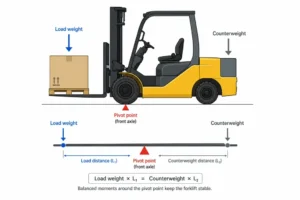
An electric counterbalance forklift consists of several key systems that work together to ensure efficient and safe material handling operations. The Mast System includes the mast, lift cylinder, fork carriage, and forks, which are responsible for lifting and positioning loads. The Counterweight is located at the rear of the forklift and maintains stability during lifting by balancing the weight of the load.
The Electric Power System consists of the lithium battery, Battery Management System (BMS), and controller, providing power for the forklift’s operation. The Drive System includes the drive motor, drive axle, and wheels, which control the movement and traction of the forklift. The Hydraulic System, including the hydraulic pump, hydraulic cylinder, and control valve, enables smooth lifting and lowering operations.
The Steering System is composed of the steering wheel and steering axle, allowing operators to control the forklift’s direction with precision. The Safety System includes the emergency stop button, overload alarm, reverse buzzer, and seat safety switch, helping improve operational safety and protect both operators and surrounding personnel.
Common Electric Counterbalance Forklift Capacity Types
The capacity of an electric counterbalance forklift mainly refers to the maximum load weight it can handle during material handling operations. Common capacity options include the following three types, each with its own characteristics and applications.
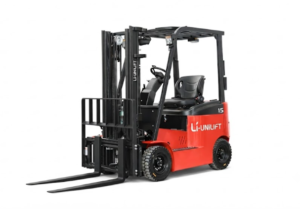
1.5 Ton Electric Forklift
Designed for light-duty material handling, the 1.5-ton electric forklift features a compact design and excellent maneuverability, making it ideal for flexible operation in limited spaces such as small warehouses, retail storage facilities, light manufacturing workshops, and indoor distribution areas.
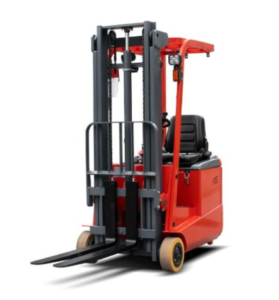
2 Ton Electric Forklift
The 2-ton electric forklift is an ideal choice for general warehouse and industrial applications, offering a perfect balance of load capacity, energy efficiency, operating flexibility, and maintenance cost. It is widely used in warehouse pallet handling, factory material transportation, logistics operations, and production line supply, making it an efficient solution for daily material handling tasks for many companies.
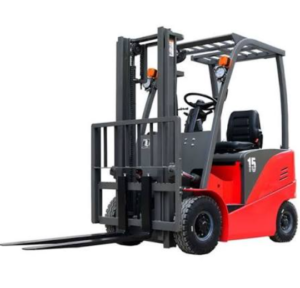
3 Ton Electric Forklift
Designed for heavier material handling requirements, the 3-ton electric forklift is widely used in large warehouses, manufacturing plants, distribution centers, and heavy-duty industrial applications. Compared with smaller models, it offers a higher lifting capacity and stronger performance, making it an ideal choice for demanding operations.
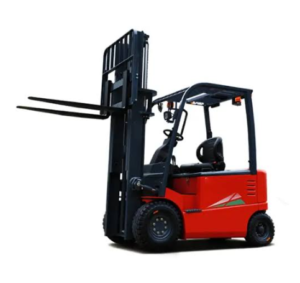
Heavy Duty Electric Counterbalance Forklift
Built for applications requiring higher load capacity and longer working hours, heavy-duty electric counterbalance forklifts are suitable for large logistics centers, heavy manufacturing facilities, and high-volume warehouse operations, typically featuring stronger frames, high-performance motors, and advanced battery systems to support continuous operation.
If you need greater load capacity,Diesel models generally have a wider common rated load capacity range and a higher upper limit for heavy loads. Mainstream electric models are concentrated in the small to medium load range, though the two overlap in the medium-to-low segment. Additionally, high-capacity electric models have been increasing in recent years
How to Choose the Right Electric Counterbalance Forklift Capacity?
Selecting the correct forklift requires evaluating your working conditions and operational requirements.Following an Electric Counterbalance Forklift Selection Guide can help businesses make better purchasing decisions.
Consider Your Load Requirements
First, determine your maximum load weight, average pallet weight, and required lifting frequency. Choosing the right electric counterbalance forklift capacity ensures that the equipment can safely handle your heaviest regular loads while maintaining efficient and reliable operation.
Consider Your Working Environment
Different working environments require different electric counterbalance forklift configurations. For indoor warehouse applications, companies usually focus on compact design, low noise operation, and battery efficiency. Manufacturing facilities often require forklifts with strong durability, continuous working capability, and higher load capacity. Logistics centers typically need high-efficiency equipment with fast handling speed and reliable battery performance to support intensive material handling operations.
Consider Daily Operating Hours
The daily working schedule also affects electric counterbalance forklift selection. For short-term operations, standard battery systems may be sufficient to meet basic material handling needs. However, for long working hours and intensive applications, lithium battery solutions are a better choice as they provide longer operation time, faster charging, and reduced downtime, helping improve overall productivity.
In addition to determining your rated load capacity, you also need to understand the ‘5 Factors to Consider When Choosing an Electric Counterbalance Forklift: Complete Buying Guide
Applications of Electric Counterbalance Forklifts
The following industries can benefit from the application of electric counterbalance forklifts.
Warehousing and Distribution Centers
Manufacturing Plants
Logistics and Transportation Hubs
Retail and Supermarket Backrooms
Food and Beverage Industry
Cold Storage Facilities
Automotive Manufacturing
Industrial Warehouses
Key Specifications of Electric Counterbalance Forklifts
Understanding the key specifications of electric counterbalance forklifts helps businesses choose the right equipment,improve operational safety, increase handling efficiency, and reduce long-term operating costs.
Electric Forklift Lifting Capacity
Electric forklift lifting capacity is a key factor when selecting a forklift. Companies should consider load weight, working frequency, and safety requirements to choose the right capacity. Generally, 1.5-ton models are suitable for light-duty handling, 2-ton models for standard warehouse operations, and 3-ton or higher models for heavy-duty applications.
Electric Forklift Mast Height
Electric forklift mast height determines the maximum lifting height of the forklift. The right mast configuration depends on warehouse rack height, storage layout, and loading requirements. Duplex masts are suitable for standard warehouse operations, while triplex masts are designed for higher lifting applications. Choosing the correct mast improves storage efficiency and operational safety.
Learn about another different yet closely related topic: Analysis of the Structural Composition of the Electric Counterbalance Forklift.
FAQ
1. What is the capacity of an electric counterbalance forklift truck?
Electric counterbalance forklift capacity refers to the maximum load weight the forklift can safely lift and transport, commonly ranging from 1.5 tons to 5 tons.Furthermore, the self-weight of the forklift is a fundamental safety factor determining its load capacity. Without sufficient self-weight, it cannot support the corresponding load capacity.
2. What are the common capacity options for electric counterbalance forklifts?
Common capacities include 1.5 ton, 2 ton, 2.5 ton, 3 ton, and 5 ton models for different material handling needs.
3. How do I choose the right electric counterbalance forklift capacity?
Choose the capacity based on load weight, lifting height, working environment, and daily operation requirements.
4. Does lifting height affect forklift capacity?
Yes. Higher lifting heights can reduce the actual load capacity due to increased stability requirements.
5. What are the key specifications of an electric counterbalance forklift?
Key specifications include load capacity, lifting height, mast type, battery type, fork dimensions, turning radius, and driving speed.
6. What is the difference between rated capacity and actual capacity?
Rated capacity is the maximum load under standard conditions, while actual capacity may vary depending on load center and operating conditions.
7. How does the counterweight affect forklift capacity?
The counterweight improves stability by balancing the load and preventing the forklift from tipping forward.
8. Does the battery affect electric forklift capacity?
Yes. Battery weight and position can influence forklift stability and overall performance.
9. What capacity forklift is suitable for warehouses?
Most warehouses use 1.5–3 ton electric counterbalance forklifts depending on load requirements.
10. Can a forklift lift more than its rated capacity?
No. Exceeding the rated capacity can reduce stability and create safety risks.