Counterbalance Forklift vs Reach Truck
For this comparison, our quick answer is that the main difference between counterbalance forklifts and reach forklift trucks lies in their design and application. Counterbalance forklifts use a counterweight at the rear to balance the load, making them very suitable for general material handling; while reach trucks are equipped with a telescopic mast, allowing them to “reach into” the racking system, so they are very suitable for narrow – aisle warehouse operations and high – level stacking.
In warehouse equipment selection, choosing between a counterbalance forklift and a reach truck is one of the most important decisions. Although both types of machines are used for lifting and transporting pallets, their uses in modern logistics environments are quite different.
Understanding the differences between these two types of forklifts helps enterprises improve efficiency, reduce costs, and optimize warehouse space utilization. This guide compares the counterbalance forklift and the reach truck in terms of design, performance, application, and selection criteria.
Before Reading: Electric Counterbalance Forklift vs Electric Pallet Truck: Key Differences Explained
Overview of Two Forklift Types
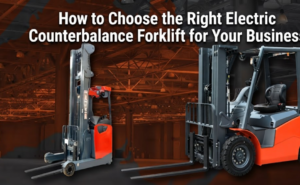
A counterbalance forklift is the most common type of forklift. It uses a heavy rear counterweight to balance the load lifted at the front, allowing it to pick up and transport palletized goods directly without requiring additional support structures like a reach truck.
A reach forklift (also known as a reach truck) is designed for warehouse environments with high racking systems. It features a retractable mast that allows the forks to move forward and extend into storage racks for efficient pallet placement and retrieval.
Both types of forklifts are essential in modern warehouses, but they are designed to meet different operational requirements.
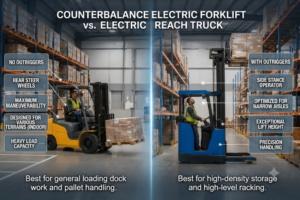
Comparison Table of Counterbalance Forklift vs Reach Truck in 8 Different Aspects
The differences between counterbalance forklifts and reach forklifts mainly focus on their design, maneuverability, and applications.
Design: Counterbalance forklifts rely on a rear counterweight for stability, while reach forklifts use a retractable mast system.
Aisle Width: Counterbalance forklifts require wider aisles, while reach forklifts are designed for narrow aisle operations.
Lifting Height: Reach forklifts typically achieve higher lifting heights compared with counterbalance forklifts.
Operation: Counterbalance forklifts are easier for general handling tasks, while reach forklifts require more specialized operator training.
Applications: Counterbalance forklifts can be used both indoors and outdoors, while reach forklifts are mainly designed for indoor warehouse operations.
The comparison is shown in the table below:
| Comparison | Counterbalance Forklift | Reach Forklift |
|---|---|---|
| Design | Uses a rear counterweight to balance the load and maintain stability. | Uses a retractable mast system to extend forks into storage racks. |
| Working Principle | The rear counterweight offsets the front load, allowing direct pallet handling. | The mast moves forward and backward to pick and place pallets in high racks. |
| Aisle Width | Requires wider aisles due to larger turning space. | Designed for narrow aisle operations with better space utilization. |
| Lifting Height | Suitable for standard lifting applications with moderate heights. | Typically provides higher lifting capabilities for high-rack warehouses. |
| Operation | Easier to operate and suitable for general material handling tasks. | Requires more specialized training due to advanced operation methods. |
| Working Environment | Suitable for both indoor and outdoor applications. | Mainly designed for indoor warehouse operations. |
| Main Applications | Manufacturing plants, logistics centers, loading docks, and general warehouses. | High-density warehouses, narrow aisle storage systems, and distribution centers. |
| Advantages | Strong versatility, high stability, and suitable for various applications. | Excellent space utilization and efficient high-level storage performance. |
What Is a Counterbalance Electric Forklift?
The following section provides a brief introduction to the Counterbalance Electric Forklift from four aspects: features, advantages, applications, and functions.
Counterbalance Electric Forklift Features
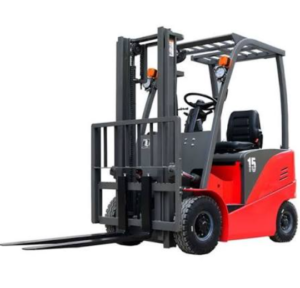
Counterbalance electric forklifts are equipped with a rear counterweight, electric power system, mast lifting system, and ergonomic controls. They provide stable load handling, precise operation, and flexible maneuverability for various material handling tasks.
Counterbalance Electric Forklift Advantages
They offer zero emissions, low noise operation, lower maintenance costs, high energy efficiency, and excellent indoor performance, making them an environmentally friendly alternative to fuel-powered forklifts.
Counterbalance Electric Forklift Functions
Counterbalance electric forklifts are designed for lifting, transporting, loading, unloading, and stacking palletized goods. Their hydraulic lifting system and electric drive system ensure smooth and efficient material handling.
Counterbalance Electric Forklift Application
They are widely used in warehouses, manufacturing plants, logistics centers, retail facilities, food and beverage industries, and other indoor material handling environments.
Related Reading: Electric Counterbalance Forklift vs Diesel Forklift: Which Forklift Should You Choose?
What Is an Electric Reach Truck?
The following section provides a brief introduction to the Electric Reach Truck from four aspects: features, advantages, applications, and functions.
Electric Reach Truck Featues
Electric reach trucks are designed with a retractable mast system that allows the forks to extend forward and reach into storage racks. They feature compact dimensions, excellent maneuverability, and high lifting capabilities for efficient warehouse operations.
Electric Reach Truck Advantages
They provide better space utilization, higher lifting heights, low noise operation, zero emissions, and improved efficiency in narrow aisle environments, making them ideal for high-density storage applications.
Electric Reach Truck Functions
Electric reach trucks are mainly used for pallet storage and retrieval, high-level stacking, and transporting goods within warehouse aisles. The reach mechanism and precise control system enable accurate pallet placement at different heights.
Electric Reach Truck Application
They are widely used in high-rack warehouses, distribution centers, cold storage facilities, and logistics operations where narrow aisles and vertical storage efficiency are important.
UNILIFT-mhe offers a complete forklift solution set
UNILIFT-mhe provides a full series of material handling equipment for modern warehouses:
- Electric forklift
- Electric pallet truck
- Electric pallet stacker
- Electric reach truck
- Electric order picker
Our forklifts are designed to provide efficiency, safety, and reliability for warehouse and logistics operations.
FAQ
1. What is the main difference between a counterbalance forklift and a reach forklift?
A counterbalance forklift uses a rear counterweight for stability, while a reach forklift uses a retractable mast for narrow aisle storage.
2. Which forklift is better for warehouse use?
Reach forklifts are better for narrow aisle warehouses, while counterbalance forklifts are suitable for general material handling operations.
3. Can a reach forklift be used outdoors?
Reach forklifts are mainly designed for indoor warehouses with smooth floors and are not recommended for outdoor applications.
4. Which forklift has a higher lifting height?
Reach forklifts usually provide higher lifting capabilities and are ideal for high-rack storage systems.
5. Is a counterbalance forklift easier to operate?
Yes. Counterbalance forklifts are generally easier to operate and require less specialized training.
6. Do warehouses need both types of forklifts?
Some warehouses use both forklifts to balance operational flexibility and storage efficiency.
7. Which forklift saves more space?
Reach forklifts save more space because they are designed for narrow aisles and high-density storage.